






Definition & Meaning
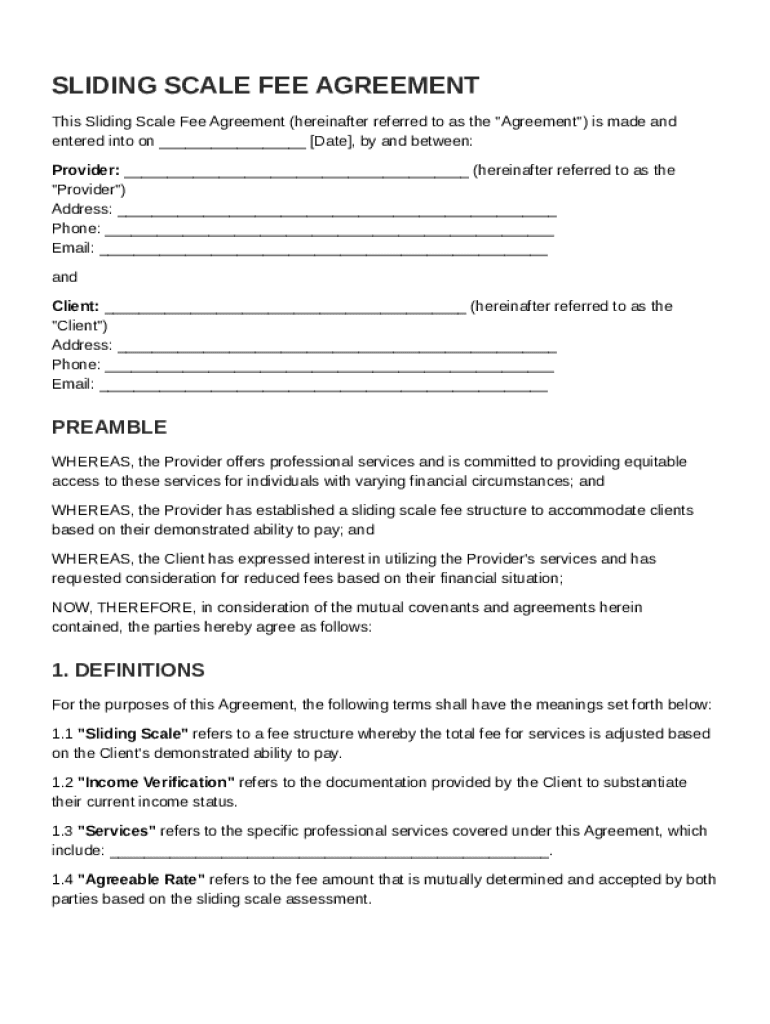
A Sliding Scale Agreement Template is a formal document that establishes a fee structure between a service provider and a client. This template is designed to accommodate varying levels of financial capacity among clients by adjusting fees based on income or financial need. Such agreements are commonly employed in services where equitable access is prioritized, such as in health care, legal services, or nonprofit organizations.
Key Features
- Flexible Pricing: Adjust fees based on the client's income, ensuring affordability.
- Mutual Agreement: Both parties must consent to the terms, enhancing trust and transparency.
- Confidentiality: Protects sensitive financial information shared between parties.
Practical Example
Consider a mental health counselor who offers services to clients with diverse financial circumstances. By using the sliding scale agreement, the counselor can offer reduced rates to clients with lower income, thereby expanding access to essential mental health services without compromising financial sustainability.
How to Use the Sliding Scale Agreement Template
Using the Sliding Scale Agreement Template involves a series of steps that ensure all parties have a clear understanding of the terms and conditions. This process typically includes the customization of terms based on individual financial assessments.
- Assess Client Financial Ability: Evaluate the client's income to determine applicable fees.
- Customize the Agreement: Modify template fields to reflect agreed terms.
- Review Terms with Client: Discuss and confirm each section with the client.
- Finalize and Sign Agreement: Both parties sign to formalize the agreement.
Customization Tips
- Income Verification: Include fields to record documents that verify client income.
- Fee Adjustment Scale: Clearly outline how fees correlate to income brackets.
- Termination Clause: Define conditions under which the agreement can be ended.
Why Should You Use a Sliding Scale Agreement Template
Utilizing a Sliding Scale Agreement Template provides numerous benefits for both the provider and the client, fostering a relationship built on accessibility and trust.
Key Benefits
- Broader Access: Ensures services are affordable for clients from varying economic backgrounds.
- Professional Integrity: Demonstrates commitment to equitable service provision.
- Risk Management: Mitigate disputes by clearly outlining fee structures and conditions.
Case Study
A legal firm employing this agreement can assist low-income clients with necessary legal representation at reduced rates, while maintaining financial viability through higher fees from clients who have the ability to pay more.
Key Elements of the Sliding Scale Agreement Template
The template incorporates several critical sections that establish and govern the terms of the fee structure between the service provider and the client.
Key Sections
- Payment Terms: Specifies how and when payments should be made.
- Income Verification Requirement: Outlines necessary documentation for income proof.
- Dispute Resolution: Steps to resolve disagreements regarding fees or services.
- Confidentiality Clause: Ensures privacy and protection of financial information.
Important Terms Related to the Sliding Scale Agreement Template
Understanding the terminology used within the Sliding Scale Agreement Template is essential for its proper application.
Common Terms
- Fee Structure: The specific breakdown of service costs as related to income levels.
- Equitable Access: The principle of ensuring service availability to diverse economic demographics.
- Mutual Consent: Agreement reached upon review and acceptance by both parties involved.
Examples
- Income-Based Adjustments: Fee modifications directly tied to verified income levels.
- Service Provider: The entity offering the service under agreed terms.
Legal Use of the Sliding Scale Agreement Template
For the Sliding Scale Agreement Template to be legally binding, certain criteria and compliance with applicable laws must be met.
Legal Considerations
- ESIGN Act Compliance: Electronic signatures must follow legal protocols under the ESIGN Act.
- State Regulations: Adapt terms to satisfy state-specific legal requirements concerning fee adjustments.
- Valid Consent: Both parties must provide informed consent without coercion.
State-Specific Rules for the Sliding Scale Agreement Template
Each U.S. state may have unique legal considerations when it comes to employing a sliding scale fee structure.
State Variations
- Licensing Requirements: Certain professions may require specific license conditions for fee adjustments.
- Income Verification Guidelines: Documentation standards for income verification can differ by state.
- Disclosure Requirements: Obligations to disclose specific information may vary.
Digital vs. Paper Version
The Sliding Scale Agreement Template can be executed either in digital or traditional paper format, each offering distinct advantages.
Digital Version
- Efficiency: Speeds up processing and sharing through electronic means.
- Security: Encryption enhances document protection against unauthorized access.
- Eco-Friendly: Minimizes physical paper use, promoting sustainability.
Paper Version
- Tangibility: Some clients may prefer hardcopies for physical records.
- Traditional Legitimacy: More universally accepted in less tech-savvy demographics.
Understanding these concepts ensures that service providers and clients use the Sliding Scale Agreement Template effectively, promoting fair access and transparent business practices.