
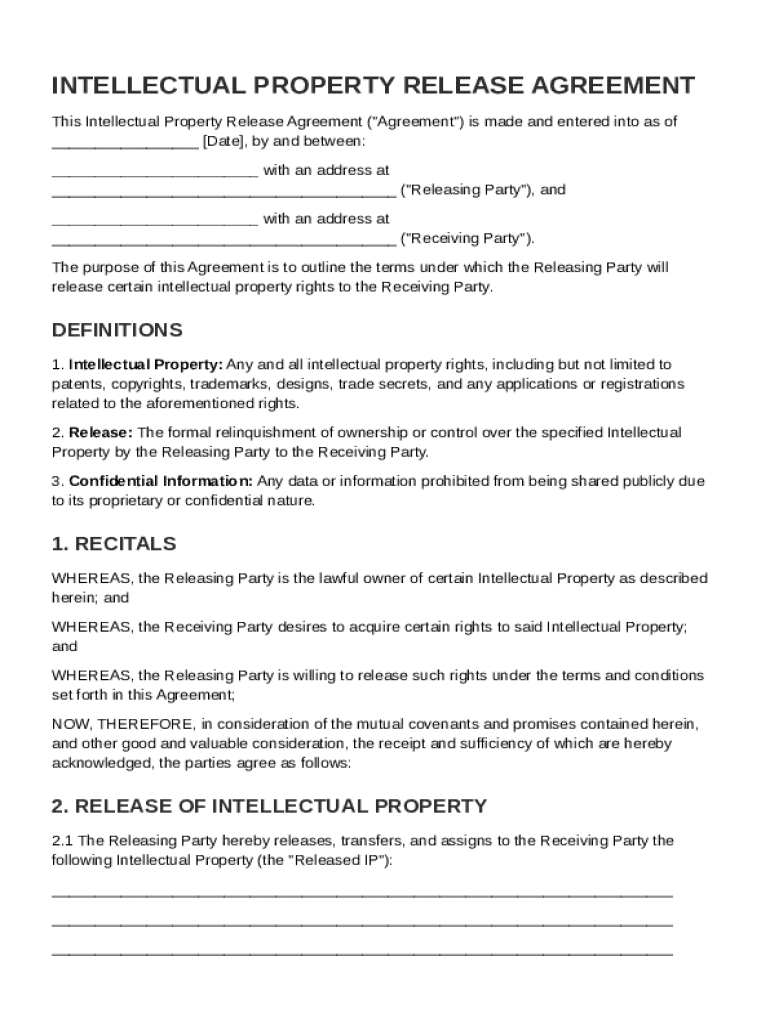







Definition and Meaning of an Intellectual Property Release Agreement
An Intellectual Property Release Agreement is a legally binding document that outlines the terms and conditions under which one party, known as the Releasing Party, transfers specific intellectual property rights to another party, referred to as the Receiving Party. This agreement is pivotal for formalizing the transfer of rights and ensuring both parties understand their responsibilities and limitations concerning the intellectual property involved.
- Key Components:
- Details of the intellectual property being released
- Obligations and rights of both parties
- Confidentiality clauses to protect sensitive information
This document is often employed in scenarios where intellectual property needs to be shared or transferred, such as during mergers, acquisitions, or collaborations. It safeguards both parties by providing clear guidelines on the use and limitation of the intellectual property.
How to Use the Intellectual Property Release Agreement Template
Utilizing an Intellectual Property Release Agreement Template involves several steps to ensure that the document correctly reflects the intentions and requirements of both parties involved.
-
Identify Parties Involved:
- Clearly specify the Releasing Party and the Receiving Party. Full legal names and contact information should be included to avoid any ambiguities.
-
Detail the Intellectual Property:
- Precisely describe the intellectual property being transferred. Include patent numbers, trademarks, or descriptions of the property to avoid misunderstandings.
-
Define Terms and Conditions:
- Clearly outline the terms under which the intellectual property will be used. This includes restrictions, conditions, and any geographical or temporal limitations.
-
Execution of the Agreement:
- Both parties should thoroughly review the agreement, ideally with legal counsel, before signing. Ensure that all fields are filled out accurately to validate the contract.
-
Maintain Documentation:
- Keep signed copies of the agreement for record-keeping and future reference. This aids in compliance and can be pivotal in case of disputes.
Important Terms Related to the Intellectual Property Release Agreement
Understanding the terminology used in an Intellectual Property Release Agreement is crucial for both parties to ensure a mutual comprehension of the document's provisions.
- Indemnification: A clause that specifies how liabilities or losses that arise due to the use or infringement of the intellectual property will be handled.
- Confidentiality: Terms that ensure proprietary information remains protected, preventing unauthorized disclosure or misuse by either party.
- Governing Law: The legal framework under which the agreement is construed and enforced, which is particularly important for international transactions.
Familiarity with these terms will help parties better negotiate terms and understand the long-term implications of the release agreement.
Key Elements of the Intellectual Property Release Agreement Template
The template for an Intellectual Property Release Agreement typically includes several fundamental components that need to be meticulously filled out to ensure compliance and effectiveness.
- Title and Introduction: Clearly labeled title and introductory paragraph stating the purpose of the agreement.
- Property Description: A detailed account of the intellectual property, including any supporting documentation and identifiers.
- Transfer Conditions: Specifics on how rights are being transferred and under what conditions they can be utilized.
- Rights and Responsibilities: Obligations of each party concerning the maintenance, protection, and usage of the intellectual property.
These elements form the backbone of the release agreement, ensuring that all aspects are appropriately addressed.
Steps to Complete the Intellectual Property Release Agreement Template
Completing an Intellectual Property Release Agreement Template requires thorough attention to detail and a step-by-step approach to ensure accuracy.
-
Gather Information:
- Collect relevant data about both parties and the intellectual property. This includes legal names, addresses, and specific intellectual property identifiers.
-
Draft the Agreement:
- Using the template, draft the agreement by filling in the necessary details, conditions, and terms related to the transfer of the intellectual property rights.
-
Review and Revise:
- Both parties should meticulously review the drafted agreement for any ambiguities or errors. It may be beneficial to consult legal experts to ensure the agreement is comprehensive and complies with applicable laws.
-
Finalize and Sign:
- Once both parties are satisfied with the terms, sign the agreement in the presence of a witness or notary, if required, to validate its legality.
-
Distribute and Archive Copies:
- Distribute executed copies to all parties involved and store them securely for future reference.
These steps facilitate the smooth execution of the agreement, ensuring both parties fully comprehend and commit to its terms.
Legal Use of the Intellectual Property Release Agreement
The legal utilization of an Intellectual Property Release Agreement serves multiple purposes, primarily focused on formalizing the transfer of intellectual property rights while ensuring that both parties abide by the stipulated conditions.
-
Compliance with Laws:
- The agreement must adhere to relevant intellectual property laws and regulations, which may vary significantly from one jurisdiction to another.
-
Protection Against Infringement:
- Clearly outlined terms protect against potential infringement claims by establishing documented permission to use the intellectual property.
-
Dispute Resolution:
- In cases of disagreement, the agreement provides a basis for legal recourse by documenting all stipulated terms and conditions.
By establishing a formal legal framework, such agreements prevent future disputes and provide clear pathways for resolution, thereby fostering a trustworthy relationship between the parties.
Examples of Using the Intellectual Property Release Agreement Template
The Intellectual Property Release Agreement Template is used across various scenarios, illustrating its versatility and necessity in protecting intellectual property rights.
- Collaborative Projects: In joint ventures or collaborations between multiple entities, an agreement helps determine how shared intellectual property can be used.
- Film and Media: When incorporating externally-owned music, scripts, or other creative works, this agreement defines the scope of use and any royalty arrangements.
- Technology Transfers: In situations where a company licenses its technology to another entity, this agreement enforces restrictions and conditions of use.
These real-world applications demonstrate the agreement's practical utility, ensuring that the intellectual property is used fairly and legally.
State-Specific Rules for the Intellectual Property Release Agreement
While the general structure of an Intellectual Property Release Agreement is consistent, specific rules and considerations can vary depending on the state.
-
Jurisdictional Governing Laws:
- Each state may have unique statutes and regulations that influence how intellectual property agreements are interpreted and enforced, necessitating adjustments to the standard template.
-
Specific Clauses:
- Some states may require additional clauses concerning liabilities, indemnifications, or statutory rights that need to be integrated into the agreement.
-
Legal Advice:
- Consulting with a lawyer who specializes in intellectual property laws within the relevant jurisdiction can ensure compliance with any state-specific requirements.
Adapting the agreement to the appropriate legal context of its jurisdiction is essential for its validity and enforceability.




