






Definition and Meaning
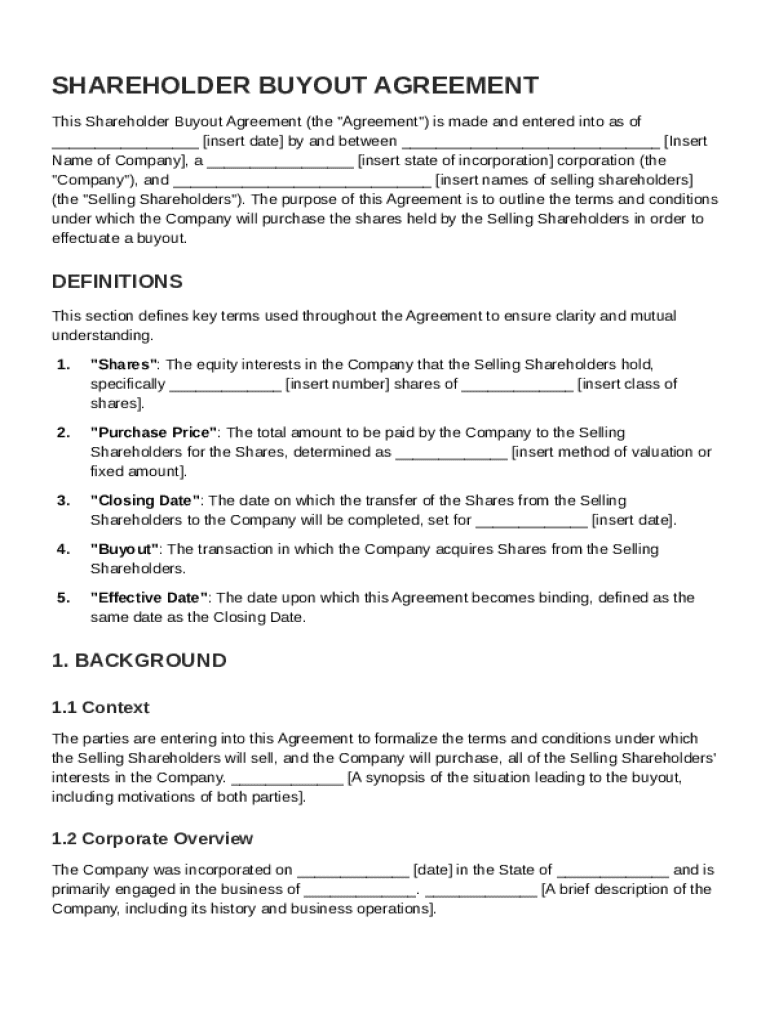
A Shareholder Buyout Agreement is a legal document that sets forth the terms under which a company purchases shares from one or more of its shareholders. This template outlines the roles and responsibilities of each party involved in the buyout process. It defines key terms such as 'purchase price,' 'closing date,' and 'conditions precedent.' These definitions ensure that all parties have a shared understanding, minimizing potential disputes.
- Purchase Price: The amount agreed upon for the shares being bought out. This price can be based on a company valuation or predetermined by a shareholder agreement.
- Closing Date: The date on which the transaction is finalized, and the ownership of the shares is officially transferred.
- Conditions Precedent: These are specific conditions that must be fulfilled before the buyout can be completed, such as necessary regulatory approvals or company board resolutions.
Key Elements of the Shareholder Buyout Agreement Template
The Shareholder Buyout Agreement Template comprises several critical components that ensure the transaction is clear and legally binding. Key elements include:
- Representation and Warranties: Statements of fact made by the selling shareholder and the company, assuring the other party of certain conditions.
- Indemnification Clauses: Provisions that protect parties against potential legal claims arising from misinformation or failure to disclose relevant data.
- Payment Terms: Details on how the purchase price will be paid (e.g., lump sum, installments) and the currency in which the transaction will be processed.
These elements are crucial as they establish a framework for the transaction, providing legal safeguards for both parties.
Steps to Complete the Shareholder Buyout Agreement Template
Completing a Shareholder Buyout Agreement involves several methodical steps to ensure accuracy and legal compliance:
- Identify Parties: Clearly list the names and details of the selling shareholders and the purchasing entity.
- Draft Terms: Specify the purchase price, the method and schedule of payment, and any conditions precedent.
- Review Representation and Warranties: Both buyer and seller should verify that all statements made are truthful and complete.
- Consult Legal Counsel: Have a legal professional review the draft to ensure compliance with applicable laws.
- Finalize and Sign: Once all parties agree to the terms, sign the document to make it legally binding.
These steps ensure thoroughness and protect against future legal challenges.
Legal Use of the Shareholder Buyout Agreement Template
In the United States, using a Shareholder Buyout Agreement Template requires adherence to federal and state laws to ensure the agreement is enforceable:
- Federal Securities Regulations: Compliance with regulations set by the Securities and Exchange Commission (SEC) is necessary if public shareholders are involved.
- State Corporate Laws: Each state may have its own set of rules governing the process of shareholder buyouts, including requisite shareholder approvals.
- Tax Implications: The agreement may necessitate documentation and reporting to the IRS, especially if the transaction involves significant capital gains.
These legal considerations are vital for maintaining the integrity and validity of the agreement.
Who Typically Uses the Shareholder Buyout Agreement Template
Various entities and individuals engage with Shareholder Buyout Agreements for different purposes:
- Corporations: Often use buyout agreements to repurchase shares from departing or retiring shareholders.
- Private Equity Firms: This template can facilitate the acquisition of controlling interests in target companies through shareholder buyouts.
- Individual Investors: Someone divesting their stock holdings may use this agreement to formalize the sale of their shares.
Understanding who uses this agreement can provide insights into how it might be tailored for specific business goals.


Important Terms Related to the Shareholder Buyout Agreement Template
Familiarity with the terminology specific to Shareholder Buyout Agreements is essential for effective negotiation and execution:
- Due Diligence: A comprehensive appraisal of the business undertaken by the buyer to establish value and identify risks.
- Earn-out: A provision that might allow sellers to receive additional compensation based on future performance.
- Right of First Refusal: An existing shareholder’s right to purchase shares before the company offers them to outside buyers.
Grasping these terms will aid in creating a well-rounded agreement.
Examples of Using the Shareholder Buyout Agreement Template
Practical examples of applying a Shareholder Buyout Agreement can illustrate its adaptability and utility:
- Family-Owned Businesses: When transitioning ownership to the next generation, this agreement can formalize transferring shares within the family.
- Employee Buyout Schemes: A company may use the template to enable employees to acquire a stake in the business.
- Hostile Takeover Defense: Corporations might employ this agreement template as part of a strategy to reacquire shares and consolidate control.
These scenarios highlight the agreement's flexibility in various contexts.
Business Types that Benefit Most from the Shareholder Buyout Agreement Template
Different business entities can leverage Shareholder Buyout Agreements to achieve specific objectives:
- Startups and Small Businesses: These entities might use buyout agreements to remove inactive investors and streamline decision-making processes.
- Partnerships: As partners exit the business, the remaining partners can use the template to purchase the outgoing partner's equity effectively.
- Public Companies: These companies may execute share buybacks to adjust their capital structure or increase share value.
Each business type can employ buyout agreements to align their shareholder structure with strategic goals.