
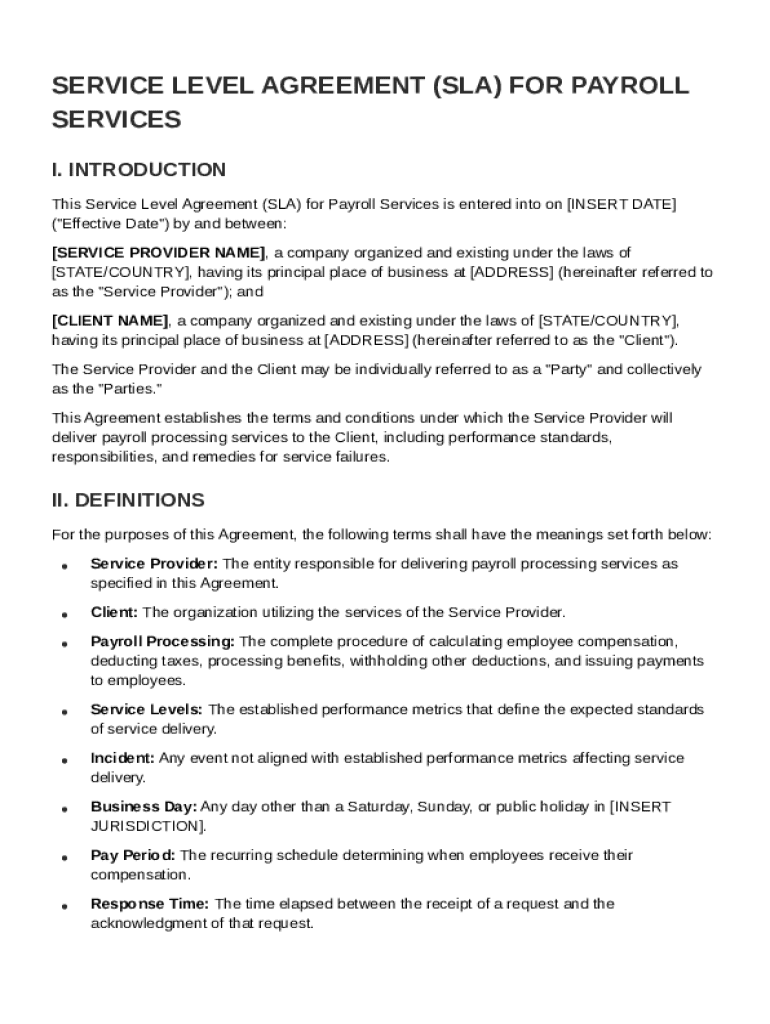







Definition and Meaning
A Service Level Agreement (SLA) for Payroll is a formal document that specifies the terms, conditions, and expectations between a payroll service provider and a client. It outlines the scope of services provided, performance metrics, responsibilities of both parties, and protocols for data security. The primary purpose is to ensure that payroll processing is accurate, timely, and compliant with applicable laws. This document often includes clauses related to incident management procedures and change management processes to clarify how deviations from the agreement are handled.
Three critical components typically outlined in the SLA include:
- Scope of Services: Describes the payroll services offered, such as salary calculation, tax deductions, and issuance of paychecks or direct deposits.
- Performance Metrics: Establishes benchmarks for service quality, including response times for inquiries and the accuracy of payroll calculations.
- Confidentiality and Compliance: Ensures that both parties adhere to privacy standards and legal requirements, such as the protection of employee data.
How to Use the Service Level for Payroll Agreement Template
To effectively utilize the Service Level for Payroll Agreement Template, follow these steps:
-
Review the Template:
- Begin by thoroughly reading the template to understand the provisions and stipulations included. Look for sections that outline service expectations, performance standards, and compliance requirements.
-
Customize the Agreement:
- Modify the template to reflect the specifics of your agreement, such as the names of the parties involved, the start and end dates, and any industry-specific terms or conditions. Ensure that all sections are relevant to your organization’s needs.
-
Discuss with Stakeholders:
- Engage in discussions with internal stakeholders and legal counsel to ensure the agreement aligns with both parties’ expectations and complies with relevant laws.
-
Finalize and Sign:
- Once all terms are agreed upon, formalize the agreement by obtaining signatures from authorized representatives of both parties. Ensure that all digital signatures are captured following legal standards.
Key Elements of the Service Level for Payroll Agreement Template
A comprehensive Service Level for Payroll Agreement Template typically includes the following key elements:
-
Service Description: Clearly describes the payroll services provided, specifying whether additional services like tax reporting are included.
-
Responsibilities of Parties: Details the responsibilities of both the payroll provider and the client, such as data provisioning by the client and payment processing by the provider.
-
Performance Metrics: Sets measurable criteria for service levels, such as the accuracy of payroll processing and timeliness of payroll distribution.
-
Data Security: Outlines measures for safeguarding sensitive payroll information, including encryption protocols and access controls.
-
Change Management: Defines procedures for making changes to the agreement, such as modifying services or adjusting performance metrics.
-
Dispute Resolution: Provides a framework for resolving disagreements, specifying mediation or arbitration as necessary steps before litigation.
Steps to Complete the Service Level for Payroll Agreement Template
Completing the Service Level for Payroll Agreement Template involves several structured steps:
-
Gather Information:
- Collect relevant details about parties involved, services to be provided, and specific requirements or expectations.
-
Fill in the Details:
- Enter specific information into the template, including company names, point of contacts, and service start date.
-
Define Metrics and Responses:
- Outline performance targets in clear, quantitative terms and specify the response times for issues or inquiries.
-
Review Legal Sections:
- Ensure clauses related to compliance with labor laws and data protection standards are accurate and complete.
-
Collaborate for Clarity:
- Work closely with team members and legal experts to verify the document reflects mutual understanding and business objectives.
-
Finalize the Document:
- Once all inputs are thoroughly reviewed and agreed upon, proceed to obtain necessary signatures for formal approval.
Who Typically Uses the Service Level for Payroll Agreement Template
Users of the Service Level for Payroll Agreement Template include a range of organizations and individuals:
- Small and Medium-sized Enterprises (SMEs): Often outsource payroll to focus on core business operations without investing in internal payroll software or expertise.
- Human Resources Departments: Utilize the agreement when negotiating terms with external payroll service providers to ensure clear accountability and service expectations.
- Legal Advisors: Assist in drafting or reviewing the agreement to ensure compliance with relevant labor laws and data protection regulations.
- Business Owners and Managers: Engage with the template to formalize relationships with payroll providers and ensure alignment with business needs.


Important Terms Related to Service Level for Payroll Agreement Template
Understanding key terminology is crucial when dealing with SLAs for payroll services:
- Service Provider: The entity offering payroll processing services.
- Client: The recipient of payroll services, often a company or business entity.
- Performance Metrics: Criteria used to measure the effectiveness and quality of service delivered.
- Confidentiality Agreement: A legal requirement ensuring that sensitive payroll information is protected.
- Escalation Procedures: Defined processes for advancing the severity of concerns if initial contact does not resolve them.
Examples of Using the Service Level for Payroll Agreement Template
Real-world examples illustrate the application of the SLA for payroll services:
-
Example 1: A startup partners with an external payroll provider to facilitate bi-weekly salary payments. The SLA outlines how the provider will handle payroll tax calculations and filing requirements.
-
Example 2: A nonprofit organization uses an SLA to ensure its service provider maintains compliance with wage and hour laws, crucial for maintaining its tax-exempt status.
-
Example 3: A manufacturing firm establishes an SLA with a payroll software provider, specifying data security measures and support response times, crucial for handling large payroll volumes.
Legal Use of the Service Level for Payroll Agreement Template
Understanding the legal context of the SLA for payroll is essential for compliance and to mitigate risks:
-
Legal Compliance: Ensure the agreement adheres to local, state, and federal payroll laws, including tax regulations and employee rights.
-
Binding Nature: The SLA is a legally binding document once signed, holding both parties accountable to the stipulated terms and conditions.
-
Amendment Procedures: Clearly define the methods for amending the agreement to accommodate legal changes or evolving business needs.
-
Audit Rights: Include clauses allowing either party to request audits for compliance verification, particularly concerning data security and privacy commitments.




