






Definition and Meaning of the Guarantor Contract Template
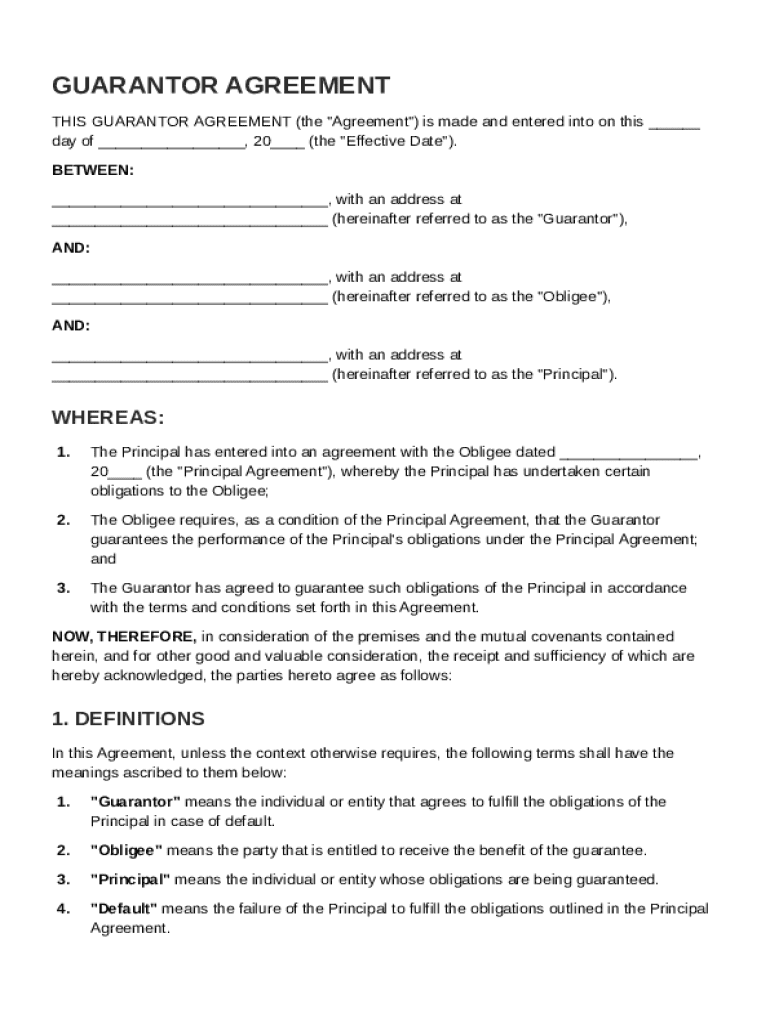
A Guarantor Contract Template is a formal document that outlines the responsibilities and obligations undertaken by a guarantor. In legal terms, the guarantor acts as a secondary party who agrees to fulfill the obligations of a primary party to an obligee if the primary party defaults on their commitments. This agreement typically includes specific terms such as the scope of the guarantee, duration, and any conditions under which the guarantor is held responsible. Importantly, the template will usually provide definitions of the key parties involved — known as the Principal, the Obligee, and the Guarantor — as well as detailed legal provisions governing the agreement to cover potential risks and ensure the execution of responsibilities.
How to Use the Guarantor Contract Template
When utilizing a Guarantor Contract Template, it's critical to review the document thoroughly to understand its provisions. Whether drafted anew or adapted from a pre-existing contract, follow these steps:
- Identify Parties: Clearly specify the Principal, Obligee, and Guarantor involved to establish who is responsible for what.
- Review Obligations: Outline the exact duties the guarantor is agreeing to cover, including any financial or operational tasks.
- Set Duration: Establish the time frame during which the guarantor's responsibilities are binding.
- Include Legal Clauses: Ensure all legal protections and obligations are included, such as indemnity clauses or confidentiality agreements.
- Finalize and Execute: Have all parties review and sign the document to enact the contract.
Each of these steps is crucial for creating a legally binding and enforceable contract.
Key Elements of the Guarantor Contract Template
A comprehensive Guarantor Contract Template often contains several critical elements. Some of these include:
- Identification of Parties: Detailed information of the Principal, Obligee, and Guarantor.
- Scope of Guarantee: Specifies what obligations are covered under the guarantee.
- Duration: Time period for which the guarantor’s obligations are valid.
- Rights and Obligations: Description of the rights of the obligee and the responsibilities of the guarantor.
- Legal Provisions: Inclusion of terms for indemnity, limitation of liability, and dispute resolution.
- Acknowledgment of Risk: Statement confirming that the guarantor understands and accepts the risks involved.
These elements ensure the contract is precise and addresses all necessary legal aspects.
Legal Use of the Guarantor Contract Template
The Guarantor Contract Template is a legally enforceable document under U.S. law, typically adhering to state-specific regulations. Its legal efficacy stems from its capacity to clearly delineate responsibilities and provide a recourse in case of default. The enforceability is reliant on all parties voluntarily entering into the agreement, with an understanding of its ramifications. Many legal professionals recommend consulting with a lawyer to ensure the template meets required legal standards and compliance with pertinent laws, such as consumer protection statutes and contract law principles, mitigating potential disputes later on.
State-Specific Rules for the Guarantor Contract Template
The application of a Guarantor Contract Template may vary by state due to different contract laws and commercial codes. Some states might have specific requirements regarding disclosure obligations or statute of limitations, which could affect the validity and enforceability of the template. It's beneficial to consult a legal professional familiar with the specific state laws to ensure accuracy and compliance, particularly in areas like New York or California, where commercial and consumer protection laws may impose additional requirements or restrictions.
Steps to Complete the Guarantor Contract Template
Completing a Guarantor Contract Template involves the following steps:
- Collect Information: Gather details about all parties involved, including names, addresses, and roles.
- Fill in Details: Complete sections concerning obligations, the scope of guarantee, and any predefined terms.
- Review Legal Terms: Ensure all included legal provisions are applicable and adequately protect your interests.
- Consult Legal Advice: Engage a legal professional to review the contract, ensuring it fulfills legal requirements.
- Finalize Document: All parties should review the final version of the document together.
- Signatures: Obtain signatures from all parties, preferably in the presence of a notary public to authenticate the document.
By following these steps, you ensure the template is correctly completed, reducing future conflicts.
Who Typically Uses the Guarantor Contract Template
The Guarantor Contract Template is commonly employed by businesses, lenders, landlords, and individuals in various transactions. Businesses may use this to secure loans or to guarantee the performance of a partner or subsidiary. Landlords might require a guarantor before leasing property to ensure rent is paid. Conversely, financial institutions or family members may serve as guarantors to facilitate smaller, personal transactions where trust is a consideration. The versatility of the template allows it to be adapted to numerous scenarios across personal and professional contexts.


Examples of Using the Guarantor Contract Template
Several practical scenarios illustrate the use of a Guarantor Contract Template:
- Business Loan Guarantee: A small business loan where the owner provides a personal guarantee if the business defaults.
- Rental Agreement: A student renting an apartment where a parent acts as a guarantor for the lease.
- Supplier Contract: A company guarantees the payment for goods supplied by a vendor to its subsidiary.
These examples reflect the template's adaptability in ensuring obligations are met across diverse agreements.
Important Terms Related to the Guarantor Contract Template
Familiarizing oneself with the terminology related to the Guarantor Contract Template is essential. Key terms include:
- Principal: The primary party obligated to fulfill the contract terms.
- Obligee: The party receiving the benefit or performance of the contract.
- Surety: Another term sometimes used interchangeably with guarantor.
- Indemnity: Protection provided to the obligee against possible losses or damages.
- Executed Contract: A fully completed and signed contract, enforcing the guarantee.
These terms are frequently encountered when dealing with such contracts, providing clarity on roles and responsibilities.