





Definition and Meaning
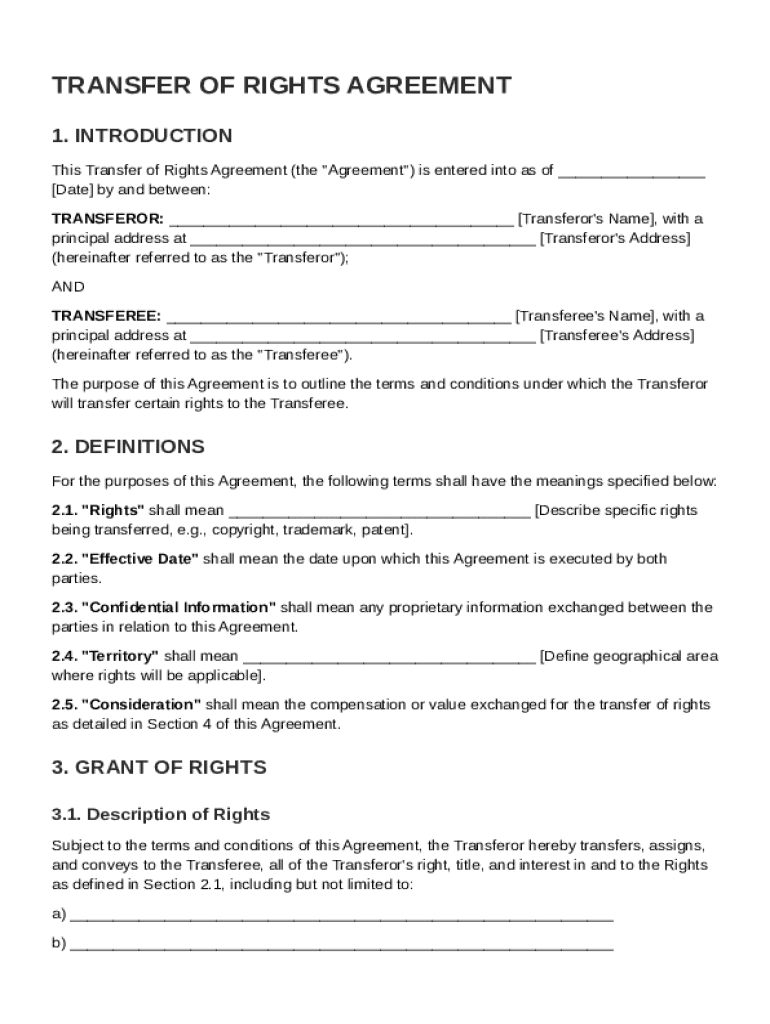
The Transfer of Rights Agreement Template is a legally binding document that formalizes the transfer of specific rights from a transferor to a transferee. This type of agreement typically involves a detailed outline of all rights being transferred, including intellectual property rights, distribution rights, or other proprietary rights. It clearly defines obligations, responsibilities, and expectations of both involved parties. Such agreements are essential in ensuring that the transfer adheres to legal standards and offers protection against future disputes regarding ownership or rights.
Practical Examples
A common example of using this agreement is in the entertainment industry, where a writer (transferor) might transfer the rights of a screenplay to a production company (transferee). Similarly, an inventor may transfer patent rights to a manufacturer for commercialization. In both cases, the template provides a structured format to document these transfers, ensuring clarity and legal compliance.
Key Elements of the Transfer of Rights Agreement Template
The Transfer of Rights Agreement Template includes several critical components designed to address all aspects of the rights transfer process. Key elements often include:
-
Definitions of Terms: Clearly outlines important terms used throughout the document to ensure mutual understanding.
-
Payment Considerations: Details any financial transactions, including payment amounts and schedules, relevant to the transfer.
-
Representations and Warranties: Includes assurances from both parties that the rights involved are free of encumbrances and that each party has the authority to enter into the agreement.
-
Confidentiality Obligations: Imposes restrictions on sharing information that may be considered proprietary or confidential.
-
Indemnification Clauses: Protects both parties by outlining responsibilities for any losses or damages resulting from infringement or breach of the agreement.
-
Dispute Resolution Procedures: Specifies mechanisms for resolving any potential disagreements, often including mediation or arbitration clauses.
Detailed Breakdown
-
Confidentiality Obligations: These provisions ensure that all confidential or sensitive information shared as part of the agreement remains protected. This element is critical in safeguarding trade secrets and proprietary information.
-
Indemnification Clauses: These are designed to protect the parties from loss or damage claims arising from failings within the transfer process. It lays out who is liable for legal fees or penalties in the case of intellectual property disputes.
How to Use the Transfer of Rights Agreement Template
Using the Transfer of Rights Agreement Template is straightforward and involves several essential steps. Here is a simplified process for using the template effectively:
-
Identifying Parties: Begin by clearly identifying the transferor and transferee, including their full legal names and addresses.
-
Specifying Rights to Transfer: Clearly list the rights that are being transferred. This might include copyrights, patents, trademarks, or any other relevant rights.
-
Detailing Compensation: Specify the financial terms, such as payment amounts and deadlines, that facilitate the rights transfer.
-
Outlining Warranties and Representations: Both parties should affirm that they have the authority to transfer and receive the specified rights and that these rights are clear of any third-party claims.
-
Drafting Confidentiality Clauses: Include clauses to protect any sensitive information exchanged during the agreement process.
-
Defining Dispute Resolution Terms: Lay out the methods that will be used to settle disputes. This includes choosing mediation or arbitration as a first step before proceeding to litigation.
Real-World Applications
In technology transfer scenarios, a company developing software might use this template to transfer rights to another entity for commercialization. Companies can seamlessly outline development credentials, ensuring a smooth transfer of rights, responsibility, and remuneration.
Who Typically Uses the Transfer of Rights Agreement Template
The template is commonly utilized by a diverse range of stakeholders who may need to transfer rights in various contexts. These stakeholders include:
-
Creative Professionals: Authors, musicians, and artists often use this agreement to transfer rights to their works.
-
Business Entities: Corporations, small businesses, and startups may use it to transfer intellectual property as part of mergers, acquisitions, or partnerships.
-
Legal and Financial Advisors: Lawyers and financial consultants often draft and review these agreements on behalf of their clients to ensure alignment with legal standards.
-
Technological Inventors: Inventors seeking commercialization alignments commonly utilize such templates to transfer patent rights.


Scenarios of Use
A novelist transferring the film rights of their book to a producer is a typical scenario. Similarly, a tech startup obtaining rights from a university for a new technology can use this template to firmly establish legal ownership and commercial viability.
State-Specific Rules for the Transfer of Rights Agreement Template
Laws regarding rights transfer can vary significantly between states. Certain jurisdictions might have specific rules that govern the transfer of intellectual property rights. It is crucial to consider these differences by:
-
Consulting Local Legal Experts: Ensuring the agreement complies with specific state laws to prevent future legal challenges.
-
Adapting Templates for State Requirements: Modify the template based on the jurisdiction, considering variations in state law concerning certain intellectual property rights.
Examples by State
Some states, like California, have stringent laws regarding non-compete clauses and the transfer of rights related to employment. Compliance with these statewide legal norms is critical for the enforceability of the agreement.
Legal Use of the Transfer of Rights Agreement Template
This template serves as a foundational document to ensure the legal transfer of rights and encompasses various statutory and regulatory requirements to maintain validity. Key considerations include:
-
Adherence to Intellectual Property Laws: It should align with federal statutes under U.S. intellectual property laws, including the Copyright Act and Patent Act.
-
Recognition of ESIGN Act Compliance: Electronic signatures obtained through platforms like DocHub are legally valid under the ESIGN Act, ensuring legality even in digital formats.
Compliance with Federal Laws
Federal intellectual property laws dictate the transferability and ownership registration requirements for all substantive rights. Carefully aligning these agreements with existing statutory requirements is paramount.
Important Terms Related to the Transfer of Rights Agreement Template
Several specific terms commonly appear in these agreements and are essential for clarification. Recognizing these terms ensures mutual understanding and legal precision. Important terms often include:
-
Transferor/Transferee: The parties involved in the transfer, each with specific roles and responsibilities.
-
Intellectual Property (IP): The category of assets transferred including patents, trademarks, copyrights, etc.
-
Consideration: Financial or other compensation exchanged for the transfer of rights.
-
Assignment: The act of formally shifting rights from one party to another.
Detailed Context
Understanding terms like "consideration" and "assignment" is crucial for both parties. "Consideration" refers to the monetary value or benefit exchanged, while "assignment" signifies the official transfer of rights itself, necessitating clarity in every agreement.