




01. Edit your form online
Type text, add images, blackout confidential details, add comments, highlights and more.

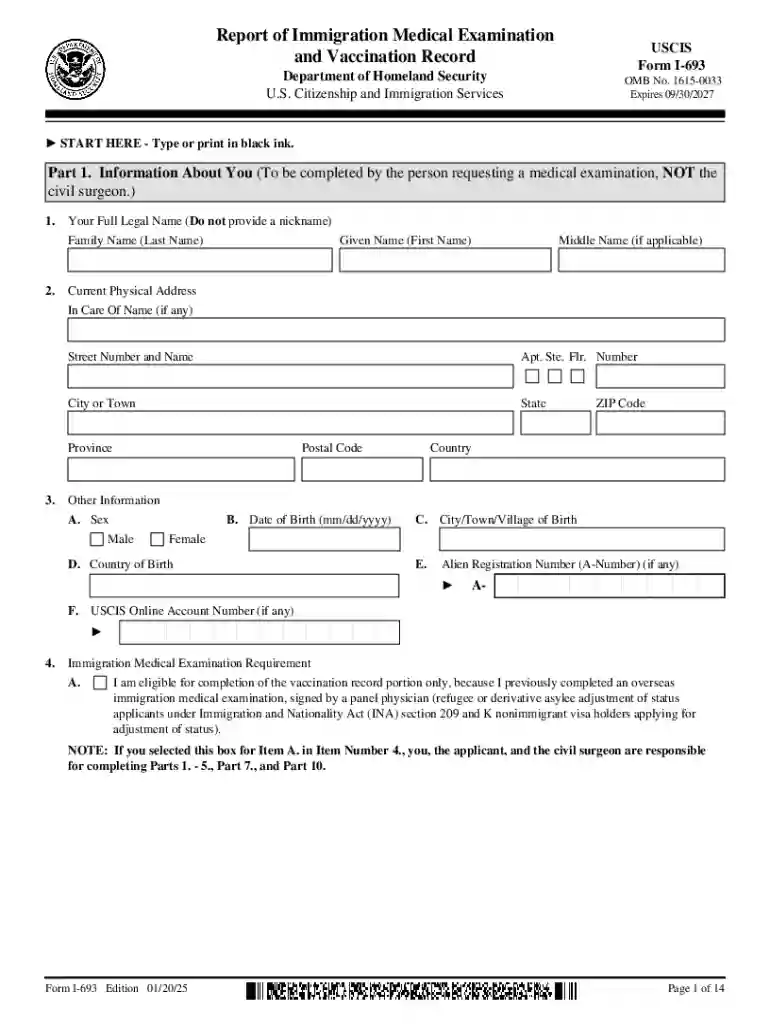
Type text, add images, blackout confidential details, add comments, highlights and more.

Draw your signature, type it, upload its image, or use your mobile device as a signature pad.

Send it via email, link, or fax. You can also download it, export it or print it out.
The Report of Immigration Medical Examination and Vaccination Record, officially known as USCIS Form I-693, is a crucial document for individuals seeking immigration benefits in the United States. This form serves to report the findings of a medical examination conducted by a USCIS-designated civil surgeon. It aims to ensure that the applicant does not pose a public health risk to the U.S., focusing on the detection and treatment of specific communicable diseases, as identified by the Centers for Disease Control and Prevention (CDC).
The form encompasses several key sections: personal information, the applicant's statement, interpreter's details, the civil surgeon's findings, and vaccination records. Through these components, Form I-693 helps in affirming that the immigration applicant has met the necessary health standards required for entry into the U.S.
Obtaining the I-693 form is a multi-step process, integral for applicants pursuing immigration through adjustment of status. Here’s how you can complete this process:
Locate a Civil Surgeon: Find a civil surgeon authorized by USCIS to conduct the immigration medical exam. You can search for a qualified doctor on the USCIS website.
Schedule Your Appointment: Contact the selected doctor to schedule an appointment. Ensure you disclose that the purpose of the exam is for your Form I-693 to allow appropriate preparation.
Prepare Necessary Documents: Gather necessary documents, including government-issued photo identification and vaccination records. Bring all relevant medical and immunization history to ensure a comprehensive examination.
Attend the Examination: During the exam, the civil surgeon will conduct a medical evaluation, review your vaccination records, and perform needed vaccinations or tests for communicable diseases.
Receive the Completed I-693: After the medical examination, the civil surgeon will fill out the I-693 form. Ensure it is placed in a sealed envelope as required by USCIS, without opening it.
Submission: Submit the sealed form to USCIS along with your application for immigration benefits. Ensure that this submission is timely relative to your immigration process deadlines.
Completing Form I-693 is vital for several reasons:
Legal Requirement: Compliance with U.S. immigration law requires this medical examination for adjustment of status applicants.
Public Health Safety: Prevents the entry and spread of communicable diseases within the United States, thus safeguarding public health.
Eligibility Confirmation: Helps in confirming the eligibility of the applicant for the immigration benefit by meeting the health standards established by U.S. regulations.
Failure to complete or properly submit Form I-693 can delay the processing of an immigration application or lead to outright denial.
Understanding the form's key elements provides clarity on the information required:
Personal Information: Includes the applicant's name, place of birth, intended residence, and more.
Applicant’s Statement and Signature: A declaration by the applicant that all information provided is true.
Interpreter’s Details: Needed if language assistance is used during the examination. Includes the interpreter's name and contact information.
Civil Surgeon’s Findings: Detailed medical examination results, including tests and vaccinations.
Vaccination Record: A checklist of mandated vaccinations, detailing those already received, and any additional shots administered for compliance.
To better illustrate the practical usage of Form I-693, consider the following scenarios:
Family-Based Adjustment Applicants: A person seeking to join family in the U.S. must include a properly completed Form I-693 with their adjustment of status application.
Employment-Based Immigrants: Professionals entering the U.S. for work must also complete the medical exam to ensure compliance with health standards.
Refugees and Asylees Adjusting Status: After their initial entry into the U.S. based on refugee or asylum status, individuals must submit Form I-693 when applying for permanent residency.
Each use case highlights the form's critical role in the immigration process, ensuring all applicants align with U.S. health regulations.
Determining who must complete Form I-693 involves specific eligibility criteria:
Applicants for Adjustment of Status: Individuals applying for permanent residency (green cards) must submit the form as part of their complete application package.
Certain Nonimmigrant Visa Holders: In some cases, nonimmigrant visa holders adjusting to immigrant status may also be required to complete the form.
Immigrants Subject to Health-Related Grounds of Inadmissibility: Especially those requiring particular health screenings or vaccinations.


The legal use of Form I-693 is governed by both immigration laws and health standards:
Compliance with the Immigration and Nationality Act (INA): Section 212(a) outlines health-related grounds for inadmissibility, which the I-693 exam helps to assess.
CDC Guidelines: The CDC provides guidance on diseases and vaccinations that must be screened.
Paperwork and Validity Standards: The I-693 must be completed by a USCIS-designated civil surgeon and submitted in an unopened sealed envelope. The form remains valid for two years from the date of the civil surgeon's signature.
Meeting these legal and procedural requirements ensures the successful inclusion of Form I-693 in the adjustment of status application process.
At DocHub, your data security is our priority. We follow HIPAA, SOC2, GDPR, and other standards, so you can work on your documents with confidence.


Sep 7, 2022 Report of Medical Examination and Vaccination Record | USCIS,. Form I-693. Page 48. References. 1. See the Immigration Act of 1891, 26 Stat.
Jul 8, 2025 Effective Dec. 2, 2024, you must submit Form I-693, or a partial Form I-693 (such as the Vaccination Record), and you must submit it with your
The Interviewer Conference Report. The Interviewer Conference Report is a record of the cases currently assigned to you and the results of your work on those


