
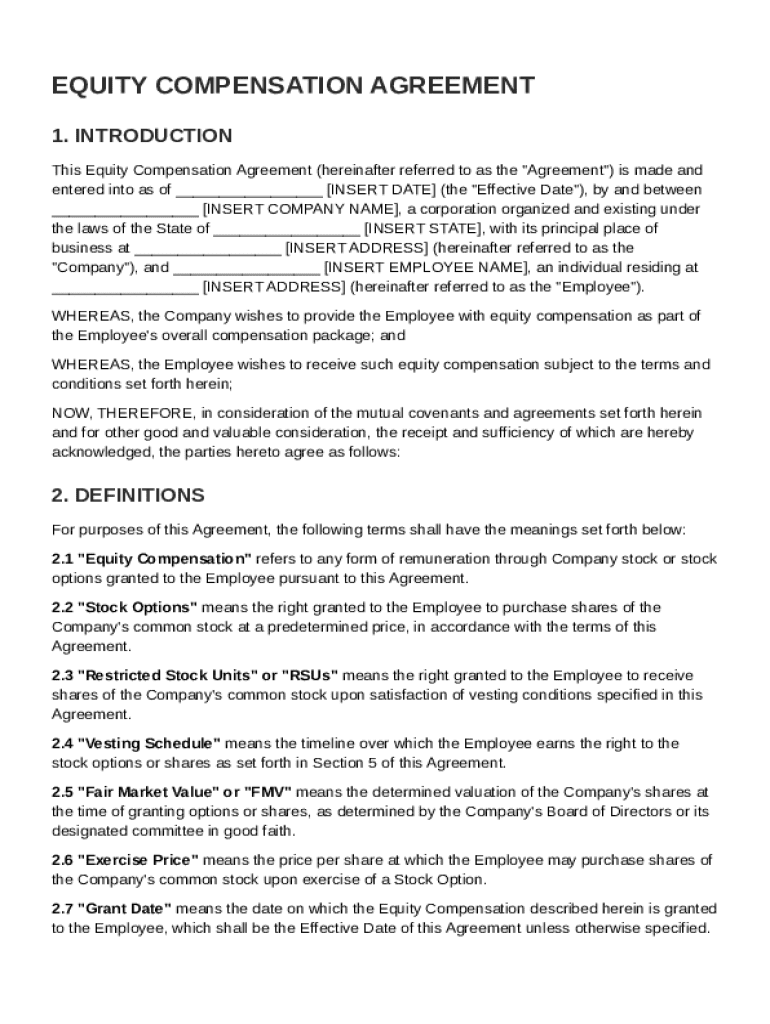







Definition and Importance of the Equity Compensation Agreement
The Equity Compensation Agreement is a formal document that outlines the terms under which a company provides equity-based compensation to an employee. This compensation typically comes in the form of stock options, restricted stock units (RSUs), or other equity instruments. The agreement serves several purposes:
- Clarifying Terms: It provides detailed descriptions of key terms such as the type and quantity of equity granted, exercise price, and vesting schedule.
- Legal Provisions: The document includes legal provisions such as rights of equity holders, tax implications, and general conditions.
- Relationship Formalization: It formalizes the relationship between the employer and employee regarding equity as a part of the overall remuneration package.
Understanding the importance of this agreement is crucial for both parties to ensure compliance with legal standards and to foster a transparent and fair working environment.
Key Elements of the Equity Compensation Agreement Template
The Equity Compensation Agreement Template includes several critical components that need to be detailed precisely:
- Definitions of Key Terms: Specific legal and financial terminology related to equity compensation must be clearly defined.
- Type and Quantity of Equity: Description of whether compensation is through stock options, RSUs, or another equity form, and the amount offered.
- Vesting Schedule: Outlines how and when the equity compensation becomes the employee’s property over time.
- Exercise Price and Mechanism: Explains the price at which stock options may be exercised and the process involved.
- Termination Conditions: Details conditions under which the agreement may be terminated or modified.
Each element ensures both parties have a clear understanding of their obligations and benefits under the agreement.
How to Use the Equity Compensation Agreement Template
Using the template involves several straightforward steps that can facilitate accurate and legally compliant documentation:
- Customize the Template: Begin by filling in specific details such as the names of the parties involved, the type and amount of equity, and the vesting schedule.
- Review Key Sections: Carefully review definitions, legal provisions, and signature sections to ensure their applicability to the situation.
- Consult with Legal Experts: It’s advisable to have a legal expert review the document to ensure it meets all required legal criteria and standards.
- Finalize and Sign: Once reviewed, execute the agreement with signatures from all requisite parties.
Utilizing the template in this orderly manner ensures the agreement is comprehensive and legally sound.
Steps to Complete the Equity Compensation Agreement Template
Completing the Equity Compensation Agreement Template efficiently involves a methodical approach:
- Enter Basic Information: Start with the essential details such as name, address, and contact information of the parties involved.
- Specify Compensation Details: Outline the type, quantity, and conditions of the equity compensation.
- Detail the Vesting Schedule: Include specific timelines for when equity becomes vested.
- Outline Legal Provisions: Carefully elaborate on the legal implications and obligations for both parties.
- Set Up Signature Lines: Ensure there is a space for signatures from all relevant parties.
- Review for Accuracy: Double-check all data entries and clauses for accuracy before execution.
By following these steps, the process of completing the template can be conducted with minimal errors.
Important Terminology in the Equity Compensation Agreement
Terminologies used within the Equity Compensation Agreement play a critical role in its understanding:
- Vesting: Refers to the process by which an employee earns the right to compensation over time.
- Exercise Price: The price at which the employee can purchase stock options.
- Grant Date: The initial date on which the equity compensation is awarded.
- Clawback Provision: Conditions under which a company may rescind equity compensation.
- Fair Market Value: The estimated value of a share at the time of the award.
Understanding these terms ensures clarity and alignment between all parties involved.
Legal Use and Compliance with the Equity Compensation Agreement
Legal compliance is critical for the validity of the Equity Compensation Agreement:
- Adherence to Securities Laws: Companies must comply with applicable securities regulations when offering equity compensation.
- Respecting Tax Obligations: The agreement should align with IRS guidelines regarding taxation of equity compensation.
- Employment Law Compliance: Ensure the agreement meets state and federal employment law standards.
- Dispute Resolution: Incorporate clauses that stipulate how any disputes arising from the agreement will be handled.
These compliance factors safeguard the interests of both employer and employee.
Examples and Use Cases for Equity Compensation Agreements
Real-world use cases of Equity Compensation Agreements are widespread across industries:
- Startups: Often use equity compensation to attract talent without impacting cash flow significantly.
- Tech Companies: Regularly utilize equity options to incentivize and retain key personnel.
- Established Corporations: Offer equity as part of a broader compensation package for senior executives.
These examples illustrate the flexibility and strategic importance of equity compensation agreements across various business contexts.
State-Specific Rules Impacting Equity Compensation Agreements
While federal guidelines govern many aspects, state-specific rules can influence equity compensation agreements:
- California: Has stringent regulations on stock options for employee protection.
- New York: Implements extensive disclosure requirements for offered equity.
- Texas: May offer more flexibility in tax treatments of equity compensation.
Understanding these state-specific nuances ensures the agreement complies with all relevant legalities.




