




Definition and Meaning of a Supply for Goods Agreement
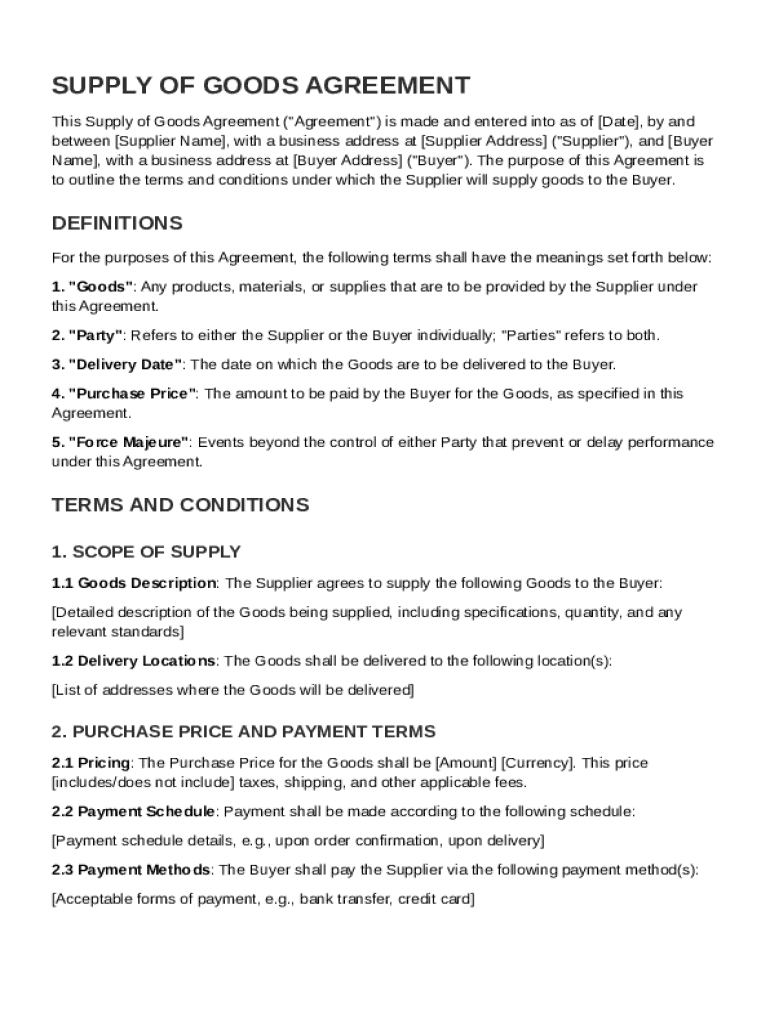
A Supply for Goods Agreement is a legally binding contract that outlines the terms and conditions under which one party, the supplier, agrees to provide specific goods to another party, the buyer. This document delineates each party's responsibilities, rights, and obligations. It includes essential components such as definitions, the scope of the supply, purchase price, delivery terms, warranties, indemnification, confidentiality, termination conditions, governing law, and dispute resolution mechanisms.
Key Features of the Agreement
- Scope of Supply: Details what goods will be supplied, setting clear expectations for both parties.
- Pricing and Payment Terms: Specifies the cost of goods and payment schedule, which could be milestone-based or all upfront.
- Delivery Schedules: Outline when and how goods are to be delivered, including any associated logistics.
- Warranties and Liabilities: Describes the warranty provided for the goods and the degree of responsibility each party holds if issues arise.
- Amendments and Notices: Procedures for making changes to the agreement and how notices should be communicated between parties.
How to Use the Supply for Goods Agreement Template
Using a Supply for Goods Agreement template involves several critical steps to ensure validity and effectiveness. While using a pre-existing template simplifies the process, customization is necessary to address specific needs.
Steps to Customize the Template
- Identify Parties Involved: Clearly state the legal names of the supplier and the buyer, along with their contact information.
- Detail the Goods Provided: Include comprehensive descriptions, including quantity and quality specifications, to avoid disputes.
- Set the Terms: Adjust the sections involving price, delivery, warranties, and liabilities according to specific requirements.
- Include Legal Essentials: Address indemnification, confidentiality, and termination conditions pertinent to the contractual relationship.
- Review for Accuracy: It’s crucial to proofread and verify details to prevent contradictions and ambiguities.
Examples of Customization
- For a supplier of electronic parts, the description might need technical specifications and compatibility requirements.
- In a food supply contract, detailed quality standards and inspection rights may be prominent.
Key Elements of the Supply for Goods Agreement Template
Several key elements form the backbone of a Supply for Goods Agreement. Each is integral to ensuring the agreement is legally robust and operationally effective.
Essential Components
- Definitions: Clarity on terms like "goods," "delivery," and "parties" to prevent misinterpretation.
- Amendments Clause: Establishes how changes to the agreement are managed and communicated.
- Governing Law and Jurisdiction: Specifies which state's laws govern the agreement and where disputes will be resolved.
- Confidentiality Provisions: Protects sensitive information exchanged between parties during and after the contractual term.
Real-World Scenario
A tech company entering into an agreement for hardware components would detail exact model numbers, quantities, delivery dates, and an exclusive supply period clause in their Supply for Goods Agreement.
Legal Use and Compliance for Supply for Goods Agreement
A Supply for Goods Agreement must adhere to legal standards and practices to ensure its enforceability and compliance with governing laws.
Legal Requirements
- Compliance with ESIGN Act: If executed electronically, the agreement must adhere to the Electronic Signatures in Global and National Commerce Act for legal recognition.
- Conflicts with State Laws: Some terms may need adjustment based on state-specific business contract laws.
- Document Retention: Maintain records as required by law to ensure traceable transactions and compliance.
Case Study: Distribution Contract
A wholesaler signing a goods supply contract with multiple retail chains should ensure the contract is thorough to cover aspects like territorial rights and promotional obligations, thus minimizing legal risks.
State-by-State Differences in Supply for Goods Agreements
While the basic structure of these agreements remains consistent, certain state-specific laws can influence sections of the document.
Notable Variations
- Sales Tax Requirements: May differ regarding collection and remittance responsibilities.
- Statute of Limitations: Can affect the enforceability period for claims related to breaches of the contract.
- Consumer Protection Laws: Could impose additional requirements or limitations on supply contracts particularly in B2C contexts.
Illustration
In California, suppliers might need to include additional disclosure statements regarding product safety laws that are not required in other states.
Examples of Using the Supply for Goods Agreement
Practical use cases illuminate how this type of contract is applied across different industries and situations.
Industry Applications
- Manufacturing: A Supply Agreement ensures timely and consistent parts delivery to assembly plants.
- Retail: Large chains employ Supply Agreements with multiple suppliers to streamline delivery and inventory processes.
Specific Instances
- A beverage company sourcing flavors from a particular supplier would have specific clauses concerning ingredient quality, delivery timelines, and penalties for non-compliance.
Penalties for Non-Compliance with a Supply for Goods Agreement
Non-compliance can lead to severe consequences, making it crucial for both parties to understand and adhere to the terms outlined in the agreement.
Potential Repercussions
- Financial Penalties: May include fines or damages due to delayed or improper goods delivery.
- Contract Termination: If breaches occur, the agreement may be terminated, affecting supply continuity.
- Legal Actions: Non-compliance might result in litigation to enforce terms or seek compensation.
Preventive Measures
Ensuring clarity in all sections, regular compliance checks, and open communication can mitigate risks of non-compliance.