
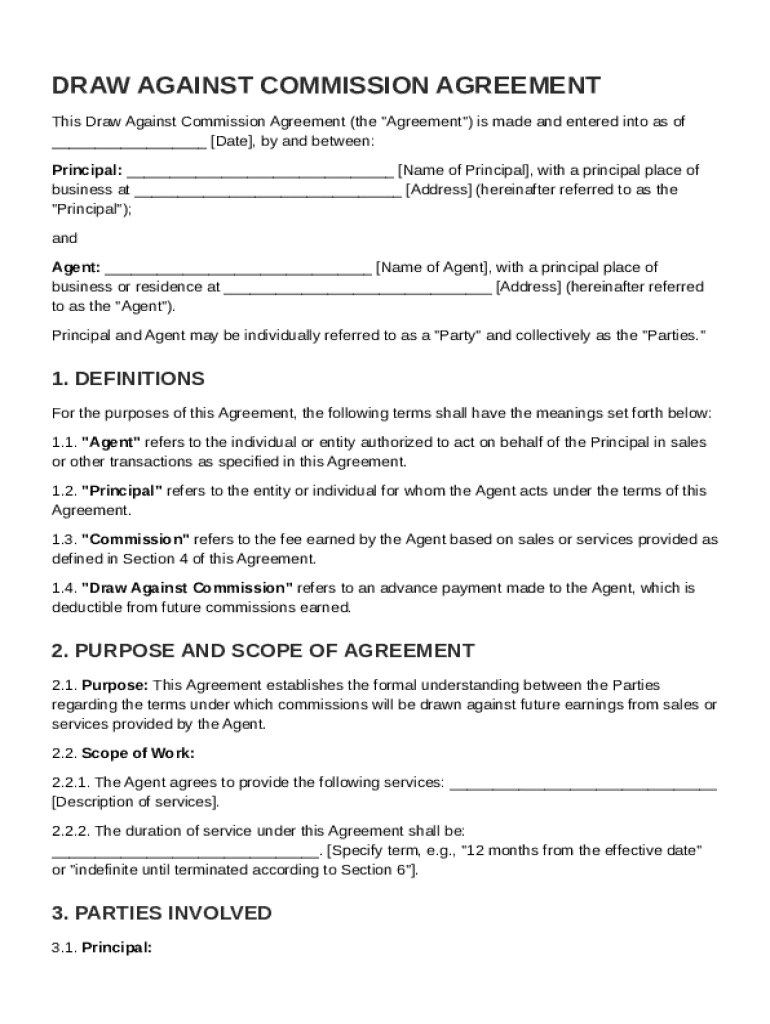







Definition & Meaning
A Draw Against Commission Agreement is a legal document that defines the contractual relationship between a Principal and an Agent. This agreement primarily covers the terms related to advance payments made by the Principal to the Agent based on expected future sales or services. It serves as a baseline for setting expectations, responsibilities, and obligations for both parties involved. A key purpose of this agreement is to establish that the Agent acts as an independent contractor rather than an employee, thereby delineating the nature of their professional relationship.
Examples of Situations
- Sales Representatives: Often used when a sales representative receives an initial draw against their commissions, providing them with a stable income for a period.
- Marketing Consultants: Independent consultants may use this agreement when receiving upfront commission advances for future service contracts.
Key Elements of the Draw Against Commission Agreement Template
The structure of this agreement includes crucial components to ensure clear, mutual understanding and legal compliance. These elements form the backbone of the document and are essential for its effectiveness.
Primary Sections
- Commission Structure: Outline the percentage or formula used to determine commission eligibility.
- Repayment Terms: Define how and when the draws against commissions are to be repaid.
- Scope of Work: Specify the tasks and responsibilities expected from the Agent.
- Termination Clauses: Detail conditions under which the agreement can be terminated by either party.
- Dispute Resolution: Provide mechanisms for resolving any issues that may arise from the agreement.
- Miscellaneous Provisions: Cover additional contractual obligations, restrictions, or permissions pertinent to the agreement.
Practical Implementation
- Advance Payments: Clearly state the schedule and amount of any advance payments.
- Confidentiality Requirements: Highlight any confidentiality obligations regarding sensitive information exchanged between parties.
How to Use the Draw Against Commission Agreement Template
Implementing this template effectively requires understanding its elements and ensuring correct application in practice.
Step-by-Step Utilization
- Download the Template: Obtain the correct version that aligns with your state's requirements.
- Review Context: Understand the specific business scenario and objectives for both parties.
- Customize Terms: Adjust the clauses to reflect the agreed terms on commissions and draw repayments.
- Legal Review: Consult with a business attorney to ensure legal sufficiency and compliance.
- Finalize and Execute: Both parties should review and sign the final document.
Real-World Example
- A sales agency might use this template to formalize agreements with multiple agents, detailing specific commission and draw structures for each.
Who Typically Uses the Draw Against Commission Agreement Template
This template is primarily utilized by businesses or individuals who engage contractors to perform sales or service-related tasks. These entities often seek to incentivize high-performance levels without assuming full employment responsibilities.


Common Users
- Entrepreneurs & Startups: Use this setup when hiring new sales teams to promote their offerings.
- Freelance Professionals: Agents looking to formalize terms with their clients frequently use such templates.
- Corporations: Larger entities might adopt this agreement when dealing with commissioned agents or brokers.

Legal Use of the Draw Against Commission Agreement Template
The legal effectiveness of this document depends on adherence to relevant laws and incorporation of vital legal clauses.
Compliance Considerations
- ESIGN Act: Ensure that electronic signatures within the agreement are legally binding as per federal law.
- Independent Contractor Status: Properly classify agents to avoid misclassification issues.
Example of Legal Usage
A high-end retail company might employ this template to formalize relationships with independent sales agents, addressing commission-based rewards while maintaining legal independence.
Important Terms Related to Draw Against Commission Agreement Template
Understanding specific terms is essential for all parties involved in ensuring clear interpretation and avoiding disputes.
Key Terminologies
- Agent: The individual or entity receiving the commission for services or sales.
- Principal: The party providing the draw, responsible for setting sales targets and paying commissions.
- Draw: The advance payment against expected future commissions.
- Commission: The monetary reward based on performance metrics, such as sales volume.
Steps to Complete the Draw Against Commission Agreement Template
Filling out this template correctly involves careful attention to detail and clarity in defining terms.
Detailed Procedure
- Identify Parties: Clearly state the names and contact information of both Principal and Agent.
- Define Terms: Specify the commission percentage and payment schedule.
- Incorporate Clauses: Introduce confidentiality, termination, and dispute resolution clauses.
- Legal Validation: Optionally, have the document reviewed by legal counsel.
- Sign and Date: Ensure all parties sign and date the agreement.
Implementation Example
An Agent negotiating for additional marketing responsibilities might specifically outline new commission rates and expand the scope of work in their agreement.
State-Specific Rules for the Draw Against Commission Agreement Template
Different states may have unique requirements or standards impacting the usage and provisions of this agreement.
Variations by State
- California: Requires clear distinctions between employees and independent contractors, impacting draw structures.
- Texas: Subscribes to specific regulations around repayment terms for draws against commissions.
Tips for Compliance
- Research state-specific laws to incorporate appropriate clauses.
- Consider consulting with lawyers familiar with local employment and contract laws.




