






Key Elements of the Software Developer Contract Template
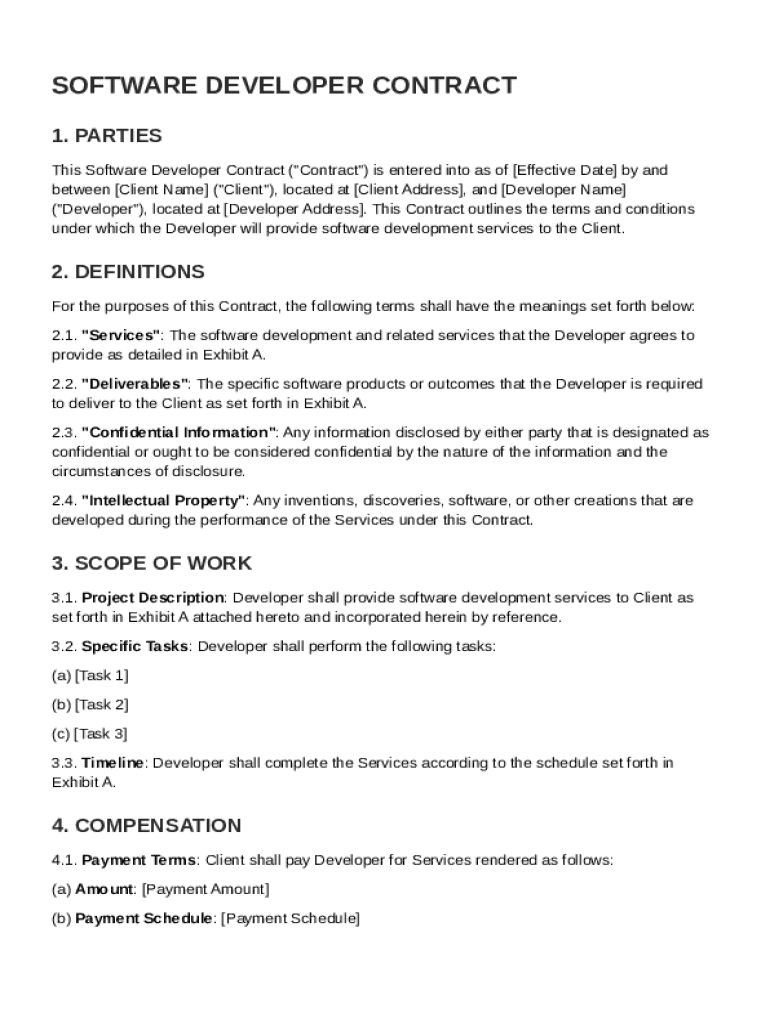
A Software Developer Contract Template is a critical document that outlines the framework for a professional relationship between a client and a developer. It includes several key elements to ensure a comprehensive understanding of roles, responsibilities, and expectations.
-
Scope of Work: This section details the specific tasks and deliverables that the developer will complete. It provides a clear framework of the project goals and milestones, ensuring both parties are aligned on the expected outcomes.
-
Compensation Details: Compensation is thoroughly covered, including payment schedules, rates, and any conditions for billing. This ensures clarity on financial terms to avoid disputes during the contract term.
-
Ownership and Intellectual Property Rights: Clearly defines the intellectual property ownership, specifying whether the developer or the client retains rights to the software and associated works. This section is essential to protect both parties' interests concerning the project's creations.
-
Confidentiality Obligations: Outlines the requirement for both parties to keep certain information confidential. This section protects sensitive data, trade secrets, and proprietary information essential to the software project.
-
Warranties and Representations: This section covers any guarantees or commitments made by the developer concerning the quality and functionality of the software. It provides a basis for the client to hold the developer accountable for the deliverables.
-
Termination Conditions: Describes the circumstances under which either party may terminate the contract. It often includes clauses related to the breach of agreement, project delays, or other significant issues that might arise.
-
Indemnification Clauses: Protects each party from legal claims that may result from the project's execution. Indemnification clauses ensure both the client and developer are clear about the liabilities involved in the project.
-
Governing Law and Dispute Resolution: Specifies the legal jurisdiction and processes for resolving disputes. This section ensures any legal proceedings are conducted under agreed-upon rules and locations, simplifying the resolution process.
Important Terms Related to Software Developer Contract Template
Understanding the terminology used in a Software Developer Contract Template is crucial for both parties involved. Below are some important terms to consider:
-
Deliverables: These are the tangible outputs the developer commits to providing. This term is vital for tracking project progress and ensuring that all objectives are met.
-
Milestones: Specific targets within the project timeline that signify the completion of a significant phase of the project. Milestones help in managing the project's schedule and finances.
-
Non-Disclosure Agreement (NDA): A legal contract to keep shared information confidential. NDAs are often included to protect sensitive information related to the project.
-
Force Majeure: Refers to unforeseeable circumstances that prevent someone from fulfilling a contract. This clause absolves parties from liability if an event beyond their control impedes contract execution.
-
Liability Limitation: This term caps the extent to which a party can be held accountable for damages, acting as a risk mitigation measure.
Who Typically Uses the Software Developer Contract Template
A Software Developer Contract Template is utilized by various professionals and entities to formalize engagements related to software creation, ranging from freelance developers to large organizations:
-
Freelance Developers: Independent professionals who need a formal agreement with clients to outline project scope, payment terms, and client expectations.
-
Software Development Firms: Companies that provide software development services often use this template to standardize their contracts with clients.
-
Start-ups: Emerging businesses that need specialized software or applications for their operations prefer using these contracts to ensure clear communication and expectations.
-
Businesses Outsourcing Development: Organizations that do not have in-house software development capabilities may use this contract when outsourcing work to external developers.

How to Use the Software Developer Contract Template
Utilizing the Software Developer Contract Template effectively involves several steps, ensuring that all details are meticulously considered and addressed:
-
Initial Review: Examine the template thoroughly to ensure it aligns with the specific needs of your project, identifying any missing elements or clauses.
-
Customization: Modify sections as necessary to accurately reflect the project details, such as the scope of work, and other domain-specific requirements.
-
Consultation: Consider seeking legal advice to ensure the contract is compliant with applicable laws and includes all legal protections necessary for your context.
-
Collaborative Review: Share the draft with the other party involved before finalizing to ensure both parties have a mutual understanding of all contract elements.
-
Agreement and Signature: Once all parties are satisfied with the terms, each should sign the document, cementing the agreement and making it legally binding.
Legal Use of the Software Developer Contract Template
To ensure the legality and enforceability of a Software Developer Contract Template, certain legal considerations and best practices should be followed:
-
Compliance with Local Laws: The contract must comply with the local jurisdiction's laws where it is being executed. This includes observing any specific legal requirements for contract validity in that state or region.
-
Clear and Unambiguous Language: Use precise language to avoid misunderstandings. This includes defining any industry-specific jargon or terms used within the agreement.
-
Mutual Consent: Both parties should willingly agree to the contract terms without any coercion, ensuring that it reflects their genuine agreement.
-
Legal Review: A lawyer's review can provide crucial insights into potential legal pitfalls, safeguarding against unwittingly entering into unfavorable terms.
-
Proper Execution: Ensure that the signatures are collected correctly and that the document is dated appropriately to validate the contract's execution date.
Steps to Complete the Software Developer Contract Template
Completing a Software Developer Contract Template requires attention to detail and a methodical approach to fill in all necessary sections comprehensively:
-
Gather Required Information: Collect all necessary project details, such as timelines, scope, compensation, and parties involved.
-
Fill in Modular Sections: Complete each section of the template with corresponding information, ensuring clarity and precision.
-
Cross-Verification: Review each completed section for accuracy, ensuring alignment with the overall project goals and terms agreed upon.
-
Legal Considerations: Make necessary adjustments as per legal reviews to include recommended clauses or modifications.
-
Final Review: Conduct a thorough review with all parties involved to capture any missing elements or points of contention.
-
Sign and Execute: Once finalized, ensure all parties sign the document in the presence of necessary witnesses, if required.
-
Distribution and Safekeeping: Distribute copies to the relevant parties and keep a securely stored version for future reference.
By taking these steps, the integrity of the Software Developer Contract Template can be maintained, and its enforceability assured, providing a solid foundation for the developer-client relationship.
State-Specific Rules for the Software Developer Contract Template
When drafting or using a Software Developer Contract Template, understanding state-specific rules is essential for legal compliance and clarity:
-
Jurisdictional Variances: Different states have unique regulations on contracts, including execution, interpretation, and enforcement. It’s critical to customize the contract to address these state-specific legal nuances.
-
Digital Signing Laws: While electronic signatures are generally valid, states may have distinct requirements or exceptions that need to be followed closely.
-
Intellectual Property Considerations: States can vary in their handling of intellectual property rights in contracts, making it important to adapt the respective sections according to the applicable state laws.
-
Minimum Wage and Labor Laws: For compensation terms, ensure that state-mandated wage standards are respected, including any applicable labor regulations.
-
Dispute Resolution Protocols: Some states might prefer or mandate specific dispute resolution processes, such as arbitration or mediation, over traditional litigation.
Examples of Using the Software Developer Contract Template
Practical examples illustrate how a Software Developer Contract Template can be a vital tool for various real-world applications:
-
Start-Up Collaborations: A start-up needing a custom app developed uses the template to clearly outline deliverables, thus reducing the risk of misaligned expectations.
-
Freelancer Engagement: A freelance developer maintaining an existing system can use the template to secure compensation details and project scope with a startup client.
-
Large-Scale Projects: An established corporation contracting a development firm for an enterprise solution utilizes the template to manage intellectual property rights and establish clear confidentiality terms.
-
Prototype Development: Innovators employing developers to create an early-stage product can benefit from the template by defining clear milestones and ownership rights to manage project evolution and protect intellectual property.