01. Edit your form online
Type text, add images, blackout confidential details, add comments, highlights and more.

Type text, add images, blackout confidential details, add comments, highlights and more.

Draw your signature, type it, upload its image, or use your mobile device as a signature pad.

Send it via email, link, or fax. You can also download it, export it or print it out.
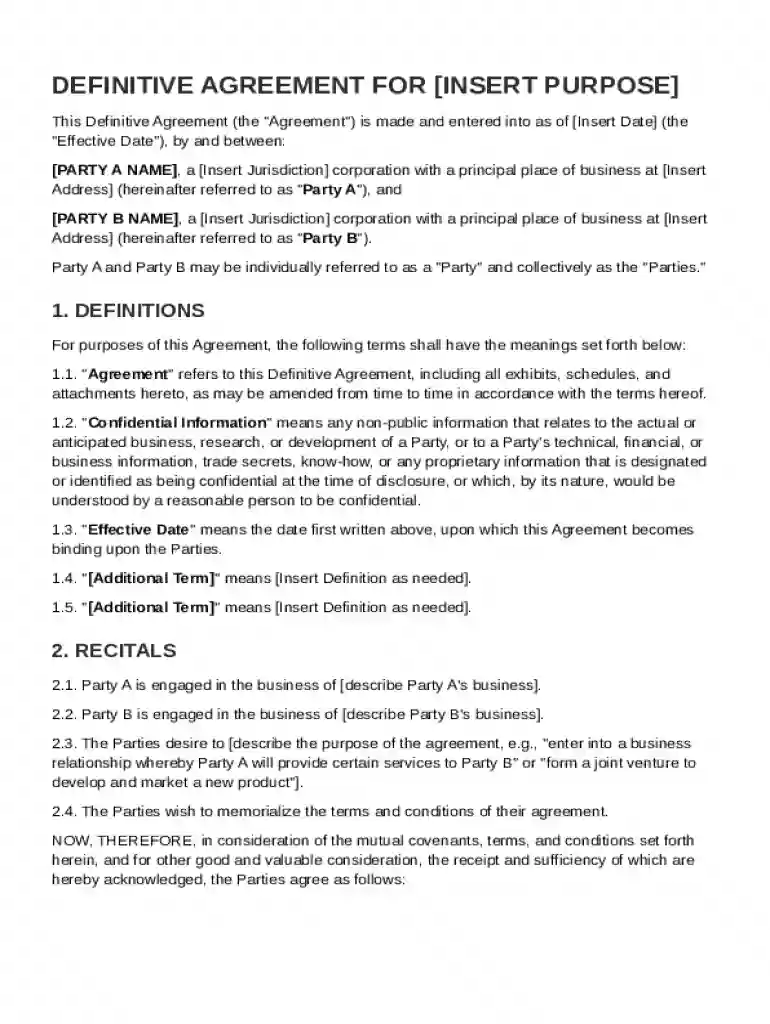
A Definitive Agreement Template serves as a detailed contract that formalizes a business relationship between two parties. This document outlines the terms and conditions, including definitions, the scope of services, confidentiality obligations, payment terms, and dispute resolution procedures. It ensures mutual understanding, protecting both parties by clearly defining their rights and responsibilities. For instance, a technology firm and a client company might use this template to delineate service expectations and payment schedules.
The template is composed of several essential sections:
Before using the template, gather all necessary information regarding the parties involved, specific terms of the agreement, and supplementary documents. Understanding the exact needs and expectations of each party will guide the completion of the form. For example, if a construction business negotiates a new job, detailed plans would be critical.
In the United States, definitive agreements must comply with both federal and state laws. It's important to consult legal experts to account for all jurisdictional obligations, such as state-specific disclosures that may be required in a business contract. For instance, California might require different consumer protection language than New York.
A major benefit of using a platform like DocHub is the inclusion of electronic signatures that are compliant with the ESIGN Act, ensuring that digitally signed agreements have the same legal standing as their paper counterparts. This facilitates quicker transactions and broadens the geographical reach of the agreement process.
For a definitive agreement to be robust, it should encompass:
DocHub supports integration with Google Workspace, making it easier to import and export agreements from Google Drive. This seamless connectivity improves workflow efficiency, especially for businesses heavily reliant on Google's services. Additionally, the platform's compatibility with DOC, PPT, XLS, and TXT formats further enhances its versatility.
With DocHub, multiple stakeholders can collaborate on a document in real time. This is especially useful for companies needing simultaneous input from legal, financial, and operational teams. Each participant can comment or suggest edits without disrupting document flow, ensuring the latest version is always accessible to all parties.
While the core elements of the definitive agreement are consistent, states can have varying requirements or interpretations. For instance, due to local employment laws, a company operating in Texas may have different clauses related to workforce management than one in Illinois. Consulting a local attorney ensures adherence to these nuances.
Each state's business laws may affect confidentiality clauses and employee-related provisions. California, with its strong focus on consumer privacy, may require additional confidentiality commitments. It's essential to be aware of these differences and integrate them into the agreement to avoid legal conflicts.
Consider a scenario where a software firm enters into a definitive agreement with a healthcare provider for system integration. This template would include specific deliverables like data migration, system uptime guarantees, and training schedules. The agreement would also adopt stringent confidentiality clauses to safeguard patient information under HIPAA regulations.
Examining previous definitive agreements can provide insight into effective clause structuring and potential pitfalls. Companies often iterate on these templates based on what worked well in past negotiations or what lacked clarity. Real-world examples also highlight the importance of clear amendment procedures and termination rights to handle unexpected changes in circumstances.
By focusing on these aspects, stakeholders can craft a comprehensive and legally sound definitive agreement, tailored to their specific business needs while ensuring compliance with applicable laws.
At DocHub, your data security is our priority. We follow HIPAA, SOC2, GDPR, and other standards, so you can work on your documents with confidence.