




01. Edit your form online
Type text, add images, blackout confidential details, add comments, highlights and more.

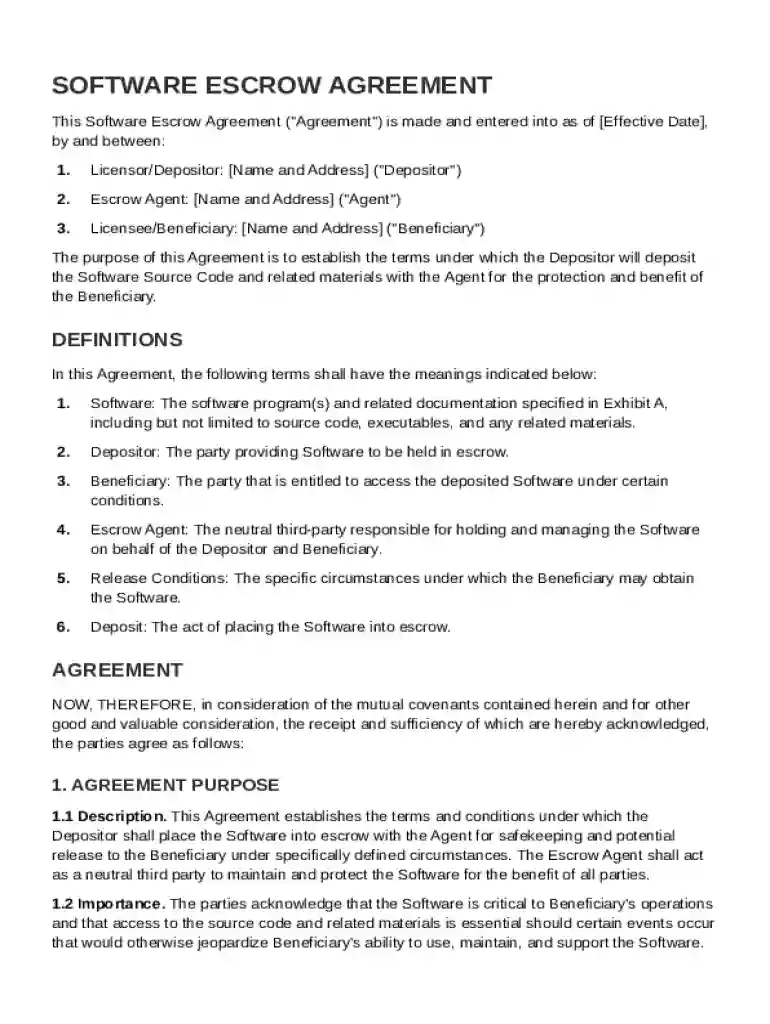
Type text, add images, blackout confidential details, add comments, highlights and more.

Draw your signature, type it, upload its image, or use your mobile device as a signature pad.

Send it via email, link, or fax. You can also download it, export it or print it out.
A Software Escrow Agreement is a legally binding contract that involves three main parties: the software developer or vendor (Depositor), the beneficiary or client who obtained the license (Beneficiary), and the independent third-party escrow service (Escrow Agent). This arrangement ensures that the source code and related materials are securely held by the Escrow Agent. In situations where the Depositor fails to uphold the contractual obligations, such as providing updates or maintaining support, the Escrow Agent releases the source code to the Beneficiary. The agreement typically includes detailed provisions on the circumstances that trigger the release, confidentiality terms, and conditions for termination.
In the United States, a Software Escrow Agreement serves to protect the interests of both software vendors and licensees. It provides legal assurance that the Beneficiary can access crucial source code if the Depositor fails to meet their obligations. This agreement must comply with federal and state-level regulations, ensuring legal enforceability. Furthermore, adhering to standards such as the ESIGN Act for electronic signatures enhances its legal validity. Given its legal implications, the Agreement should be drafted or reviewed by legal professionals specialized in software and intellectual property law to mitigate risks related to disputes.
The primary users of a Software Escrow Agreement Template include software developers, organizations relying on third-party software for critical operations, and professional escrow services. Companies often use these agreements when they invest in custom software solutions critical to their business functions. Government agencies and large corporations are frequent Beneficiaries, requiring robust assurance that they can maintain operational continuity if the software vendor fails to deliver updates or support.


Certain states in the U.S. may have additional requirements or variations in enforcement standards for software escrow agreements. For instance, California emphasizes strong consumer protection laws, which could influence terms related to release conditions and warranties. Businesses must verify compliance with their specific state's legislation to ensure that their escrow agreements are enforceable. Consulting legal experts specializing in state-specific contract law is advisable to include any necessary state-mandated clauses.
While the standard template provides a basic framework, businesses may opt for customized agreements that accommodate unique needs, such as including specific performance benchmarks or user agreements. Additionally, alternatives like multi-party escrow arrangements or international escrow contracts can be utilized for more complex scenarios involving numerous stakeholders or cross-border software transactions. These variants address specialized requirements that standard templates may not comprehensively cover, ensuring tailored legal protection.
At DocHub, your data security is our priority. We follow HIPAA, SOC2, GDPR, and other standards, so you can work on your documents with confidence.

May 8, 2014 Subscribers are required to sign a Subscriber agreement regarding the usage of an issued TLS Certificate in accordance with CP/CPS. 4.2
Licensee warrants and covenants that it will not, directly or indirectly, export nor re-export the Licensed Products (including any associated products, items,


