




01. Edit your form online
Type text, add images, blackout confidential details, add comments, highlights and more.

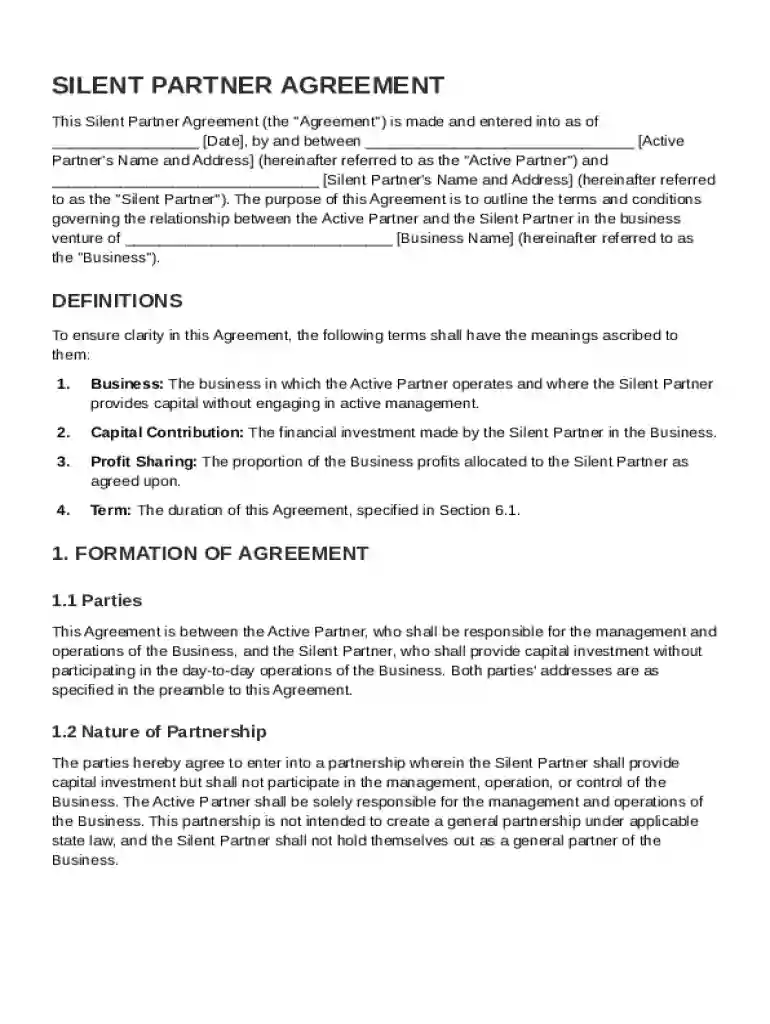
Type text, add images, blackout confidential details, add comments, highlights and more.

Draw your signature, type it, upload its image, or use your mobile device as a signature pad.

Send it via email, link, or fax. You can also download it, export it or print it out.
A Silent Partner Agreement Template is a legal document that establishes the relationship between an active partner responsible for managing a business and a silent partner who invests capital. It outlines the roles, responsibilities, and expectations of both parties. This agreement clarifies the distinction between an investor and a manager by defining key elements such as capital contributions, profit-sharing, and limited engagement in management activities for the silent partner. This arrangement facilitates a clear understanding of each partner's rights and obligations while protecting their respective interests, ensuring a smooth business operation.
The agreement specifies how much each partner contributes to the business and determines the percentage of profits allocated to each party. This section is crucial as it sets the financial foundation of the partnership, ensuring that contributions are recognized and returns are fairly distributed. Disputes on financial matters can significantly affect partnerships, so clearly defining these terms is crucial for preserving a harmonious relationship.
This clause outlines the active partner’s exclusive rights and responsibilities in managing the business operations. The silent partner's role typically excludes management duties, maintaining their involvement solely as a financial participant. Clarity in this section helps streamline decision-making by limiting potential interference from non-managing partners, which is essential for an efficient and unified management process.
To safeguard business interests, the agreement often includes a confidentiality clause to protect sensitive business information from unauthorized disclosure. Indemnification clauses serve to protect partners from liabilities incurred by the other during business activities. These provisions are vital in protecting proprietary information and personal assets against unexpected legal or financial burdens.
Identify Parties: Clearly list the names and roles of the silent and active partners involved in the agreement.
Specify Contributions: Detail the capital or resources each partner will provide to ensure business financing and operations are adequately supported.
Define Profit Sharing: Establish how profits and losses will be shared, ensuring that each partner's financial interests are fairly represented.
Outline Roles and Responsibilities: Clearly delineate management duties assigned to the active partner, while the silent partner maintains a non-interfering stance.
Incorporate Legal Protections: Include clauses for confidentiality, indemnification, and dispute resolution methods to address potential disagreements amicably.
Finalize and Sign: Both parties should review the completed document thoroughly, ensuring all terms are clearly understood before signing to bring the agreement into legal effect.
These terms help in establishing a strong foundation for understanding and engaging with the specifics of the silent partnership arrangement.
In the United States, silent partner agreements must comply with federal and state laws governing partnership agreements. They serve not only to document the business relationship but also to protect the interests of both parties by providing a legally binding framework. Silent partnerships can appeal to investors seeking passive income options while benefiting from business growth, whereas managers can leverage external capital without surrendering control over daily operations. Consulting with a legal expert to ensure compliance with jurisdictional regulations is advisable during the drafting and execution of the agreement.
These user profiles highlight the strategic advantage of silent partnerships in various business contexts, catering to both emerging and mature enterprises.


SMEs often require additional capital injections to expand their operations or enter new markets. Silent partners provide financial backing without influencing business decisions, allowing SMEs to grow under the direction of experienced active partners.
Start-ups benefit significantly from silent partners who provide the necessary resources to scale quickly, whether it's through development, marketing, or operational expansion. The streamlined decision-making process helps maintain agility and innovation, which are often critical in the early stages.
In family-operated companies, bringing in a silent partner can inject capital while maintaining control within the family. This arrangement can balance resource needs and preserve family governance, making it a practical solution for growth initiatives.
At DocHub, your data security is our priority. We follow HIPAA, SOC2, GDPR, and other standards, so you can work on your documents with confidence.



The address of each partner is set under his signature at the end of this Agreement, and each partner agrees to notify the Partnership of any change of address.
Grandstream has a reseller agreement with our reseller customers. If you have purchased our products through a Grandstream Certified. Partner or Reseller,


