




01. Edit your form online
Type text, add images, blackout confidential details, add comments, highlights and more.

Type text, add images, blackout confidential details, add comments, highlights and more.

Draw your signature, type it, upload its image, or use your mobile device as a signature pad.

Send it via email, link, or fax. You can also download it, export it or print it out.
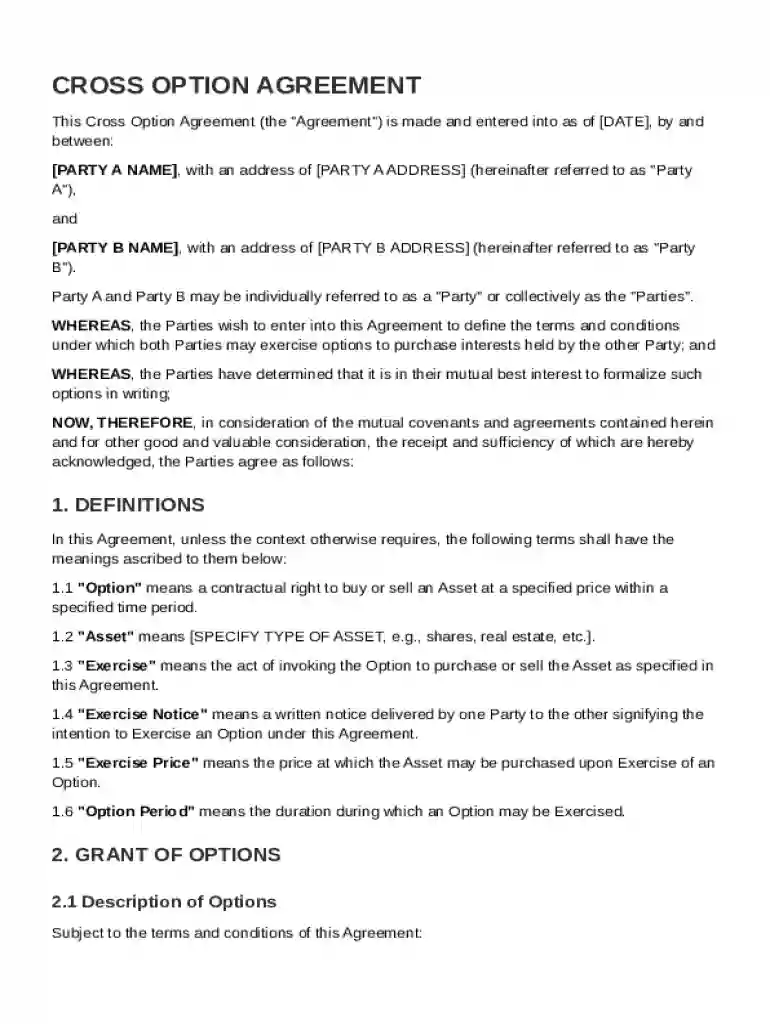
A Cross Option Agreement is a legal contract between two parties that facilitates the reciprocal right to purchase assets held by each party. This agreement is fundamental for businesses and individuals wishing to protect their interests through buy-sell provisions. It is commonly utilized in partnership dissolutions or when owners need to ensure continuity without the disruption of outside influence. The document clearly delineates crucial terms like 'Option', 'Asset', and 'Exercise', setting the groundwork for each party's rights and obligations under specified conditions and timelines.
The Cross Option Agreement Template includes several core components ensuring a comprehensive understanding of the parties' contractual relationship. These elements encompass:
Utilizing the Cross Option Agreement Template involves several steps to customize the document according to specific needs. First, both parties should review the template to understand the terms and structure fully. Adjustments can then be made to suit particular circumstances, such as modifying the options or updating the payment terms. Every amendment should reflect mutual agreement, and signatures are required to validate the final document. It's highly recommended to consult with a legal professional to ensure compliance and address any nuances relevant to the specific jurisdiction or situation.
Completing the Cross Option Agreement Template involves a detailed yet straightforward process:
The Cross Option Agreement Template is employed in various legal contexts, providing a structured method to safeguard asset transactions. Primarily used by businesses, it serves as a preemptive measure to manage ownership transitions smoothly, often in inheritance situations or when one partner decides to exit a company. The legally binding nature underscores the importance of thoroughness and clarity, as this agreement often dictates the terms of significant financial transactions. As such, legal counsel is typically sought to ensure all aspects adhere to applicable laws.
Understanding key terminology within the Cross Option Agreement Template is essential for effective utilization:
This template is predominantly used by business partners, stakeholders in joint ventures, and family businesses. It is particularly beneficial for partnerships where continuity is crucial, and decisions regarding asset transfers need clarity and pre-determined procedures. The agreement's detailed documentation and binding terms provide reassurance to any involved party that their interests will be safeguarded, whether they're buying or selling.


While the Cross Option Agreement is broadly similar across the United States, specific state laws can impact its application, particularly in relation to taxation, asset valuation, and enforceability of certain clauses. Each state may have unique regulations regarding the legal formalities required for such agreements. Therefore, it is advisable to align the agreement with state-specific legal advice to ensure full compliance and prevent any enforceability issues down the line.
Consider a family-run business where two siblings are co-owners. A Cross Option Agreement can outline terms under which one sibling can acquire the other's share in the event of retirement. Similarly, in a small tech startup, partners may use this agreement to preemptively manage buyout possibilities if one decides to exit. Real-world scenarios like these demonstrate the template's versatility in safeguarding interests and ensuring smooth transitions.
At DocHub, your data security is our priority. We follow HIPAA, SOC2, GDPR, and other standards, so you can work on your documents with confidence.



This guide provides the conventions for writing the Federal Acquisition. Regulation (FAR). The guide addresses guidelines for clear writing; structure and.
This is an Exclusive License Agreement between Ohio State Innovation Foundation (OSIF) and a Licensee, where OSIF licenses technology for public benefit and


