




01. Edit your form online
Type text, add images, blackout confidential details, add comments, highlights and more.

Type text, add images, blackout confidential details, add comments, highlights and more.

Draw your signature, type it, upload its image, or use your mobile device as a signature pad.

Send it via email, link, or fax. You can also download it, export it or print it out.
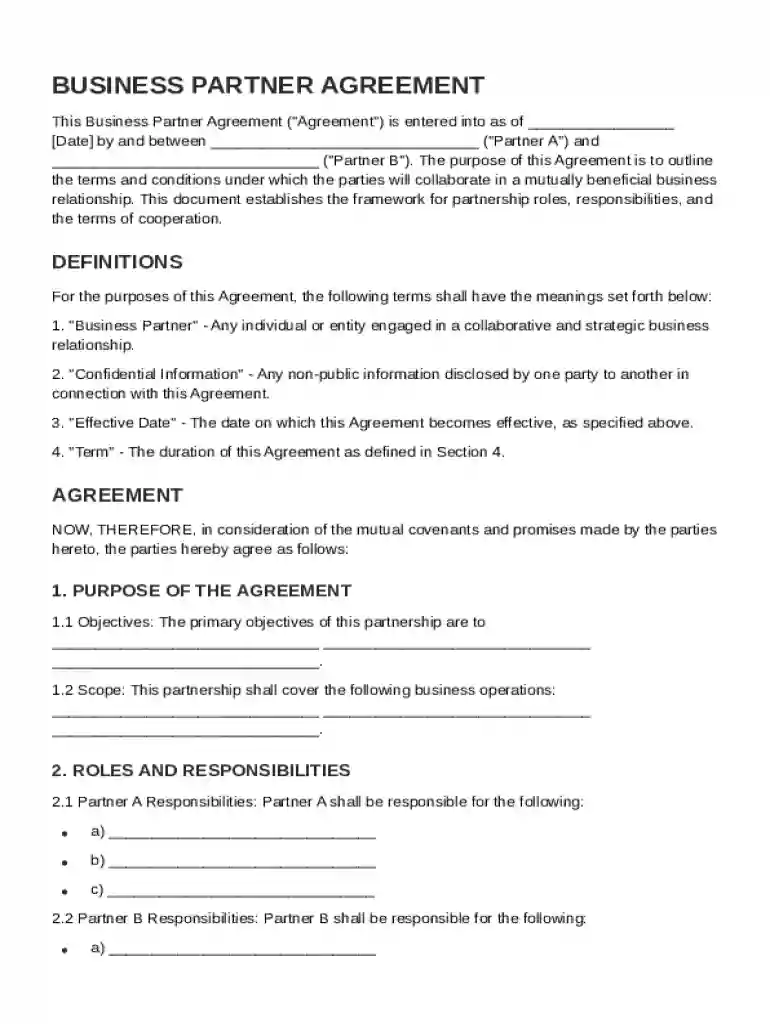
A Business Partner Contract Template is a formal document designed to outline the terms and conditions of a collaboration between two parties in a business setup. These parties, commonly referred to as Partner A and Partner B, use this template to define their mutual understanding of roles, responsibilities, financial contributions, profit sharing, confidentiality, and other vital elements of their agreement. By clearly laying out these aspects, the template helps avoid misunderstandings and provides a clear path for dispute resolution. The template serves as a foundational document, ensuring both parties operate under a common framework, thus facilitating a harmonious business relationship.
A comprehensive Business Partner Contract Template typically includes several core components:
Understanding specific legal terminology is crucial when crafting or interpreting a Business Partner Contract Template. Important terms include:
The Business Partner Contract Template is legally binding and ensures compliance with applicable business laws. It aligns with the Uniform Partnership Act followed in many U.S. states, which provides a statutory framework for partnerships. The template must be drafted to reflect all legal standards to uphold its enforceability in a court of law. In drafting such agreements, parties should be aware of legal stipulations that might affect the structuring of the contract, including necessary signatures, consent, and understanding by all involved parties.
This template serves as an integral tool for a wide array of business entities, including but not limited to:


State regulations can significantly impact the contents and requirements of a Business Partner Contract Template. For example:
Understanding these differences is crucial for ensuring compliance and protecting the interests of all parties involved under the jurisdiction in which they operate.
While both digital and paper versions serve the same legal purpose, each has its own advantages:
In both formats, ensuring accuracy, thoroughness, and security is paramount, whether the contract is stored physically in a secured location or digitally with robust encryption.
These sections are designed to comprehensively cover all relevant aspects and nuances of the Business Partner Contract Template, providing stakeholders with information necessary to use, draft, and understand the template effectively. Each section includes detailed explanations, real-world examples, and specific sub-topics to maximize utility.
At DocHub, your data security is our priority. We follow HIPAA, SOC2, GDPR, and other standards, so you can work on your documents with confidence.
The address of each partner is set under his signature at the end of this Agreement, and each partner agrees to notify the Partnership of any change of address.
This Partner Agreement, consisting of this Cover Page and the attached Business Terms. (collectively, this Agreement) is made and entered into by and


