
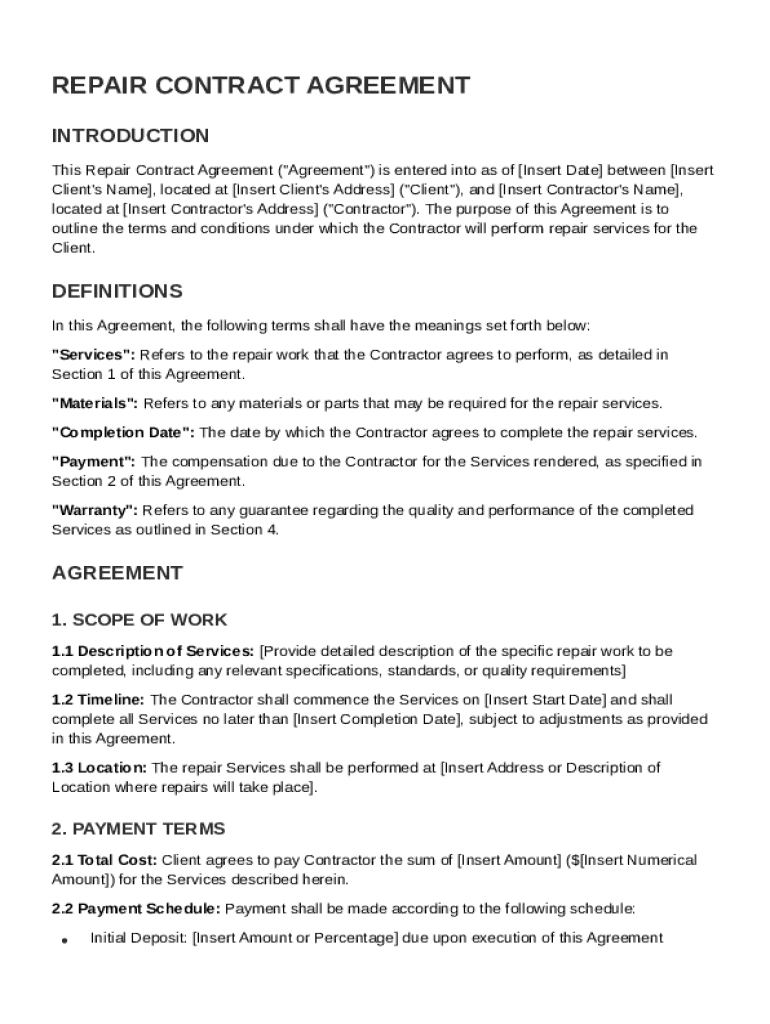







Definition & Meaning
A Repair Contract Template is a structured document that outlines the terms and conditions agreed upon by a client and a contractor for the completion of repair services. This form acts as a legal agreement that defines the relationship, responsibilities, and expectations of both parties involved. It details various elements such as the scope of work, compensation, timelines, and liabilities. Utilizing a contract template helps in standardizing agreements, ensuring mutual understanding, and providing legal protection to both parties.
The Repair Contract Template serves as a comprehensive framework, minimizing misunderstandings by clearly articulating all relevant aspects of a repair agreement. It typically includes definitions of various contractual terms, enabling both parties to have a shared understanding. This document is crucial for both residential and commercial repairs, providing a formal mechanism to resolve disputes should they arise. Comprehensive and legally sound, the template safeguards interests and maintains professional integrity.
How to Use the Repair Contract Template
Using a Repair Contract Template involves a step-by-step approach to ensure completeness and accuracy. First, download or acquire the template from a reputable source. Next, personalize the sections to reflect the details of the specific repair project, including the names of the parties involved, the detailed description of repair work, timelines, and compensation terms.
- Review Template Structure: Familiarize yourself with the template’s sections to ensure all critical areas are covered.
- Customize Fields: Enter specific information relevant to the repair job, such as the contractor's details, client's name, and addresses.
- Define Scope of Work: Clearly outline the tasks included and excluded in the project, providing precise details on the services expected.
- Set Payment Terms: Specify the agreed payment schedule, method of payment, and any advance payments or deposits required.
- Include Liability Clauses: Ensure responsibilities, obligations, and liability limitations are well-articulated to avoid future disputes.
- Review and Sign: After personalization, both parties should thoroughly review the contract, make amendments if necessary, and sign it to seal the agreement.
Steps to Complete the Repair Contract Template
Completing a Repair Contract Template effectively involves several steps. Each step requires careful consideration to ensure accuracy and mutual agreement:
- Gather Necessary Information: Obtain detailed information from both the client and the contractor, including contact details and job specifications.
- Scope of Work Documentation: Document all repair activities, specifying materials, tools, and methods intended for use.
- Finalize Financial Terms: Discuss and finalize payment schedules, fees, and terms. Ensure transparency to prevent misunderstandings.
- Agreement Review: Both parties should review the document, ensuring that all terms are clear and mutually agreed upon.
- Amendments and Approval: Make any needed amendments based on feedback from either party before final approval.
- Signatures and Date: Once all sections are complete and reviewed, both parties should sign and date the document to validate the agreement.
Key Elements of the Repair Contract Template
Key elements integral to the Repair Contract Template ensure a clear and enforceable agreement. These components include:
- Party Identification: Full names and contact details of both the client and the contractor.
- Scope of Work: A precise description of the repair services, including what is and isn't covered.
- Payment Terms: Detailed terms regarding payment amount, schedule, and accepted payment methods.
- Duration and Timeline: Start and end dates for the project, along with any important milestones.
- Warranties and Liabilities: Information on warranties offered by the contractor and limit of liabilities in case of discrepancies or defects.
- Termination Clause: Conditions under which the contract can be terminated by either party.
- Dispute Resolution: Processes to be followed should a conflict arise, generally including mediation or arbitration options.
State-Specific Rules for the Repair Contract Template
The Repair Contract Template may vary depending on state-specific legal requirements. Each state might have unique regulations regarding contractor licensing, insurance, and consumer protections, impacting how a contract should be drafted.
- Licensing Requirements: Certain states mandate specific licenses for contractors to legally conduct repair jobs.
- Insurance Obligations: Some regions require contractors to carry specific types of insurance, like liability insurance, to protect clients.
- Consumer Protection Laws: Rules that protect clients from unfair practices; these laws might necessitate disclosures or specific contract language.
Understanding and incorporating state-specific rules can prevent legal mistakes and ensure the contract is enforceable.
Legal Use of the Repair Contract Template
The Repair Contract Template acts as a legally binding document once both parties have signed it. Ensuring that the template complies with applicable laws is crucial for its enforceability. To use the template legally, parties must verify that:
- The Template Covers All Legal Requirements: Including necessary disclosures, terms, and conditions.
- Both Parties Are Competent: Signatories must be of legal age and sound mind to enter a contract.
- The Purpose is Legal: The work defined in the agreement must be legal.
Furthermore, the terms should be fair, with a clear outline of each party's responsibilities and expectations, maintaining transparency and integrity throughout the contract.
Examples of Using the Repair Contract Template
Real-world examples of how a Repair Contract Template can be used include various repair contexts, like:
- Home Repairs: Agreements for roof repairs, plumbing services, or electrical work, offering homeowners protection and clarity.
- Commercial Property Maintenance: Contracts for continuous maintenance or specific repair services in commercial buildings.
- Vehicle Repair Services: Templates used by auto repair shops or freelance mechanics to formalize repair agreements with customers.
Each example represents a different application of the template, showcasing its versatility across various sectors. Detailed documentation helps clarify responsibilities and expectations, thereby reducing the risk of conflicts.
Creating a Smart Repair Agreement
Leveraging the Repair Contract Template into a smart agreement involves using digital tools to enhance understanding and efficiency. Tools like DocHub can transform paper agreements into interactive documents, allowing for easier editing, signing, and management.
- Digital Editing and Signing: Features allow participants to edit document sections collaboratively and sign electronically.
- Storage and Integration: Smooth integration with platforms like Google Drive for managing and sharing contracts.
- Security and Tracking: Ensures documentation of actions and changes, with secure access controls for sensitive information.
Utilizing these techniques ensures contracts are not only thorough but also capable of evolving to meet modern business needs.




