






Definition and Meaning
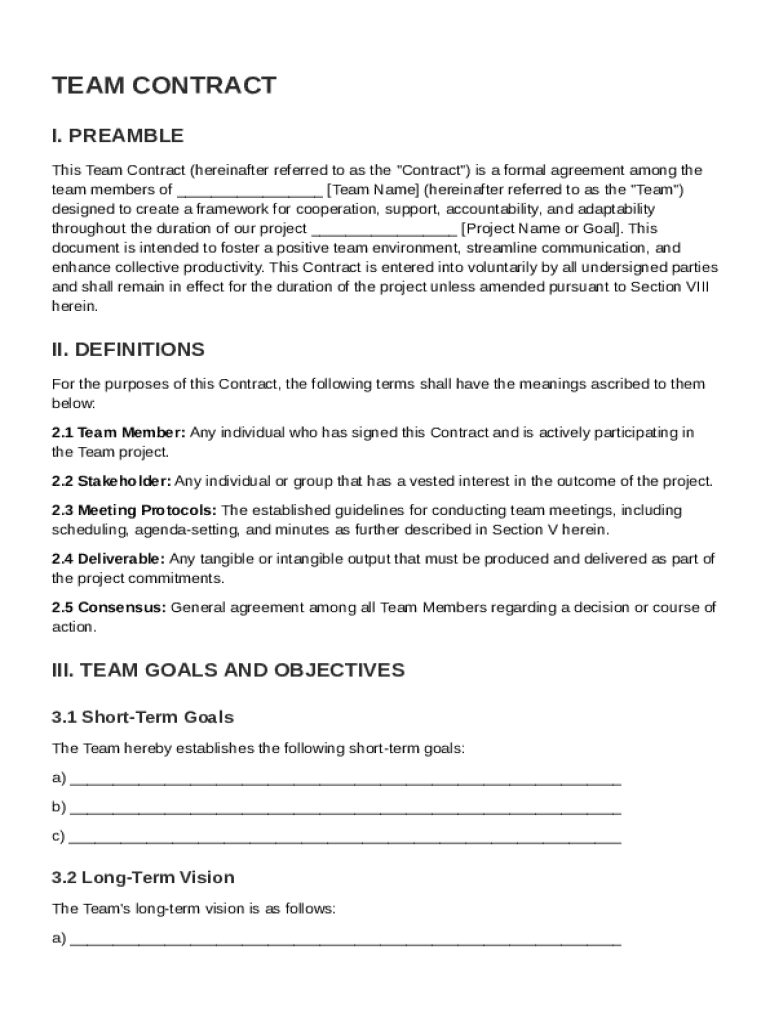
The Team Contract serves as a formal agreement among team members, establishing a structured framework for collaboration, accountability, and effective communication throughout a project. This document outlines critical elements such as definitions of key terms, short-term and long-term objectives, assigned roles, and responsibilities, thereby setting a clear pathway for project execution. The contract also includes guidelines for decision-making, meetings, conflict resolution, and accountability, emphasizing commitment and participation. It often features a provision for reviewing and adapting terms as required to accommodate changing project dynamics.
Key Elements of the Team Contract Template
A comprehensive Team Contract Template includes several key elements essential for effective cooperation within a project team. These elements typically encompass:
-
Roles and Responsibilities: Clearly defined roles ensure that every member understands their individual responsibilities and how they contribute to the larger goals of the project.
-
Goals and Objectives: Both short-term and long-term goals are outlined to provide a clear direction for the team, ensuring that everyone works toward common aims.
-
Communication Protocols: Guidelines for how team members will communicate, including preferred tools, frequency of meetings, and methods for sharing updates.
-
Decision-Making Processes: Agreed procedures for making decisions, which might involve consensus methods or designated decision-makers for specific areas.
-
Conflict Resolution Mechanisms: Strategies for addressing disagreements or conflicts that might arise within the team, including mediation processes or third-party interventions if necessary.
-
Accountability Measures: Methods for tracking progress and holding team members accountable for their contributions to the project.
Steps to Complete the Team Contract Template
Completing a Team Contract Template involves several well-defined steps, ensuring that all aspects are thoroughly covered:
-
Hold an Initial Team Meeting: Gather all team members to discuss the necessity and significance of a team contract. This meeting is crucial for understanding everyone's perspectives and drafting a mutually agreeable document.
-
Define Roles and Responsibilities: Collaboratively determine the roles and responsibilities of each team member, accounting for individual strengths and project requirements.
-
Set Goals and Objectives: Establish realistic, achievable goals linked to the team's purpose and objectives, ensuring alignment with the project timeline.
-
Develop Communication Protocols: Agree on the modes and frequency of communication to maintain transparency and efficiency in information sharing.
-
Outline Decision-Making Processes: Clarify how decisions will be made and who will be responsible for making specific decisions.
-
Create Conflict Resolution Strategies: Identify potential conflict areas and agree on a process for resolving disputes amicably.
-
Establish Accountability Measures: Specify how team members' work will be monitored and evaluated, including setting up feedback mechanisms.
-
Review and Revise: Have the team review the draft contract, make necessary revisions, and ensure that all members consent to the final document.
How to Use the Team Contract Template
Once completed, the Team Contract Template becomes a vital tool throughout the project lifecycle:
-
Reference for Disputes: Use the contract as a reference point to address and resolve conflicts based on pre-agreed terms and procedures.
-
Project Benchmark: The contract serves as a benchmark for measuring progress and realigning the team's efforts when deviations occur.
-
Accountability Framework: Employ the contract as an accountability framework, helping ensure that team members adhere to their designated roles and contribute effectively.
-
Review and Feedback: Utilize the contract to facilitate regular review meetings where team performance is assessed and improvements are suggested.
Who Typically Uses the Team Contract Template
Team Contract Templates are primarily used by:
-
Project Managers: To establish clear guidelines and expectations for a project team.
-
Cross-Functional Teams: In organizations with teams composed of members from various departments or disciplines working towards a unified objective.
-
Academic Research Teams: When conducting collaborative research projects requiring structured teamwork and clear division of labor.
-
Nonprofit Organizations: For managing volunteer teams with diverse skill sets and varying levels of commitment.


Legal Use of the Team Contract Template
While the Team Contract Template facilitates operational efficiency, it also carries legal implications:
-
Binding Agreement: Once signed by all parties, the contract can be considered legally binding, particularly when dealing with intellectual property or confidentiality clauses.
-
Protection Against Disputes: The contract serves as formal documentation that can protect against disputes and misunderstandings by clearly outlining agreed-upon terms.
-
Confidentiality Clauses: In certain scenarios, including a confidentiality clause can ensure that sensitive or proprietary information is safeguarded.
Examples of Using the Team Contract Template
Employing a Team Contract Template in real-life scenarios enhances project success:
-
Software Development Teams: Capturing the roles of developers, testers, and project managers, ensuring synchronized deliverables.
-
Marketing Campaigns: Aligning creative teams with strategic goals, helping coordinate activities like content creation and social media outreach.
-
Construction Projects: Defining responsibilities among architects, engineers, and contractors to streamline project execution.
State-Specific Rules for Team Contracts
Though not typically subject to stringent state regulations, variations in legal enforceability can occur:
-
Contract Requirements: Some states may have specific requirements for what constitutes a legally valid contract, such as the necessity for consideration or mutual assent.
-
Employment Laws Influence: State-specific labor laws can influence contract stipulations, such as working hours, payment terms, and non-compete clauses.
-
Dispute Resolution: Different states might have varying laws regarding dispute resolution, which can affect how conflicts within the team contract are managed.