Definition and Purpose of a Purchase Option Agreement
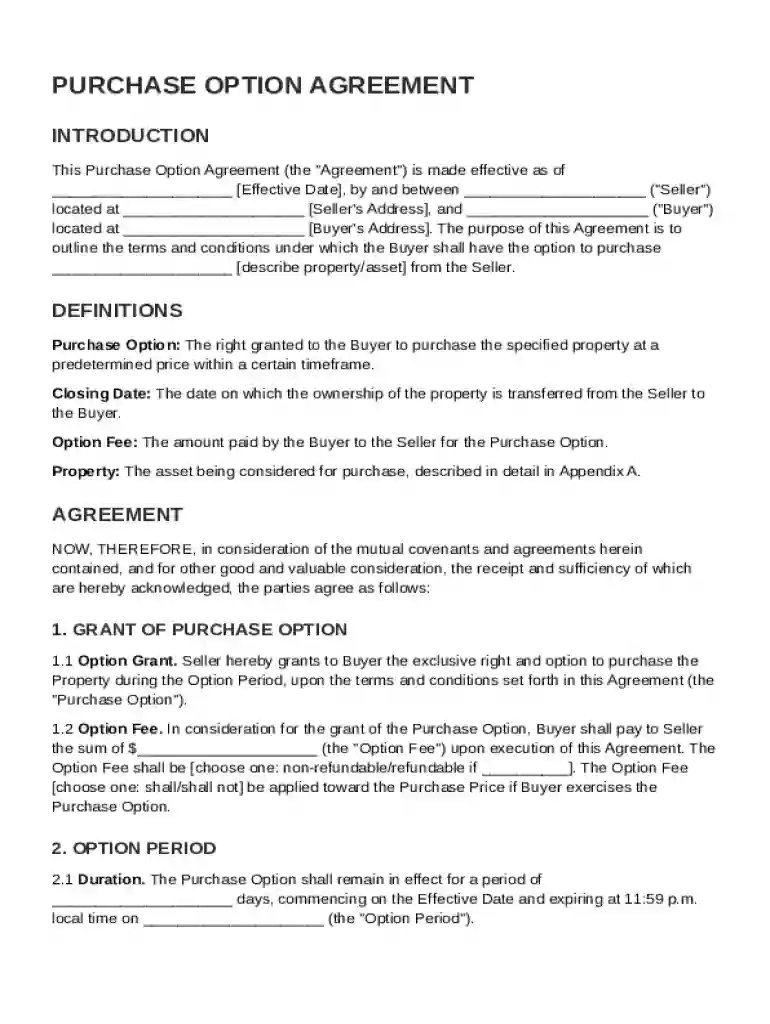
A Purchase Option Agreement is a legal document that provides a buyer with the right, but not the obligation, to purchase a particular property from a seller at a predetermined price within a specified timeframe. This agreement is widely used in real estate transactions to outline the terms and conditions under which the option to purchase is granted. Key components typically include the definition of terms, the purchase price, the duration of the option period, and any option fees that may be required. This arrangement offers both parties a degree of security and predictability, allowing the buyer time to secure financing or conduct due diligence while giving the seller a committed buyer.
Steps to Complete the Purchase Option Agreement Template
Completing a Purchase Option Agreement involves several detailed steps to ensure accuracy and legal compliance:
- Identify the Parties: Clearly state the names and contact information of both the buyer and the seller.
- Describe the Property: Provide a precise legal description of the property subject to the purchase option.
- Determine the Option Fee: Specify the amount the buyer must pay to secure the option and any conditions for its refund.
- Outline the Option Term: State the time period within which the purchase option can be exercised.
- Set the Purchase Price: Agree on the price at which the property will be sold if the option is exercised.
- List Contingencies: Include any conditions or contingencies that must be satisfied for the option to be valid.
- Signatures: Ensure the document is signed by all parties involved and, if necessary, notarized.
Key Elements of the Purchase Option Agreement Template
When drafting a Purchase Option Agreement, several critical elements need to be incorporated to safeguard both parties:
- Grant of Option: A clause that formally grants the buyer the right to purchase the property during the option term.
- Purchase Price: The agreed-up price for the property, including any terms related to its adjustment.
- Option Fee and Payment: Terms detailing the payment method and timings, as well as the conditions under which the fee may be refunded.
- Period of Option: Specific duration during which the buyer can exercise the option.
- Exercise of Option: Instructions on how the buyer can notify the seller of their decision to execute the option.
- Parties' Obligations: Duties and responsibilities of both the buyer and seller throughout the option period.
Legal Use of the Purchase Option Agreement Template
The legal enforceability of a Purchase Option Agreement depends on its compliance with relevant laws and its proper execution:
- Compliance with Real Estate Laws: Ensure the agreement is consistent with state and local real estate regulations.
- Signatures and Notarization: The agreement must be signed by both parties and possibly notarized, depending on state requirements.
- Clarity in Terms: The language should be clear and precise to avoid disputes or misinterpretations.
- Dispute Resolution: Include a section detailing the methods of resolving any disputes that may arise from the agreement.
Important Terms Related to the Purchase Option Agreement
Understanding key terminology is crucial for comprehending a Purchase Option Agreement:
- Optionor: The seller who grants the option to the buyer.
- Optionee: The buyer who receives the option to purchase the property.
- Consideration: The option fee paid by the buyer for the purchase right.
- Escrow: A third-party hold of the purchase funds until the transaction is complete.
- Due Diligence: The investigation period during which the buyer can inspect the property and review relevant documents.
Why Use a Purchase Option Agreement Template
Utilizing a Purchase Option Agreement Template offers several advantages:
- Time-Saving: Provides a standardized starting point that can be customized to suit specific transaction requirements.
- Risk Mitigation: Ensures that all critical elements are addressed, reducing the risk of incomplete or non-compliant agreements.
- Professional Structure: Offers a professionally organized format that enhances readability and understanding for both parties.
- Cost-Effective: Reduces legal costs by providing a framework that can be reviewed, rather than drafted from scratch, by an attorney.
Examples of Purchase Option Agreement Use
The versatility of Purchase Option Agreements can be illustrated through several practical examples:
- Real Estate Investment: Developers often use these agreements to secure potential investment properties while conducting feasibility studies.
- Homebuyers: Buyers use them to lock in current prices while securing mortgage financing or selling another property.
- Commercial Properties: Businesses may use them to secure future expansion sites without committing to immediate purchase.
State-Specific Rules for Purchase Option Agreements
Different states may have unique regulations governing Purchase Option Agreements:
- California: Requires detailed disclosures regarding the property's condition and any environmental hazards.
- Texas: Mandates specific language related to fire insurance and hazard insurance requirements.
- Florida: Includes particular stipulations for coastal properties, requiring additional environmental impact assessments.