




01. Edit your form online
Type text, add images, blackout confidential details, add comments, highlights and more.

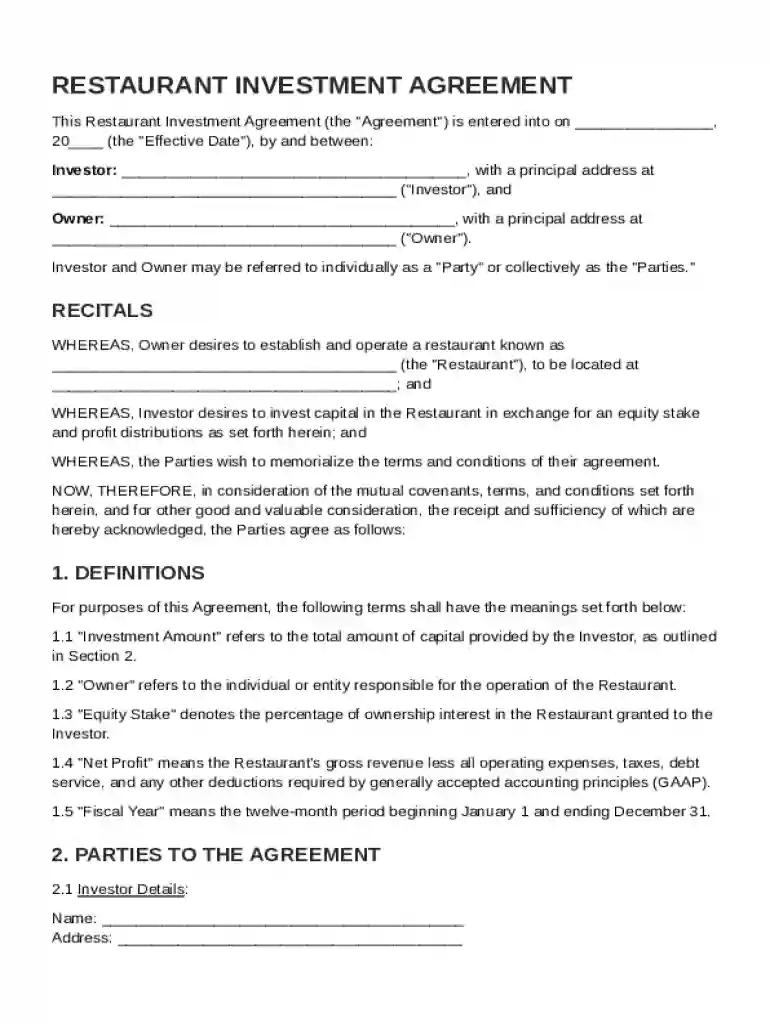
Type text, add images, blackout confidential details, add comments, highlights and more.

Draw your signature, type it, upload its image, or use your mobile device as a signature pad.

Send it via email, link, or fax. You can also download it, export it or print it out.
A Restaurant Investment Agreement Template outlines the foundational terms between an investor and a restaurant owner. This legal document specifies the capital investment provided by the investor in exchange for an equity stake or a share in the profits of the restaurant business. It serves as a formal record of the mutual obligations and expectations of both parties, ensuring a clear understanding of roles and responsibilities. The template is designed to mitigate potential disputes by clearly outlining operational responsibilities, profit-sharing arrangements, and conditions for termination. The template usually encompasses financial details, operational guidelines, and legal protections that govern the partnership.
Using the Restaurant Investment Agreement Template efficiently involves a clear understanding of its sections and functionalities. Begin by familiarizing yourself with the document's legal terminology and structure. Ensure all personal and business information of the involved parties is accurate.
This process ensures the partnership is clearly delineated and protected from potential misunderstandings that could arise from informal agreements or verbal promises.
Completing the template requires careful attention to individual and business details to maintain its validity and usefulness. Adhering to the following structured process is crucial:
Following these steps helps maintain clarity and mutual understanding, ensuring a smooth transaction and cooperation between parties.
The template contains several critical elements that form the base of a successful investment agreement:
Including these elements helps create a robust agreement that facilitates a clear operational pathway and effective management of expectations.
Using a Restaurant Investment Agreement Template legally necessitates compliance with various business laws and contractual norms. The template must:
Legal use of this template protects both parties by providing a reference point, helping avoid costly legal battles and preserving professional relationships.
Restaurant investment agreements must be tailored to meet specific state regulations governing business partnerships. Here are a few considerations:
Understanding and integrating these state-specific rules into an agreement helps ensure its validity and protect its enforceability.
Several crucial terms must be defined within the agreement to facilitate clarity:
These terms, when clearly defined, guide the dynamics of interaction between involved parties, preventing misunderstandings and misinterpretations.
Non-compliance with the terms specified in a Restaurant Investment Agreement Template may result in significant legal and financial consequences:
Ensuring adherence to the agreement terms is crucial to safeguard all parties involved and prevent irreversible harm to personal and business assets.
At DocHub, your data security is our priority. We follow HIPAA, SOC2, GDPR, and other standards, so you can work on your documents with confidence.



CHARTWELLS shall amortize the Capital Investment on a straight-line basis over a period of ten (10) years beginning in the first contract year. B. Installation
May 11, 2021 The terms we, us and our are also used in the Form 10-K to refer to the Company. Throughout this Form 10-K, the terms restaurants,


