




01. Edit your form online
Type text, add images, blackout confidential details, add comments, highlights and more.

Type text, add images, blackout confidential details, add comments, highlights and more.

Draw your signature, type it, upload its image, or use your mobile device as a signature pad.

Send it via email, link, or fax. You can also download it, export it or print it out.
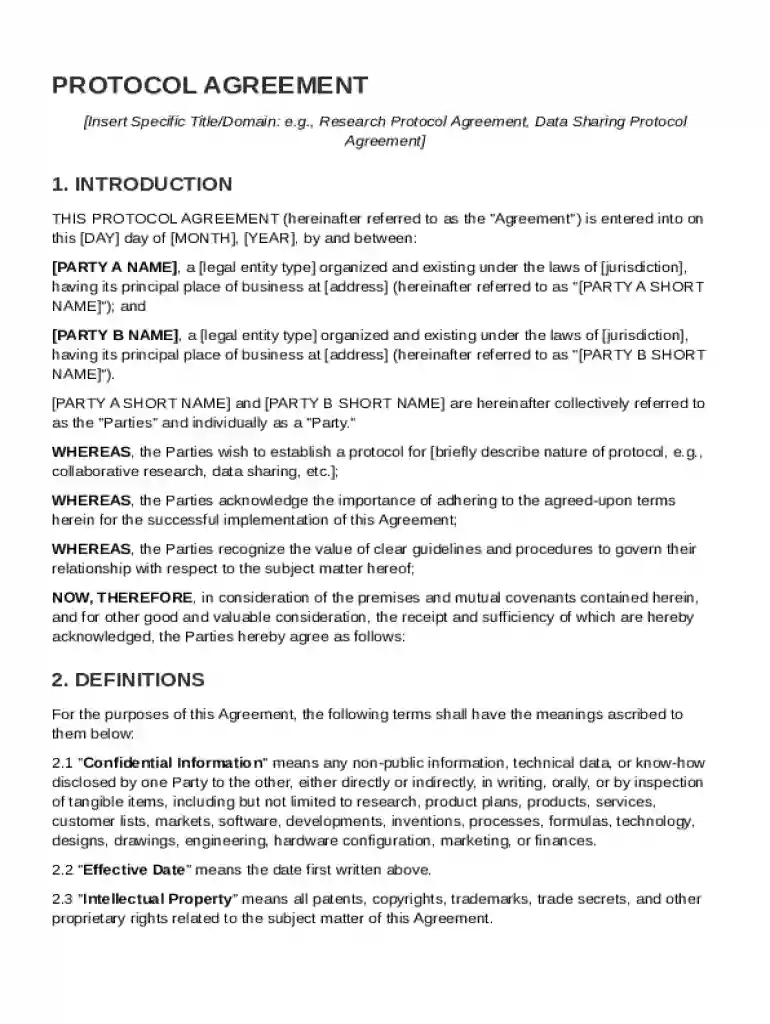
A Protocol Agreement Template is a formal document that outlines the specific terms and conditions under which two or more parties agree to cooperate on a particular project or initiative. This agreement is crucial in formalizing the operational aspects of collaboration, ensuring each party is aware of their obligations and rights. Protocol agreements are commonly used in research and data-sharing scenarios to establish clear communication pathways, protect sensitive information, and ensure compliance with laws and regulations.
The template simplifies the creation of these agreements by providing a structured format that can be tailored to the specific needs of the parties involved. It includes sections for defining key terms, roles, and responsibilities, thereby ensuring that all participants have a common understanding of the agreement's provisions. By using a standard template, organizations can expedite the negotiation process and reduce the potential for misunderstandings.
The Protocol Agreement Template comprises several critical sections necessary for a robust agreement. These include:
Definitions of Key Terms: This section provides clear definitions of important terms used throughout the agreement, such as "Confidential Information" or "Disclosing Party," which helps prevent ambiguity.
Roles and Responsibilities: A detailed breakdown of the duties and obligations of each party involved in the agreement.
Confidentiality Obligations: Guidelines for how confidential information will be handled, including any restrictions on disclosure to third parties.
Compliance with Laws: A section committing all parties to adhere to relevant legal requirements and industry standards.
Dispute Resolution: Procedures for resolving any conflicts that may arise during the implementation of the agreement.
Termination Clauses: Conditions under which the agreement may be terminated by either party.
To effectively utilize a Protocol Agreement Template, follow these steps:
Download and Review: Obtain the template, carefully reviewing its sections to ensure understanding.
Customize: Modify the template to fit the specific requirements of the collaboration, adding or removing sections as necessary.
Define Roles: Clearly outline the roles and responsibilities of each party to prevent overlap and confusion.
Address Confidentiality: Set precise terms for handling confidential information to protect proprietary data.
Specify Legal Compliance: Ensure the agreement includes compliance with all relevant laws and regulations.
Outline Dispute Mechanisms: Include effective dispute resolution procedures to address potential disagreements.
Seek Legal Review: Before finalizing, have the agreement reviewed by legal counsel to ensure it is binding and enforceable.
Sign and Execute: Once all parties agree to the terms, sign the document and commence collaboration.
Protocol Agreement Templates are widely used across various fields and industries. Common users include:
Research Institutions: Collaborating on studies that involve sharing sensitive data or intellectual property.
Corporate Partnerships: Companies engaged in joint ventures or cooperative projects requiring clearly defined roles.
Healthcare Organizations: Sharing medical data for research while adhering to privacy laws.
Educational Facilities: Institutions working together on joint educational initiatives or shared resources.
These templates provide a vital framework, promoting transparency and cooperation while safeguarding proprietary and confidential information.


Legally, a Protocol Agreement Template serves as a binding document once signed by all parties. It should be constructed in accordance with relevant laws and guidelines to ensure its enforceability. Parties must ensure their agreement complies with local, state, and federal regulations pertaining to confidentiality, data protection, and intellectual property.
Legal counsel should be consulted during the drafting process to ensure that the document reflects current laws and any industry-specific requirements, and that all clauses are clear and unambiguous. This prevents legal disputes that may arise from misinterpretation or non-compliance.
It is essential to be aware of any state-specific rules that may impact the formulation of a Protocol Agreement Template. Differences in state laws can affect:
Confidentiality Requirements: State laws may stipulate different controls over the handling and dissemination of sensitive information.
Data Protection Regulations: Variations in how data protection laws are applied and enforced.
Dispute Resolution Procedures: Some states may have specific regulations on how disputes should be managed and resolved.
By understanding these differences, parties can ensure that their agreement is comprehensive and complies with all regional legal requirements.
Completing a Protocol Agreement Template involves several steps:
Identification of Parties: Enter the full legal names and contact information of the cooperating entities.
Customization of Template Sections: Adapt each section to the specific context and requirements of the collaboration.
Reviewing Legal Obligations: Ensure that the document meets all relevant legal standards.
Defining Terms Clearly: Write clear and unambiguous definitions for any technical or proprietary terms used.
Clarification of Roles: Assign specific duties and responsibilities to each party, to avoid potential overlaps.
Final Review and Approval: Allow each party to review the document, making any necessary adjustments before obtaining legal approval.
Signing the Agreement: All parties sign the document electronically or on paper to formalize the agreement.
Commencement of Agreement: Notify all parties that the agreement is in effect once signed.
Several scenarios illustrate the utility of the Protocol Agreement Template:
Research Consortiums: Universities and private research entities use the template to define the terms of research collaboration, detailing how findings will be shared and intellectual property managed.
Technology Partnerships: Tech companies engage in joint product development, outlining ownership rights for newly developed technologies.
Public Health Collaborations: Multiple health authorities working on disease data sharing initiatives use the template to clarify data usage and access rights.
These examples demonstrate the flexibility and broad applicability of the Protocol Agreement Template in varying contexts, underscoring its importance in formalizing collaborative efforts across diverse sectors.
At DocHub, your data security is our priority. We follow HIPAA, SOC2, GDPR, and other standards, so you can work on your documents with confidence.





I have the honor to confirm the following understanding docHubed between the Government of the. United States of America (United States) and the Government of
By signing the Agreement of Investigator form, the Investigator agrees to: 1. Conduct the study in accordance with the protocol and only make changes after
Aug 16, 2024 NIH applicants can use a template with instructional and sample text to help write clinical protocols for the following types of research.


