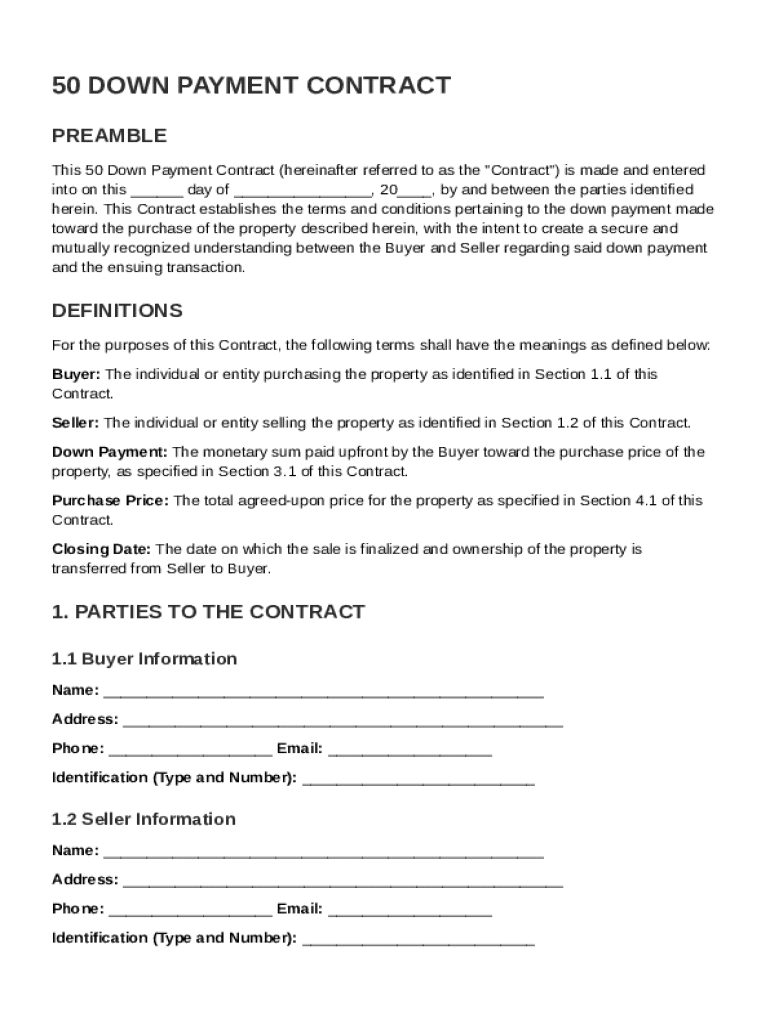







Definition and Meaning
The "50 Down Payment Contract Template" is a legally binding document outlining the terms and conditions under which a buyer agrees to pay a down payment towards the purchase of a property. The primary aim of this contract is to ensure both parties clearly understand the transaction specifics, including the amount paid upfront, the remaining balance, conditions of the sale, contingencies, and refund policies. The contract defines key terms such as "Buyer," "Seller," "Down Payment," "Property," and "Balance," providing clarity and avoiding potential disputes.
Key Terms Defined
- Buyer and Seller: The parties involved in the contract, where the Buyer provides the down payment to the Seller.
- Down Payment: The initial amount paid by the Buyer towards the purchase price of the property.
- Remaining Balance: The outstanding amount the Buyer must pay after the down payment has been made.
- Contingencies: Specific conditions or actions required to be completed for the contract to remain valid.
- Refund Policy: Terms under which the down payment may be refunded to the Buyer.
Steps to Complete the 50 Down Payment Contract Template
-
Gather Necessary Information: Collect details about both parties, property description, and payment terms.
-
Fill Out Buyer and Seller Information: Include names, contact information, and any other pertinent details for both parties.
-
Describe the Property: Clearly detail the property's location, boundaries, and unique identifiers.
-
Specify Down Payment Details: Enter the exact amount of the down payment and the agreed payment method.
-
Outline Remaining Balance Terms: Specify the total purchase price, the remaining balance, and the payment schedule or due date.
-
Include Contingencies and Conditions: Address any preconditions that must be met before the sale can proceed.
-
State Refund Policies: Clearly define under what circumstances a refund may occur if the transaction is aborted.
-
Final Review and Signatures: Ensure all details are accurate, and both parties review and sign the contract to finalize it.
Key Elements of the 50 Down Payment Contract Template
- Parties Involved: Comprehensive information about the Buyer and Seller.
- Property Description: Detailed overview of the property, including legal description and physical address.
- Payment Terms: Clear articulation of the down payment amount, remaining balance, and payment schedule.
- Contingency Clauses: Conditions that either party must fulfill for the transaction to proceed smoothly.
- Dispute Resolution: Methods for resolving disagreements, including mediation or arbitration preferences.
- Governing Law: Jurisdiction under which the contract is enforceable, often the state where the property is located.
- Signature Blocks: Designated areas for both parties to sign, along with the date of signature.
Legal Use of the 50 Down Payment Contract Template
Compliant Signing Processes
The use of electronic signatures within DocHub ensures compliance with the ESIGN Act, making them legally binding. Users can opt to draw, type, or upload their signature via secure electronic means, ensuring authenticity and acceptance in legal scenarios.
State-Specific Legal Considerations
While the template serves a general purpose, users must adapt it to meet specific state laws which might influence governing clauses, contingency acceptability, or dispute resolution procedures. It's advisable to consult with a legal professional familiar with real estate laws in the property's location.
Important Terms Related to the 50 Down Payment Contract Template
- Good Faith Deposit: Another term for the down payment which indicates the Buyer's commitment to the transaction.
- Default: The failure of either party to meet stipulated obligations, potentially leading to penalties or contract termination.
- Escrow: A third-party managed account where the down payment might be temporarily held until certain conditions are met.
Digital Versus Paper Versions
The digital version of the 50 Down Payment Contract Template offers flexibility and ease of use. Integration with platforms like DocHub allows for seamless modification, signing, and sharing without printing. In contrast, paper versions might be manually processed but can serve as physical documentation if electronic records are not feasible.
Advantages of the Digital Version
- Editability: Easily make changes or corrections.
- Accessibility: Retrieve and manage from any device with internet access.
- Security: Protects with encryption and provides audit trails for all interactions.
Considerations for Paper Copies
- Storage: Requires physical space and archiving.
- Handling: Risk of loss, damage, or document tampering over time.
- Distribution: More cumbersome to distribute for signing and storing compared to electronic files.
Examples of Using the 50 Down Payment Contract Template
In practice, a real estate agent might use the 50 Down Payment Contract Template when closing a residential property sale. The template facilitates straightforward documentation of payment terms and ensures both the Buyer and Seller have mutual understanding of the down payment conditions and any contingencies affecting the sale.
- Buyer with Financing: Buyers relying on mortgages may use this template to demonstrate their financial commitment when making an offer.
- Private Sales: Homeowners selling properties without an agent can utilize this template to document the transaction and protect both parties' interests legally.
- Commercial Real Estate Transactions: Businesses often adopt templates like this to streamline real estate acquisitions involving substantial down payments.
State-Specific Rules for the 50 Down Payment Contract Template
While the general form applies across the United States, certain states might have additional stipulations regarding down payments, refund policies, or escrow holdbacks. Legal requirements or standard practices could vary, so it's important for users to validate compliance with local regulations.
Examples of State Variations
- California: Additional disclosures or contingencies required by state regulations.
- New York: Specific timeframes for payments due to unique escrow closing procedures.
- Texas: Varying refund policies linked to property inspection results prior to the final purchase.