






Definition & Meaning
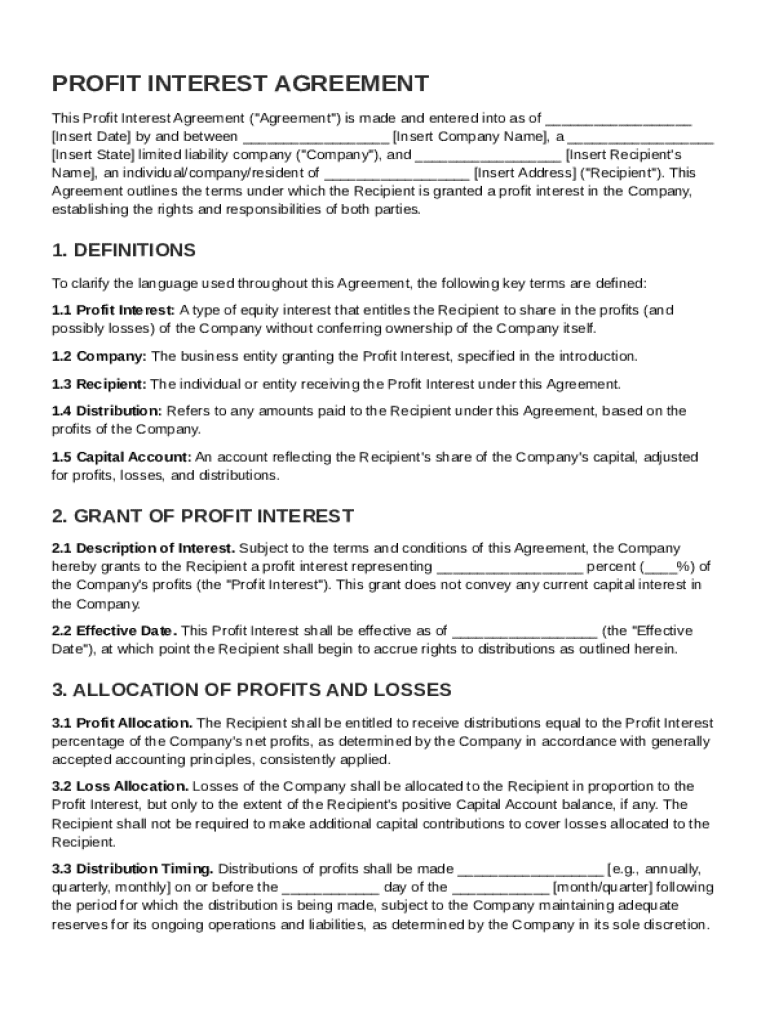
A Profit Interest Agreement Template is a legal document used primarily by companies to allocate profit-sharing interests to individuals without granting equitable ownership. This type of agreement is often utilized by partnerships and LLCs to reward key contributors based on the future success of the company. Profit interest grants the recipient the right to share in the earnings of the company, fostering motivation and commitment without providing direct company shares. The agreement is structured to detail the specific rights, obligations, and conditions under which profit interest is granted and maintained, ensuring both parties have a clear understanding of expectations.
Key Elements of the Profit Interest Agreement Template
Understanding the critical components within a Profit Interest Agreement Template is essential for constructing a robust and legally compliant document. The primary components include:
- Definitions: Clear explanations of terms and concepts used throughout the agreement, such as "Recipient," "Profit Interest," and "Company."
- Rights and Obligations: Detailed descriptions of the rights attributed to the profit interest recipient and their corresponding responsibilities.
- Profit and Loss Allocations: Guidelines for the allocation of profits and losses among beneficiaries, ensuring transparency and fairness.
- Vesting Schedules: Timelines and conditions that dictate when and how recipients gain full rights to their profit interest.
- Termination Conditions: Clear criteria for agreement termination, including breaches, voluntary terminations, or insolvency scenarios.
- Tax Treatment: Instructions for handling tax implications, including compliance with IRS guidelines.
By incorporating these elements, the agreement ensures comprehensive protection and clarity for all parties involved.
Steps to Complete the Profit Interest Agreement Template
Filling out a Profit Interest Agreement Template involves several detailed steps to ensure accuracy and completeness:
- Identify Parties Involved: Clearly list the names and contact information of all parties participating in the agreement.
- Define Profit Interest Terms: Specify the percentage of profit interest being granted and any conditions for eligibility.
- Detail Rights and Responsibilities: Enumerate the specific roles and obligations of the recipient in relation to the profit interest.
- Establish Vesting Schedules: Outline any vesting periods and milestones required for the recipient to gain full interest rights.
- Determine Termination Procedures: Clearly articulate the processes and conditions under which the agreement may be terminated.
- Review Tax Implications: Ensure that the agreement aligns with tax regulations and consider consulting a tax expert for compliance validation.
Completing these steps meticulously ensures the Profit Interest Agreement Template serves its intended purpose effectively.
Legal Use of the Profit Interest Agreement Template
A Profit Interest Agreement Template serves as a significant legal instrument within a business, providing enforceable terms for profit-sharing arrangements. Compliance with applicable federal and state laws is crucial, including the Internal Revenue Code for tax obligations and possibly the Securities Act for equity interests. The agreement must outline the legal framework for granting, maintaining, and terminating profit interests. Legal counsel or a tax advisor is often consulted during the drafting phase to ensure all statutory requirements are met, mitigating potential disputes or legal issues.
Examples of Using the Profit Interest Agreement Template
Profit Interest Agreement Templates are used across various scenarios to incentivize and reward contributions:
- Startup Incentives: A growing tech startup may grant profit interests to early-stage employees to attract and retain talent without dispersing ownership equity.
- Partnership Arrangements: In a real estate partnership, profit interests may be offered to a new partner contributing unique expertise or capital.
- Succession Planning: Established family businesses can use profit interest agreements to transition management to the next generation while aligning with profit motivations.
These examples illustrate how different business contexts can leverage a Profit Interest Agreement to enhance alignment between compensation and performance incentives.
Important Terms Related to Profit Interest Agreement Template
Understanding terminologies is crucial for effective use of the Profit Interest Agreement Template:
- Recipient: The individual or party receiving profit interest rights.
- Vesting: The process by which the recipient earns ownership of the profit interest over time or upon meeting specific conditions.
- Sweepstakes: This refers to the distribution of profits or losses among members.
- Profit Sharing: Allocation of a portion of an organization's profits to employees or partners.
- Termination Clause: Part of the agreement that outlines the conditions for ending the agreement.
Grasping these terms ensures all parties have a unified understanding of the agreement's provisions.
IRS Guidelines
The Internal Revenue Service offers specific guidelines that govern the tax treatment of profit interests. Under Section 83(b) of the Internal Revenue Code, recipients can elect to pay taxes on the current value of a granted interest, potentially reducing future tax liabilities. However, this election must be made within 30 days of receiving the interest. Companies must also ensure compliance with partnership tax rules, particularly those related to capital account maintenance and profit allocation. Proper adherence to IRS guidelines ensures that both the granting organization and the recipient understand their tax obligations and opportunities.
State-Specific Rules for the Profit Interest Agreement Template
Though profit interest agreements are used widely across the United States, certain elements may be influenced by state-specific legislation. Each state may have variations in how they interpret contractual agreements, taxation stipulations, or company formation regulations. For instance, states like California and New York often have additional disclosure requirements and employee protections that businesses must adhere to. Companies are encouraged to consult state-specific legal experts to navigate these intricacies and ensure that the agreement is not only valid but optimized according to local laws. Exploring state-level nuances helps align the template's provisions with both federal and state requirements.