



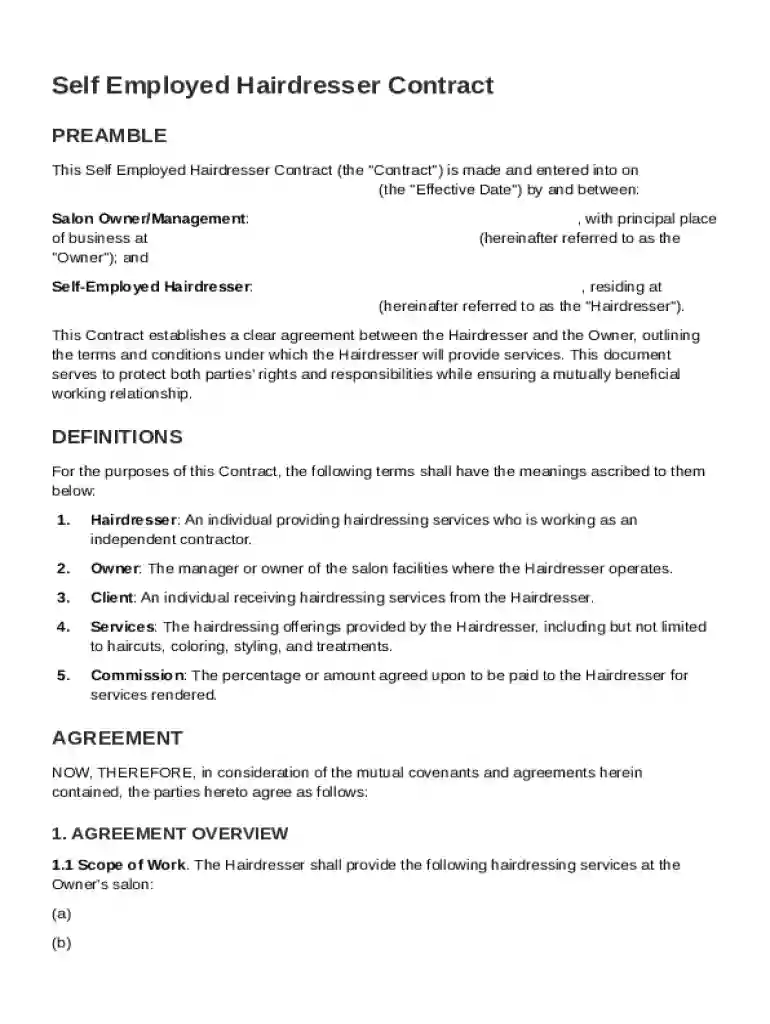
01. Edit your form online
Type text, add images, blackout confidential details, add comments, highlights and more.

Type text, add images, blackout confidential details, add comments, highlights and more.

Draw your signature, type it, upload its image, or use your mobile device as a signature pad.

Send it via email, link, or fax. You can also download it, export it or print it out.
The Self Employed Hairdresser Contract Template serves as a critical tool in establishing the professional dynamics between a salon owner and a self-employed hairdresser. It covers essential components such as the scope of services provided, the compensation structure, and the allocation of responsibilities. Specific terms regarding insurance obligations are also included, ensuring both parties understand their coverage requirements. Confidentiality clauses safeguard proprietary information, while dispute resolution procedures provide a roadmap for handling disagreements.
A pivotal component of the contract is the compensation structure, which outlines how the hairdresser will be remunerated for their services. Common approaches include commission-based payments or fixed hourly rates. The contract will specify whether any additional benefits or incentives apply, such as bonuses for reaching certain sales targets or percentages of product sales.
Clearly defining the responsibilities of each party is essential for smooth operations. The salon owner might be responsible for providing the necessary workspace and utilities, while the hairdresser must agree to adhere to the salon's operational standards and customer service policies. This section ensures both parties have aligned expectations regarding day-to-day duties.
Completing the contract template efficiently requires following a structured approach. First, gather all necessary personal and business information for both parties. Next, carefully review the template to understand the standard clauses included. Customization may be needed to address any unique agreements or terms specific to the working relationship.
Collect Necessary Information: Ensure you have all relevant personal and business details for both parties involved.
Review the Template: Understand the standard terms provided in the contract and identify areas that require customization.
Modify as Needed: Adjust clauses to reflect specific agreements, ensuring both parties’ interests are accurately represented.
Seek Legal Review: Before finalizing, have a legal advisor review the contract to confirm compliance with applicable laws.
Finalize and Sign: Once both parties agree on the terms, sign the document to give it legal standing.
Ensuring the legal integrity of the contract template is vital for its enforceability. The document should align with U.S. federal and state laws and regulations pertinent to independent contractor agreements. Personal legal advice is recommended to address state-specific requirements and ensure the contract does not inadvertently classify the hairdresser as an employee.
Incorporating confidentiality and non-disclosure clauses can protect salon proprietors from the unauthorized sharing of sensitive business information. These clauses should specify what constitutes confidential information and outline the consequences for any breaches.
Understanding the terminology used in the contract is important for both parties. Terms such as “independent contractor,” “compensation,” “terms of service,” and “confidentiality” each have specific legal implications. Accurate interpretation of these terms helps prevent misunderstandings and ensures all parties comprehend their rights and obligations.
This term clarifies the professional relationship's nature, confirming that the hairdresser operates as an independent business entity rather than an employee.
Real-world examples can demonstrate the template's utility. For instance, a salon in New York might use the contract to establish a clear compensation and commission structure with a hired stylist, ensuring transparency and compliance with state labor laws. Another example involves a hairdresser operating in California, where the contract is pivotal in formalizing the professional relationship and protecting the contractor’s autonomy.
Laws governing independent contractor agreements can vary by state. It is crucial to tailor the contract template to accommodate these differences. For instance, California's AB5 legislation dictates a stricter classification between employees and contractors, affecting how such contracts should be structured. Consulting legal expertise familiar with state-specific laws ensures compliance and mitigates legal risks.
Utilizing this contract template provides a structured approach to delineating roles and expectations, which can prevent disputes and foster a harmonious work environment. Establishing clear terms in writing helps mitigate the risk of misunderstandings by ensuring all parties are on the same page.
At DocHub, your data security is our priority. We follow HIPAA, SOC2, GDPR, and other standards, so you can work on your documents with confidence.

OBJECTIVES: To prepare for employment in a salon, the student will apply problem-solving skills, develop positive work attitudes and excellent customer service
by BB Industry For example, a sole proprietorship would file. Form 1040, using Schedule C to report business income and expenses and Schedule SE to report Self-Employment tax.
Whilst every effort has been made to ensure that the contents of this book are accurate, no responsibility for loss occasioned to any person acting or


