




01. Edit your form online
Type text, add images, blackout confidential details, add comments, highlights and more.

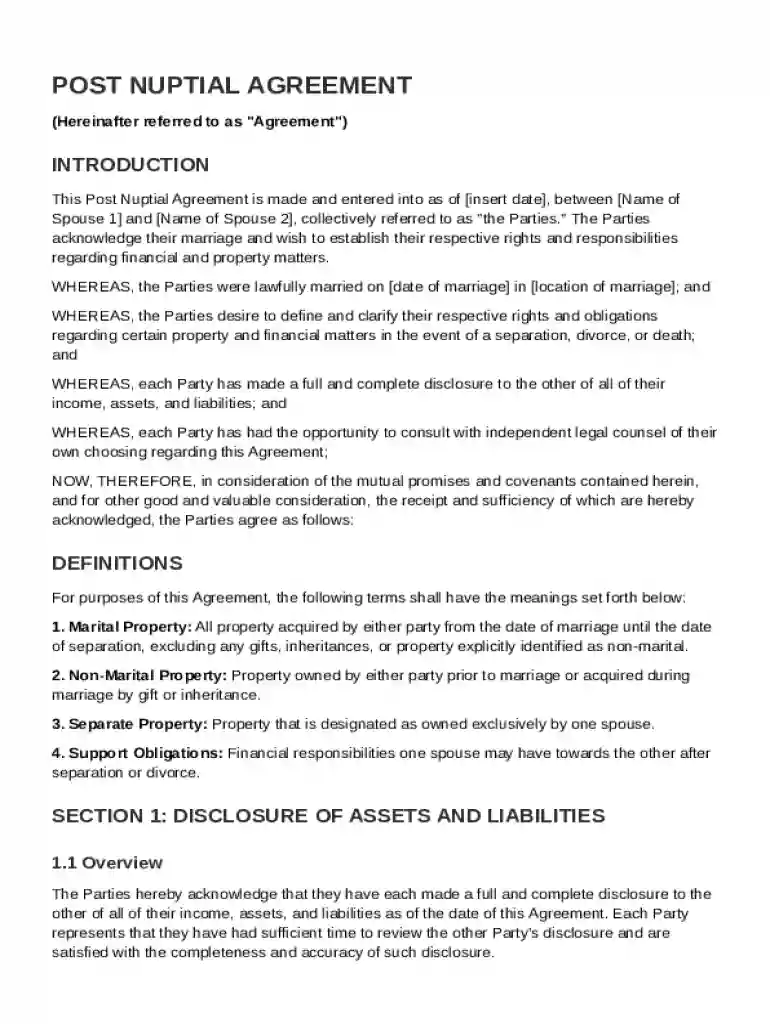
Type text, add images, blackout confidential details, add comments, highlights and more.

Draw your signature, type it, upload its image, or use your mobile device as a signature pad.

Send it via email, link, or fax. You can also download it, export it or print it out.
A Post Nuptial Agreement Template is a legal document designed to outline the terms and stipulations regarding the division of assets and financial responsibilities between spouses after marriage. Unlike prenuptial agreements, which are executed before marriage, postnuptial agreements are created when the couple is already legally married. This document serves multiple purposes, such as defining marital and non-marital property, clarifying spousal support terms, and setting ground rules for asset division in the event of a separation or divorce. By establishing these terms clearly, the postnuptial agreement aims to prevent disputes and ensure both parties' interests are protected.
Discuss and Agree on Terms: Both spouses must openly communicate and agree on the terms they wish to include in the agreement.
Gather Financial Information: Collect all relevant financial documents, including bank statements, property deeds, and debt records, for accurate disclosure.
Draft the Agreement: Use the template to detail all agreed-upon terms regarding asset division, spousal support, and other legal responsibilities.
Consult with Legal Counsel: Although optional, engaging with a lawyer is advised to ensure the document complies with state laws and meets both parties' needs.
Review and Revise: Both parties should review the initial draft, making revisions and clarifying any ambiguous terms.
Finalization: Once both parties agree, the draft is finalized, and signatures are collected to make the agreement legally binding.
Notarization (if required): Some jurisdictions might require notarization. Confirm based on local legal requirements.
Postnuptial agreements are governed by state-specific laws, which affect how these documents can be drafted and enforced. Generally, these agreements must:
It is critical that each spouse fully understands the document, sometimes necessitating the involvement of separate legal counsel. This step reduces challenges during enforcement and demonstrates the equitable intentions of both parties at the time of execution.
Each U.S. state may have unique requirements and interpretations for postnuptial agreements. For example, some states may not recognize certain provisions, while others may impose restrictions regarding waiver clauses for spousal support. Understanding and complying with regional laws is imperative to ensure the agreement's validity and enforceability.
The document is utilized by married couples seeking to delineate financial responsibilities and protect individual interests. It is particularly beneficial for:


Alternatives to a postnuptial agreement include prenuptial agreements, marital settlement agreements, and separation agreements. Understanding the distinctions and purposes of each can guide couples in choosing the most appropriate legal tool for their needs.
At DocHub, your data security is our priority. We follow HIPAA, SOC2, GDPR, and other standards, so you can work on your documents with confidence.

Jan 23, 2013 □ Toms wife is willing to sign a post-nuptial agreement. □ How should we go about this to ensure that the agreement is valid and effective?
Kinseys breaking of his agreement with Maslow and his concealment of his part of their results is better understood in this light. Also better understood
Oct 1, 1995 Premarital agreement means an agreement between prospective spouses made in contemplation of marriage. Conn. Gen. Stat.


