
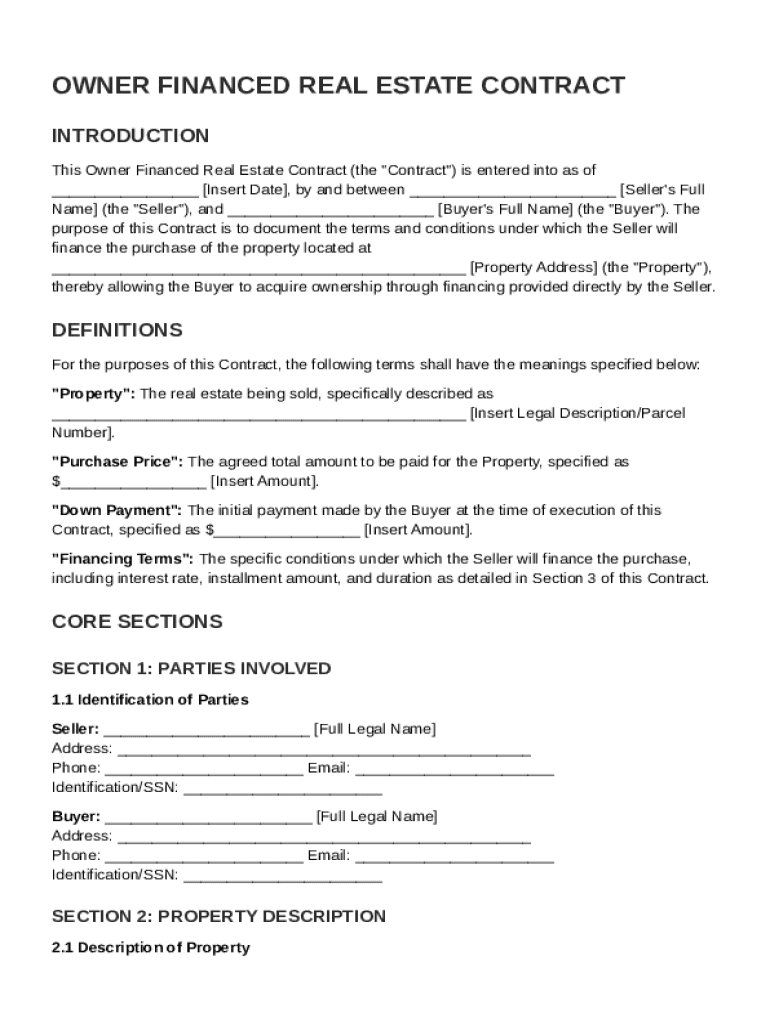







Definition & Meaning
An Owner Financed Real Estate Contract Template is a legally binding document used in real estate transactions where the seller finances the buyer's purchase of the property. This means that instead of the buyer obtaining a traditional mortgage from a bank, the seller acts as the lender and allows the buyer to make payments over time. The contract outlines essential elements such as the purchase price, interest rate, payment schedule, and consequences of default, thereby ensuring that both parties are clear about the terms and obligations involved.
How to Use the Owner Financed Real Estate Contract Template
Utilizing the Owner Financed Real Estate Contract Template involves several key steps to ensure that the document accurately reflects the agreement between the seller and the buyer.
- Understanding the Terms: Before filling out the template, both parties should thoroughly understand the terms used within the document, such as "purchase price," "down payment," and "interest rate."
- Providing Accurate Information: When completing the template, it is crucial to include accurate details regarding the buyer, seller, and property. This includes providing the correct property description and contact information for both parties.
- Setting Payment Terms: Clearly outline the payment schedule, including the frequency of payments (monthly, quarterly) and the total duration over which payments will be made.
- Including Signatures: Ensure that the contract is signed by both parties, as well as any witnesses if required, to validate and enforce the document legally.
Steps to Complete the Owner Financed Real Estate Contract Template
Successfully completing the Owner Financed Real Estate Contract Template requires attention to detail and an understanding of contractual obligations. Follow these steps:
- Gather Necessary Information: Obtain all relevant details about the buyer and seller, property specifications, and payment terms.
- Draft the Contract: Use the template to draft the contract, filling in each section accurately, including definitions, responsibilities, and terms of sale.
- Review and Revise: Both parties should review the drafted contract for accuracy and completeness. Amend any discrepancies or unclear clauses.
- Formalize and Sign: Once finalized, both parties should sign the document in the presence of a notary public or witnesses, depending on state requirements.
- Distribute Copies: Ensure that each party receives a copy of the signed contract for their records.
Key Elements of the Owner Financed Real Estate Contract Template
Key elements of this template include:
- Parties Involved: Identifying the seller, buyer, and any guarantors.
- Property Description: Detailed information about the property, including legal description, address, and any included fixtures.
- Purchase Price and Payment Terms: The agreed-upon price and the method of financing, including the down payment, installment amounts, interest rate, and payment schedule.
- Default and Remedies: Clauses detailing what constitutes a default and the remedies available to the non-defaulting party.
- Miscellaneous Provisions: Additional terms such as governing law, amendment processes, and arbitration clauses if disputes arise.
Important Terms Related to Owner Financed Real Estate Contract Template
Understanding the legal and financial terminology used in the Owner Financed Real Estate Contract Template is essential for both parties involved in the transaction:
- Promissory Note: A financial instrument that outlines the payment promise made by the buyer to the seller.
- Amortization Schedule: A table detailing each periodic payment on a loan, showing the principal and interest composition.
- Balloon Payment: A large payment due at the end of a loan, often used in owner financing as the last step after periodic installments.
- Lien: A legal right or interest that a lender has in the borrower's property, granted until the debt obligation is satisfied.
Legal Use of the Owner Financed Real Estate Contract Template
This contract template must comply with federal and state laws to be valid and enforceable:
- Compliance with ESIGN Act: If signed electronically, it must adhere to the Electronic Signatures in Global and National Commerce Act, ensuring its recognition as a valid legal document.
- State Regulations: Each state may have specific laws governing owner-financed transactions, such as interest rate caps and required disclosures. Parties should consult legal advice to ensure adherence to local regulations.
State-Specific Rules for the Owner Financed Real Estate Contract Template
Given that real estate laws vary significantly from state to state, it's important to tailor the Owner Financed Real Estate Contract Template to align with state-specific requirements:
- Interest Rate Limits: Some states impose maximum allowable interest rates on financed sales to protect buyers from usurious lending practices.
- Disclosure Requirements: States may mandate specific disclosures that must accompany the contract, such as risks associated with balloon payments.
- Foreclosure Process: Understand the foreclosure process for defaults in owner-financed transactions, as this can vary and impact the seller's recourse options.
Examples of Using the Owner Financed Real Estate Contract Template
Consider the following scenarios where the Owner Financed Real Estate Contract Template can be effectively used:
- First-Time Homebuyers: A beginner buyer might use this contract to purchase a home without qualifying for a traditional mortgage, allowing them to gain property ownership incrementally.
- Investment Properties: Investors can purchase additional properties through owner financing, leveraging existing holdings without tapping into mortgage loans.
- Property Sale Between Family Members: A parent might sell a home to a child using this contract, enabling a structured and legally recognized transaction with favorable terms.
Implementing this template requires a careful approach to ensure both parties' interests are protected, and that the transaction complies with applicable laws.




