
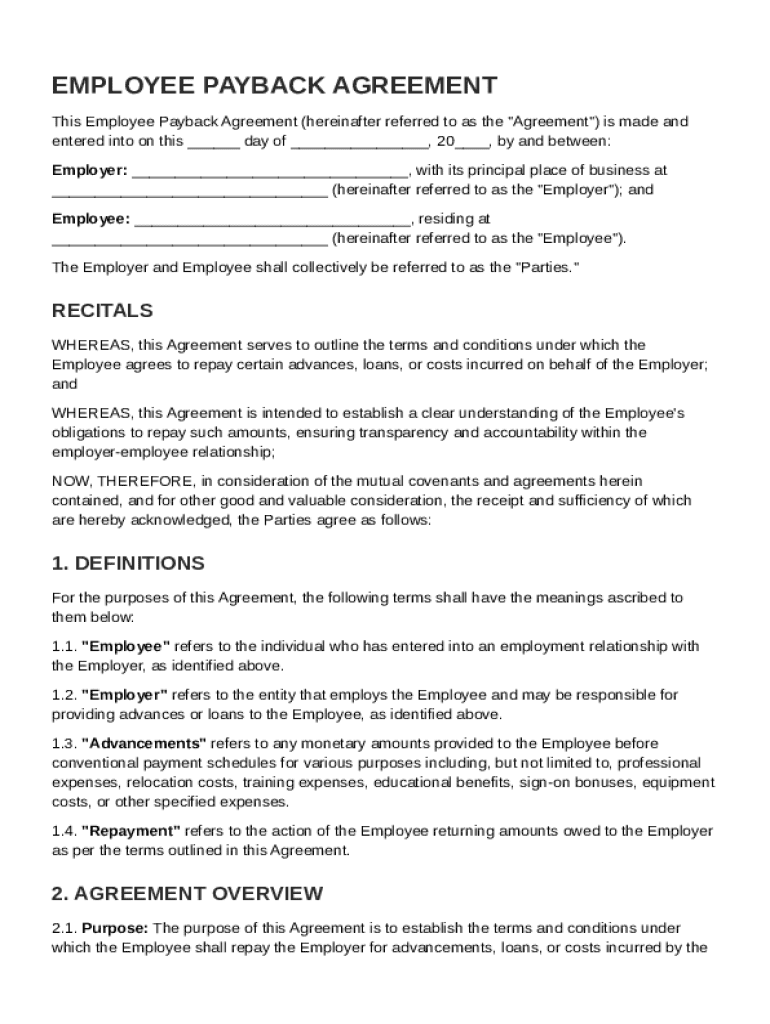







Definition and Purpose of the Employee Payback Agreement
The Employee Payback Agreement is a legal document outlining the terms under which an employee agrees to reimburse their employer for advances, loans, or expenses incurred on their behalf. This form specifies crucial details such as the amount to be repaid, the repayment schedule, and conditions under which the repayment will occur. By establishing these terms formally, both parties can avoid misunderstandings about financial obligations. This document also includes clauses related to notification of changes in circumstances, default conditions, and consequences of late payments, which help in ensuring clarity between the employer and employee.
How to Use the Employee Payback Agreement Template
Utilizing the Employee Payback Agreement Template involves several steps designed to ensure that the terms set forth are understood and acknowledged by both parties. Typically, this process begins with reviewing the template to tailor it to the specific needs of the situation. Key areas that often need customization include the repayment amount and schedule, specific obligations in the event of employment termination, and any additional conditions unique to the employer or employee. Once those areas are customized, the document can be reviewed by both parties, signed, and securely stored for future reference.
Detailed Steps for Using the Template
- Customization: Modify the template to reflect the exact terms and conditions agreed upon. This includes inputting specific amounts, timelines, and repayment conditions.
- Review and Agreement: Both employee and employer need to review and agree on the terms. Consulting with legal advisors can ensure compliance with applicable laws.
- Signatures: The document should be signed by both parties. Utilizing electronic signature platforms such as DocHub can streamline this step.
- Storage and Access: Save a copy of the signed agreement in secure, easily accessible storage for both parties to refer back to when needed.
Key Elements of the Employee Payback Agreement Template
The agreement template comprises several critical components that define the contractual obligations between the employer and the employee. These include:
- Repayment Terms: Clearly outlines the repayment amount, interest (if applicable), and the duration of the repayment period.
- Employment Termination Clause: Specifies the obligations for paying any remaining balance upon termination, whether voluntary or involuntary.
- Change of Circumstance: Requires the employee to notify the employer of any significant change in their financial situation that might impact their ability to repay.
- Default Conditions: Defines what constitutes a default and the repercussions should it occur.
- Legal Governing Law: Indicates the jurisdiction whose laws will govern the agreement, an important consideration for legal validity.
Legal Use and Compliance
Employers and employees must ensure the Employee Payback Agreement complies with state and federal laws. This often means verifying the agreement against labor laws, loan provisions, and employment contract regulations specific to the location of the business. Legal compliance ensures that the agreement is enforceable in a court of law, should disputes arise. Moreover, the agreement should not contravene any provisions related to withholding wages unless explicitly stipulated by law.
Who Typically Uses the Employee Payback Agreement Template
This template is most commonly used by businesses that offer advances to employees or incur expenses on their behalf which need repayment. It is applicable across various sectors and business sizes, particularly those requiring frequent travel or temporary relocations, resulting in advances for travel expenses. It is also used in situations where the employee needs financial assistance for personal reasons, and the employer agrees to facilitate this under certain conditions.


Examples of Using the Employee Payback Agreement Template
The agreement can be employed in numerous situations. Examples include:
- Travel Advances: An employee receives an advance to cover travel expenses for a business trip. The agreement outlines the repayment terms post-trip.
- Education and Training: If an employer finances an employee's education or training, the agreement can stipulate repayment if the employee leaves the company shortly after.
- Relocation Costs: When an employer covers relocation expenses, the agreement details the conditions under which these costs are repaid by the employee.
Digital vs. Paper Versions
In today's digital age, using a digital version of the Employee Payback Agreement Template is often more efficient and secure. Digitally signed agreements can be stored in cloud-based systems, allowing for easy access, management, and sharing. Online platforms like DocHub enable digital signing, annotations, and version control, ensuring seamless integration into existing digital workflows. While a paper version remains a legitimate option, digital agreements offer more flexibility and enhanced security.
Steps to Complete the Employee Payback Agreement Template
Completing the form involves carefully filling out each section to accurately reflect the terms agreed upon. The steps are as follows:
- Download and Access Template: Begin by downloading the template from a reliable source such as DocHub.
- Enter Details: Fill in the necessary details like names, payment amounts, and dates.
- Review: Ensure all information is correct and that both parties agree with the content.
- Finalize: Affix signatures. You can easily do this electronically using DocHub's signing functionalities.
- Store and Distribute: Save digital copies for both parties and distribute as agreed.
Important Terms Related to the Employee Payback Agreement Template
Understanding the terminology within the agreement is crucial for both parties. Key terms include:
- Advance: Money given to an employee before it is generally due, which will need to be repaid.
- Principal Amount: The initial amount borrowed or advanced before interest.
- Interest Rate: The percentage charged on the unpaid portion of the debt.
- Default: Failure to fulfill the repayment obligations as per the agreement.
- Governing Law: Legal framework under which the agreement will be interpreted.
These terms must be clearly defined in the agreement to avoid disputes and to ensure both parties have a mutual understanding of their responsibilities.




