




01. Edit your form online
Type text, add images, blackout confidential details, add comments, highlights and more.

Type text, add images, blackout confidential details, add comments, highlights and more.

Draw your signature, type it, upload its image, or use your mobile device as a signature pad.

Send it via email, link, or fax. You can also download it, export it or print it out.
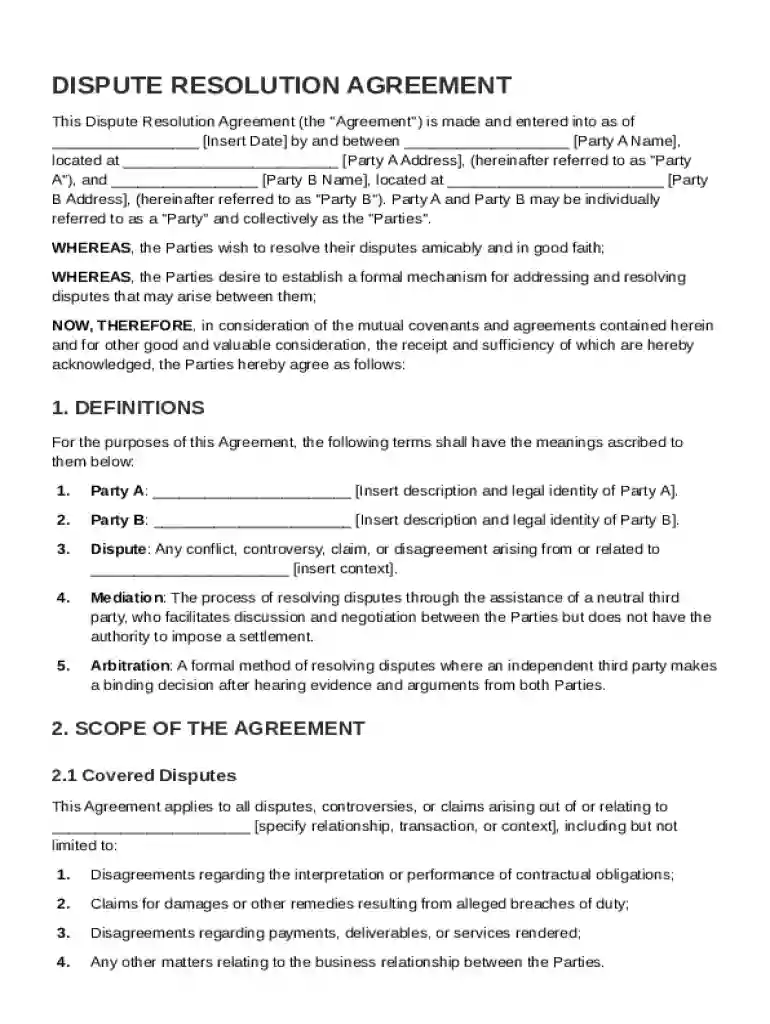
The Dispute Agreement Template is a well-structured document designed to facilitate amicable resolutions between conflicting parties. It comprises several critical components that ensure clarity and fairness in any dispute resolution process.
Identification of Parties: The template begins by clearly identifying the involved parties, typically referred to as Party A and Party B. This ensures that there is no ambiguity about who the agreement pertains to.
Scope of Disputes: It delineates the types of disputes covered by the agreement. This is critical for avoiding any overlap or confusion with other types of agreements. The scope may include specific business disagreements, contractual breaches, or any expressly stated issues.
Resolution Methods: The primary methods for dispute resolution — negotiation, mediation, and arbitration — are elaborately defined. Each method outlines its procedures, the roles of mediators or arbitrators, and how decisions are reached.
Confidentiality Agreements: A provision for confidentiality ensures that all parties respect the privacy of the proceedings and the information exchanged. This is vital for maintaining trust and integrity throughout the resolution process.
Cost-Sharing Arrangements: Details about how the costs associated with various resolution methods will be divided between the parties are included. This section often specifies equal cost-sharing unless otherwise agreed upon.
The template serves as a legally binding framework that abides by the laws governing dispute resolutions in the United States. It embodies crucial legal principles to enforce adherence and fairness.
Governing Law: This component specifies the state laws that will govern the agreement. This is essential to ensure that any legal proceedings align with the jurisdiction’s requirements.
Termination Conditions: Terms under which either party can terminate the agreement are clearly listed. These conditions ensure that the agreement remains fair and enforceable even if one party chooses to withdraw from it.
Legally Binding Nature: The template includes a clause verifying that both parties have read, understood, and agreed to the terms. This clause solidifies the contract’s enforceability in legal terms.
Arbitration Clauses: These clauses often specify that any disputes not resolved through negotiation or mediation will proceed to binding arbitration, waiving the right to take these disputes to court.
The process to complete the Dispute Agreement Template is structured to ensure that all sections are addressed thoroughly and correctly.
Review the Template: Before completing the template, review each section to understand the information required.
Fill in Party Information: Provide full contact details and legal names for both parties involved in the dispute.
Specify Disputes: Clearly define the disputes that are to be addressed, ensuring they fall within the specified scope.
Select Resolution Methods: Choose the primary method of resolution, be it negotiation, mediation, or arbitration, and outline the required steps.
Agree on Confidentiality Terms: Both parties should agree on the extent of confidentiality and include all necessary clauses.
Determine Cost-Sharing: Agree upon and document how costs will be shared between parties during the resolution process.
Legal Review: It may be wise for each party to consult with legal counsel to ensure all aspects align with their interests and legal standards.
Signatures: Once all sections are completed and agreed upon, both parties should sign the document to make it legally binding.
This template is versatile and finds utility across multiple sectors and entities.
Businesses: Companies often use this template to manage disputes with clients, partners, or even internally among staff members.
Legal Professionals: Lawyers may deploy the template to expedite resolution processes for clients, offering a standardized method for conflict management.
Government Entities: Public agencies may utilize the template to manage disputes related to contracts, regulations, and public service obligations.
Private Individuals: In some cases, private citizens engaged in personal agreements or partnerships may use the template to resolve disputes without courtroom involvement.


Utilizing the Dispute Agreement Template is a straightforward process that enhances efficiency and clarity.
Accessible Format: The template should be in a digital format, such as a DOC or PDF, allowing users to fill it out electronically or print it for manual completion.
Detailed Instructions: Accompanying instructions guide users on how to complete each section of the template, ensuring accuracy and completeness.
Collaboration Tools: Digital versions often allow multiple parties to access, edit, and provide input on the document concurrently, which is especially useful for remote or distributed teams.
Electronic Signatures: Platforms like DocHub allow users to apply legally binding electronic signatures, streamlining the validation process without printing.
Several terms are integral to understanding and effectively using the Dispute Agreement Template.
Mediation: A non-binding process where a neutral third party helps parties reach a mutual agreement.
Arbitration: A binding resolution process where an arbitrator makes decisions that parties must adhere to.
Confidentiality: An agreement between parties to keep the details of the dispute and its resolution private and withheld from external parties.
Governing Law: Refers to the jurisdictional laws that the agreement operates under, affecting legal outcomes and enforceability.
Cost Sharing: The agreed-upon distribution of expenses incurred during the resolution process, often critical for financial fairness.
These terms are vital for fully grasping the implications of the dispute agreement and ensuring that it functions as intended.
At DocHub, your data security is our priority. We follow HIPAA, SOC2, GDPR, and other standards, so you can work on your documents with confidence.


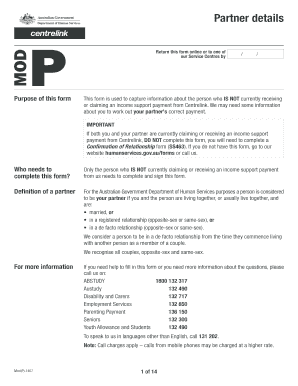



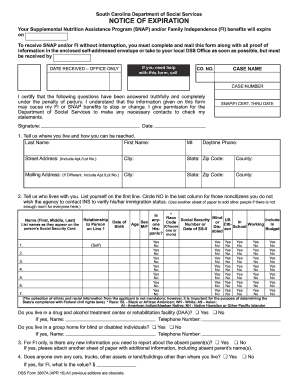
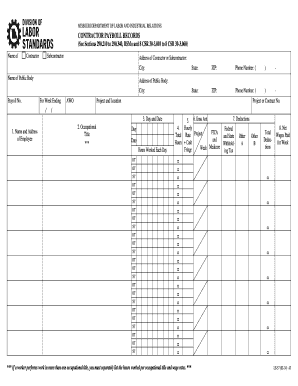
This agreement is between. (name) and. (name) and. (Mediator). The purpose of this agreement is to resolve a dispute using a neutral mediator.
The purpose of Alternative Dispute Resolution (ADR) in this matter is to assist the parties to resolve the issues in dispute between Appellant and Respondent. (
PROVIDER DISPUTE RESOLUTION REQUEST. NOTE: SUBMISSION OF THIS FORM CONSTITUTES AGREEMENT NOT TO BILL THE PATIENT. Please complete the below form. Fields with


