




01. Edit your form online
Type text, add images, blackout confidential details, add comments, highlights and more.

Type text, add images, blackout confidential details, add comments, highlights and more.

Draw your signature, type it, upload its image, or use your mobile device as a signature pad.

Send it via email, link, or fax. You can also download it, export it or print it out.
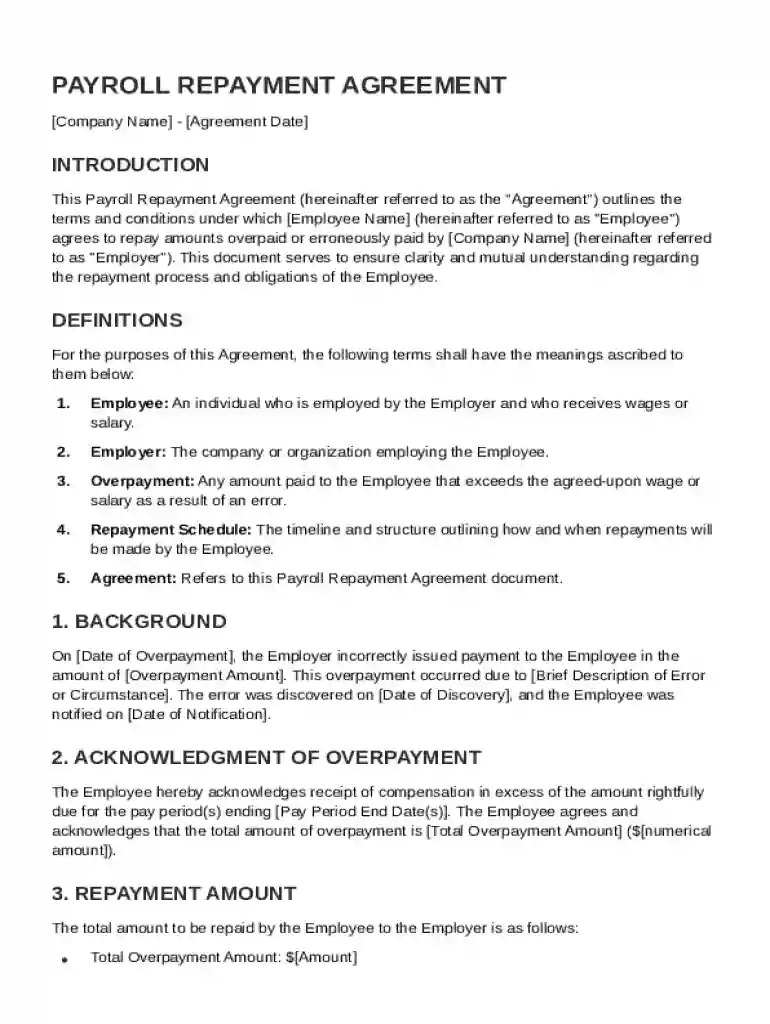
A Payroll Repayment Agreement Template serves as a formal document outlining the terms under which an employee agrees to repay any excess payment received from an employer. This agreement typically highlights critical components like the definitions of key terms, acknowledgment of the overpayment, agreed repayment amounts, and scheduled timelines. Additionally, it includes important legal elements like conditions of default, dispute resolution procedures, governing laws, and severability clauses. The purpose of this template is to ensure transparency and mutual understanding between employers and employees regarding repayment obligations, thereby avoiding potential disputes.
Using the Payroll Repayment Agreement Template involves a few straightforward steps designed to capture essential repayment details while safeguarding both parties' interests. It begins with understanding the purpose and structure of the agreement, followed by accurately filling in relevant information specific to the situation.
This template is primarily used by employers and human resources departments needing to regulate the repayment of overpaid wages. However, understanding its usage is also crucial for employees, enabling informed consent to the repayment terms.



Legally, the Payroll Repayment Agreement must comply with both federal and state laws, ensuring it provides clear, enforceable terms. Employers are advised to consult legal advisors to incorporate appropriate clauses protecting both parties.
Essential elements of the Payroll Repayment Agreement Template include:
Completing this form requires attention to detail and a step-by-step approach to ensure accuracy and comprehensiveness.
While federal regulations provide a baseline, individual states may have specific rules affecting the use of payroll repayment agreements. It’s advisable for employers to research and adhere to local laws to ensure compliance and effectiveness.
State laws can greatly impact how Payroll Repayment Agreements are constructed and enforced. For example, some states may have stricter rules on how much of an employee's salary can be deducted per pay period.
Understanding these differences ensures proper legal compliance and fosters trust between employers and employees.
At DocHub, your data security is our priority. We follow HIPAA, SOC2, GDPR, and other standards, so you can work on your documents with confidence.





This agreement is for repaying overpaid benefits from the EEOICPA, with a monthly plan. Payments are made to the U.S. Dept. of Labor, OWCP/DEEOIC, with Case ID
I also agree to repay the University of Michigan, within 6 months of the end of my employment, the remaining balance of the debt that has not been repaid via
This transmittal introduces Chapter 40, Hospital and Hospital Health Care Complex Cost Report,. Form CMS-2552-10, which contains instructions for the completion


