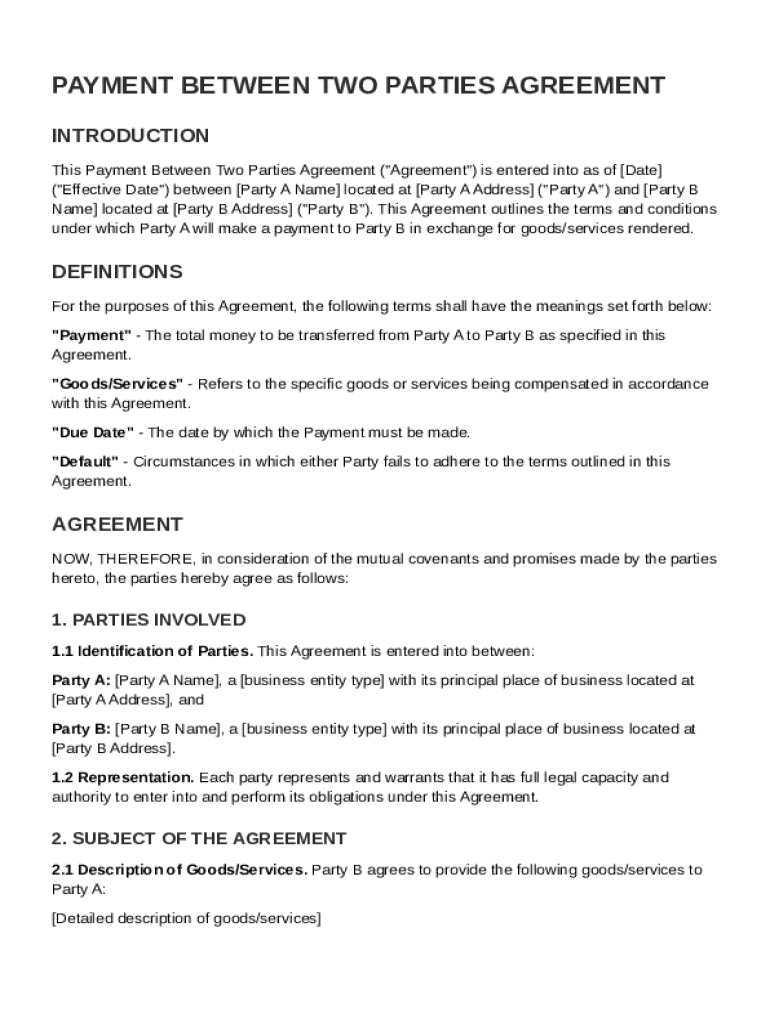







Definition and Meaning
The Payment Between Two Parties Agreement Template serves as a legally recognized document that defines the arrangement under which one party agrees to make payments to another party for the provision of goods or services. This agreement is essential in establishing a clear understanding between the parties regarding the payment terms, including methods, deadlines, and responsibilities. By explicitly outlining these elements, the agreement minimizes potential disputes and fosters a professional transaction process.
In practice, the agreement typically includes sections that define the key terms such as "Parties," "Payment Terms," "Obligations," and "Dispute Resolution." These definitions ensure all parties are aligned on the terminology, thus reducing misinterpretations that could lead to conflicts.
Key Elements of the Payment Between Two Parties Agreement Template
The template is structured to provide clarity and protection to both parties involved in a financial transaction. It encompasses several key elements:
-
Parties Involved: Clearly identifies the payer and the payee, including their legal names and contact details.
-
Payment Terms: Details the amount to be paid, the payment schedule, and the method of payment (e.g., bank transfer, check).
-
Obligations of Parties: Outlines the responsibilities of both parties, ensuring each understands their commitments.
-
Dispute Resolution: Provides mechanisms for resolving conflicts that may arise, normally through arbitration or mediation.
-
Amendments and Termination: Conditions under which the agreement can be altered or terminated are specified, along with procedures for making such changes.
Each element is crucial for ensuring legal enforceability and providing security to both parties in the event of a disagreement.
Steps to Complete the Payment Between Two Parties Agreement Template
Completing the Payment Between Two Parties Agreement Template involves several structured steps:
-
Identify the Parties: Include the full legal names and contact information for both parties.
-
Specify Payment Details: Enter the payment amount, frequency, and method in clear, concise terms.
-
Define the Obligations: Clearly articulate the responsibilities and deliverables expected from each party.
-
Outline Dispute Resolution Procedures: Specify how disputes will be handled, including preferred methods such as mediation or arbitration.
-
Review and Edit: Carefully review the document for accuracy, ensuring all sections are filled in and correctly reflect the agreed-upon terms.
-
Sign and Date: Both parties should sign and date the document to execute the agreement legally.
Following these steps ensures the document is comprehensive and legally binding, providing a solid foundation for the business transaction.
Who Typically Uses the Payment Between Two Parties Agreement Template
This template is widely used across various sectors and by different entities, including:
-
Businesses: Companies of any size use it to formalize payment structures with suppliers or service providers.
-
Freelancers and Contractors: Independent workers often utilize this agreement to secure payment for services rendered to clients.
-
Landlords and Tenants: It can mediate financial agreements concerning rental payments.
-
Individuals: Private parties may use it to document a loan or financial assistance between individuals.
Each of these users benefits from the formalized structure the template provides, ensuring clarity and legal protection in monetary dealings.


Legal Use of the Payment Between Two Parties Agreement Template
The legal standing of the Payment Between Two Parties Agreement Template is significant. It is enforceable under U.S. contract law, provided that it has the following characteristics:
-
Mutual Consent: Both parties must agree to the terms, as evidenced by their signatures.
-
Consideration: Specifies an exchange of value, where Party A provides goods/services, and Party B provides payment.
-
Legality: The purpose of the agreement must be lawful.
-
Capacity: All parties must have the legal capacity to enter into the agreement.
When these conditions are met, the agreement is legally binding, offering the protection necessary for both parties.
Important Terms Related to the Payment Between Two Parties Agreement Template
Understanding specific terminology is critical for using the template effectively. Key terms include:
-
Payee and Payer: Defines the recipient of the payment and the party responsible for making the payment.
-
Default: Refers to the failure to meet payment obligations or other agreed-upon responsibilities.
-
Force Majeure: Clauses that excuse performance delays due to unforeseen events outside the parties' control, like natural disasters.
Each of these terms forms the backbone of the agreement, allowing for a precise understanding of each party's roles and responsibilities.
State-Specific Rules for the Payment Between Two Parties Agreement Template
While the core elements of the agreement are similar across states, some variations exist due to local laws regarding:
-
Interest Rates on Late Payments: States have differing regulations about permissible interest rates or penalties for late payments.
-
Arbitration Clauses: Some states have specific rules on the enforceability of these clauses in contracts.
-
Statutes of Limitations: The duration within which a party can sue for breach of contract varies from state to state.
Parties must consult with a legal expert to ensure compliance with state-specific regulations, ensuring the agreement remains enforceable.
Software Compatibility
When digitally managing the Payment Between Two Parties Agreement Template, certain software systems ensure seamless document handling:
-
DocHub: Offers extensive tools for editing, signing, and sharing agreements online.
-
Adobe Acrobat: Commonly used for creating and editing PDF documents.
-
Microsoft Word: Useful for drafting and customizing template documents before converting them into PDFs.
Compatibility with these tools allows users to efficiently draft, review, and finalize agreements, ensuring both access and ease of use.