






Definition & Meaning
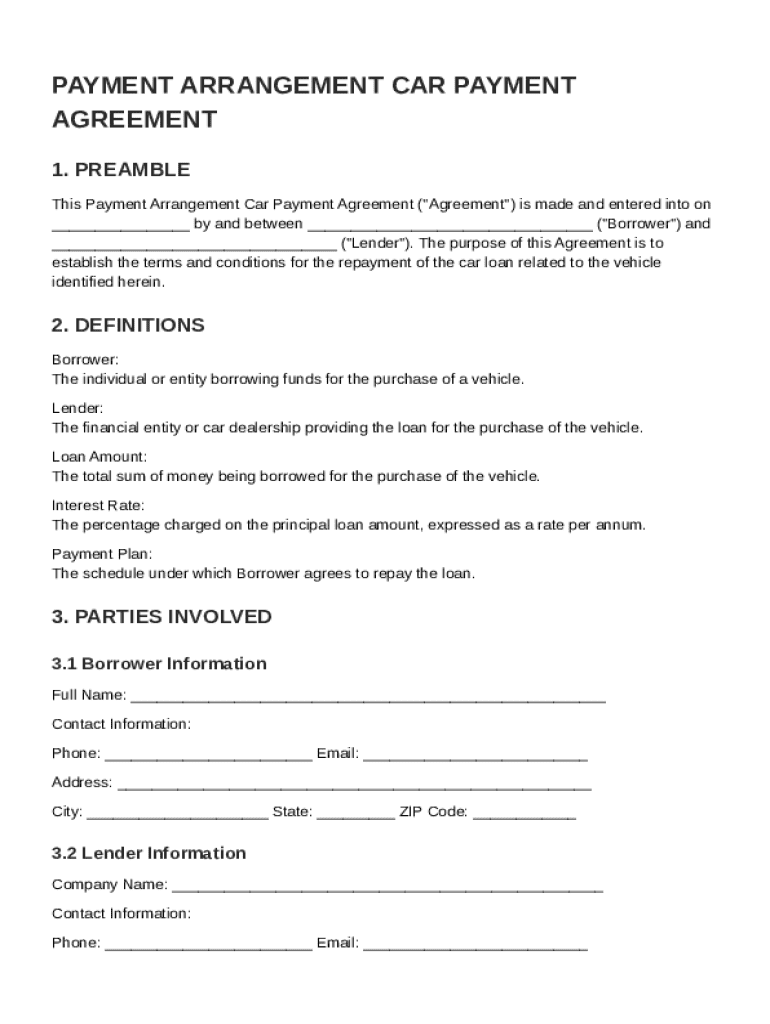
The Payment Arrangement Car Payment Agreement Template is a legal document that articulates the terms and conditions agreed upon by a borrower and a lender for a car loan. It contains key details such as the identities of the involved parties, the vehicle specifics, loan amount, interest rates, and payment schedule. Additionally, it delineates protocols for payment modifications and addresses the handling of late payments or prepayment scenarios. The agreement serves as a crucial, binding document that establishes the obligations and responsibilities of the borrower while providing the lender with legal remedies in the event of a default.
Key Elements of the Payment Arrangement Car Payment Agreement Template
Identification of Parties
- Borrower Details: Includes full name, contact information, and address.
- Lender Details: Provides the lender's name, business address, and contact number.
Vehicle Information
- Vehicle Description: Details such as make, model, year, and vehicle identification number (VIN) of the car that is being financed.
Loan Terms
- Loan Amount: The principal amount borrowed.
- Interest Rate: The percentage charged on the borrowed amount.
- Payment Schedule: Specifies the due dates and frequency of payments, such as monthly or bi-weekly.
Default and Remedies
- Default Scenarios: Conditions under which the borrower is considered to be in default, like missed payments.
- Legal Remedies: Possible actions the lender can take in the event of default, including repossession of the vehicle.
Important Terms Related to Payment Arrangement Car Payment Agreement Template
Understanding the legal and financial terminology within this template is vital:
- Amortization: The process of spreading out a loan into a series of fixed payments over time.
- Collateral: The car financed, acting as security for the loan.
- Balloon Payment: A larger payment due at the end of a loan term after a series of smaller payments.
- Acceleration Clause: Allows the lender to demand immediate repayment of the loan under specific conditions.
Steps to Complete the Payment Arrangement Car Payment Agreement Template
- Gather Information: Collect personal details of both parties, vehicle description, and loan specifics.
- Fill Agreement Sections: Input borrower and lender details, vehicle information, and specific loan terms into the template.
- Review Default clauses: Understand the conditions and legal ramifications of default.
- Provide Signatures: Both parties should sign the agreement to validate its enforceability.
Legal Use of the Payment Arrangement Car Payment Agreement Template
The template ensures legal compliance by adhering to the ESIGN Act for electronic signatures, offering a valid way to finalize the agreement digitally. The use of secure channels and authentication steps, such as OAuth 2.0, ensures the document's integrity throughout the transaction process. Its comprehensive terms and outlined responsibilities reduce potential conflicts, making it legally robust.
Examples of Using the Payment Arrangement Car Payment Agreement Template
- Loan Restructuring: When a borrower needs to renegotiate their payment plan due to financial hardship, this template provides the framework for formalizing those changes.
- Pre-Approval Loan Offers: Used by lenders to provide clear terms to pre-approved borrowers, ensuring transparent communication.
- Refinancing Agreements: Facilitate a shift in loan terms, offering lower interest rates or modified payment schedules to suit changing financial circumstances.
State-Specific Rules for the Payment Arrangement Car Payment Agreement Template
- Usury Laws: Govern the maximum interest rates that can be applied to loan agreements, varying by state.
- Repossession Regulations: Each state has specific rules detailing how and when a lender can repossess a vehicle for defaulted loans.
Digital vs. Paper Version
Both versions require adherence to legal standards; however, the digital version allows for added conveniences like quicker amendments, secure distribution via cloud services, and seamless integration with platforms like Google Workspace. For those who prefer a traditional approach, the paper version remains a credential medium, though lacking in modern conveniences.