Content Sharing Agreement Template 2026

Get Form
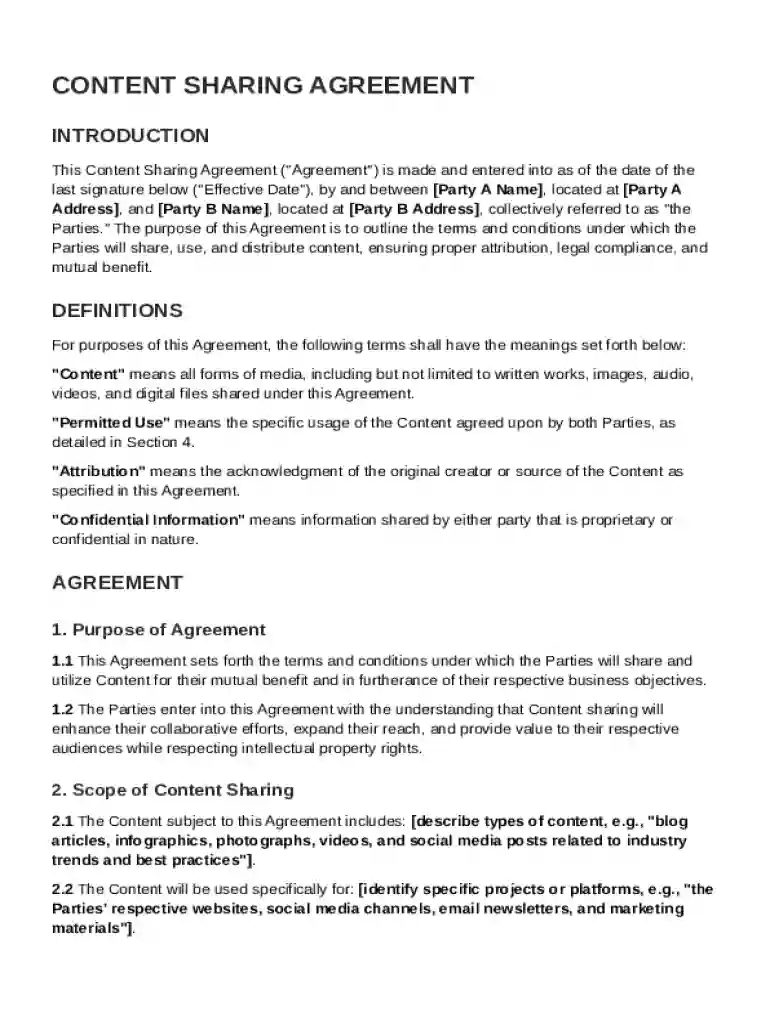
Content Sharing Agreement Template Preview on Page 1

Here's how it works

01. Edit your form online
Type text, add images, blackout confidential details, add comments, highlights and more.

02. Sign it in a few clicks
Draw your signature, type it, upload its image, or use your mobile device as a signature pad.

03. Share your form with others
Send it via email, link, or fax. You can also download it, export it or print it out.

Definition & Meaning

A content sharing agreement template is a formal document that outlines the terms and conditions for sharing, using, and distributing content between two or more parties. This agreement is integral to collaborative projects where content—such as text, images, or multimedia—needs to be used, adapted, or shared across various platforms. The template serves as a framework ensuring that all parties understand their rights and responsibilities regarding the content usage, which minimizes potential disputes and breaches of contract. Key aspects typically defined in this template include content ownership, permitted use, and attribution requirements.

Common Terminology

  • Content: The material covered by the agreement, which could include text, images, videos, and more.
  • Permitted Use: The specific ways in which the content can be used by the parties involved.
  • Attribution: The requirement for crediting the original creator of the content in any third-party usage.

Key Elements of the Content Sharing Agreement Template

Every content sharing agreement template usually contains several critical components that ensure comprehensive coverage of all necessary legal bases. These core elements provide clarity and protection for all parties involved.

Essential Sections

  • Introduction and Parties: Identifies the parties entering into the agreement and provides information about each.
  • Rights and Responsibilities: Defines who holds the rights to the content and what responsibilities each party has in terms of maintaining those rights.
  • Usage Provisions: Details how the content can or cannot be used, including any limitations or special permissions needed.

Additional Features

  • Confidentiality Clauses: Protects sensitive information and specifies what cannot be disclosed to third parties.
  • Termination Conditions: Outlines how and when the agreement can be terminated by either party.
  • Indemnification and Liabilities: Clarifies who is liable for potential breaches and how indemnification will be handled.

How to Use the Content Sharing Agreement Template

Using a content sharing agreement template involves understanding the needs of your collaboration and adapting the template accordingly. The process is structured to ensure all parties are equally protected and aware of their commitments.

Detailed Steps

  1. Identify Needs: Assess what content will be shared and how each party will use it.
  2. Customize the Template: Adapt sections of the template to reflect the specific terms of your agreement.
  3. Review Legalities: Engage legal counsel to ensure the document complies with relevant laws.
  4. Finalization: All parties review and sign the document after agreeing to the terms.

Practical Example

For instance, a digital marketing agency working with a freelance content creator would need to clearly define how social media graphics will be used and credited in advertising campaigns.

Steps to Complete the Content Sharing Agreement Template

Completing a content sharing agreement template requires careful attention to detail to avoid errors or omissions that could compromise the agreement’s enforceability.

Comprehensive Guide

  1. Gather Relevant Information: Collect details about all parties involved, including contact information.
  2. Draft Specific Terms: Include detailed terms about content usage, attribution, and permissible modifications.
  3. Include Protective Measures: Add clauses for confidentiality, indemnification, and dispute resolution.
  4. Consult with Legal Professionals: Have a lawyer review the draft to ensure all legal considerations are covered.
  5. Sign and Distribute: Once finalized, ensure all parties sign the document and distribute copies for records.

Considerations

  • Ensure all fields are complete and understandable.
  • Confirm that the responsibilities and rights are equally distributed.

Important Terms Related to Content Sharing Agreement Template

Understanding important legal and contextual terms within the document is crucial for all parties to ensure compliance and avoid disputes.

Critical Terms

  • Non-Exclusive License: Allows content to be used by multiple parties but doesn’t make the user the sole licensee.
  • Modification Rights: Specifies whether the content can be altered.
  • Governing Law: Indicates which jurisdiction’s laws will apply in interpreting the agreement.

Examples

A clause for 'Modification Rights' might specify that while parties can resize or color-adjust graphics, they are not allowed to alter the core content or digital watermark.

Legal Use of the Content Sharing Agreement Template

The legal enforceability of any content sharing agreement template hinges on clear, precise drafting and adherence to regulatory standards.

Important Legal Considerations

  • Jurisdiction Compliance: Ensure the agreement abides by the laws of the state or region where it will be enforced.
  • Validity of Signatures: Collect valid, legally binding signatures from all parties.
  • Regular Updates: Review and update the agreement periodically to align with changes in law and practice.

Scenario

A media organization in New York would need to ensure that its agreements comply with the applicable state and federal laws pertaining to intellectual property.

Who Typically Uses the Content Sharing Agreement Template

Content sharing agreements serve various sectors and individuals, cementing their significance in different industries and collaborative environments.


decoration image ratings of Dochub

Typical Users

  • Media Companies: To license content for distribution.
  • Freelancers and Creatives: To provide content while retaining rights over it.
  • Educational Institutions: For using and sharing copyrighted content in digital learning materials.

Real-World Application

A university might use the template to allow professors to share lecture materials with partner institutions, thus ensuring both attribution and usage rights are maintained.

State-Specific Rules for the Content Sharing Agreement Template

Certain states may have distinctive rules concerning content rights and distribution, necessitating modifications to the agreement to ensure compliance.

Examples of Variations

  • California: Stringent digital privacy regulations affect how content sharing agreements need to incorporate data protection clauses.
  • Texas: Particular attention to intellectual property rights means definitions and protections need to be thoroughly detailed.

Recommendations

Consult with legal professionals familiar with state-specific laws to adapt the template appropriately for your jurisdiction.

be ready to get more

Complete this form in 5 minutes or less

Get form

Got questions?

We have answers to the most popular questions from our customers. If you can't find an answer to your question, please contact us.
Contact us
Unlike a DPA, a Data Sharing Agreement governs the transfer of data between two or more data controllers or entities. Its goal is to ensure that the shared data is used responsibly and in compliance with applicable legal frameworks.
Essentially: Use a DPA when the other party processes data on your behalf without deciding the why or how. 💡 Data Sharing Agreement (DSA) Use when: Two controllers share data with each othereach deciding independently how and why to process it.
Example 1: RD Cost-Sharing in the Pharmaceutical Industry Both entities agree to share RD costs based on their expected market share for the drug. The U.S. subsidiary is responsible for 60% of the costs, while the German subsidiary covers 40%, reflecting their projected benefits from future sales.
Data sharing agreements (DSAs) are contracts that define how sensitive data is exchanged securely and legally. They reduce risks, promote accountability, and ensure compliance with laws. Heres what a strong DSA should include: Scope: Types of data, permitted uses, and timeframe.
How to Create a Collaboration Agreement + Free Template Clearly state the goals and scope of the project. Include full legal names, addresses, and contact details of all parties involved (individuals or entities). Specify what each party contributes, such as funds, labor, equipment, intellectual property, or expertise.

Security and compliance

At DocHub, your data security is our priority. We follow HIPAA, SOC2, GDPR, and other standards, so you can work on your documents with confidence.


Learn more
ccpa2
pci-dss
gdpr-compliance
hipaa
soc-compliance

People also ask

This agreement defines the responsibilities of each party, specifies content delivery formats and timelines, and outlines distribution channels. It also establishes the scope of distribution, revenue sharing structures, and protects intellectual property rights.

Related links