
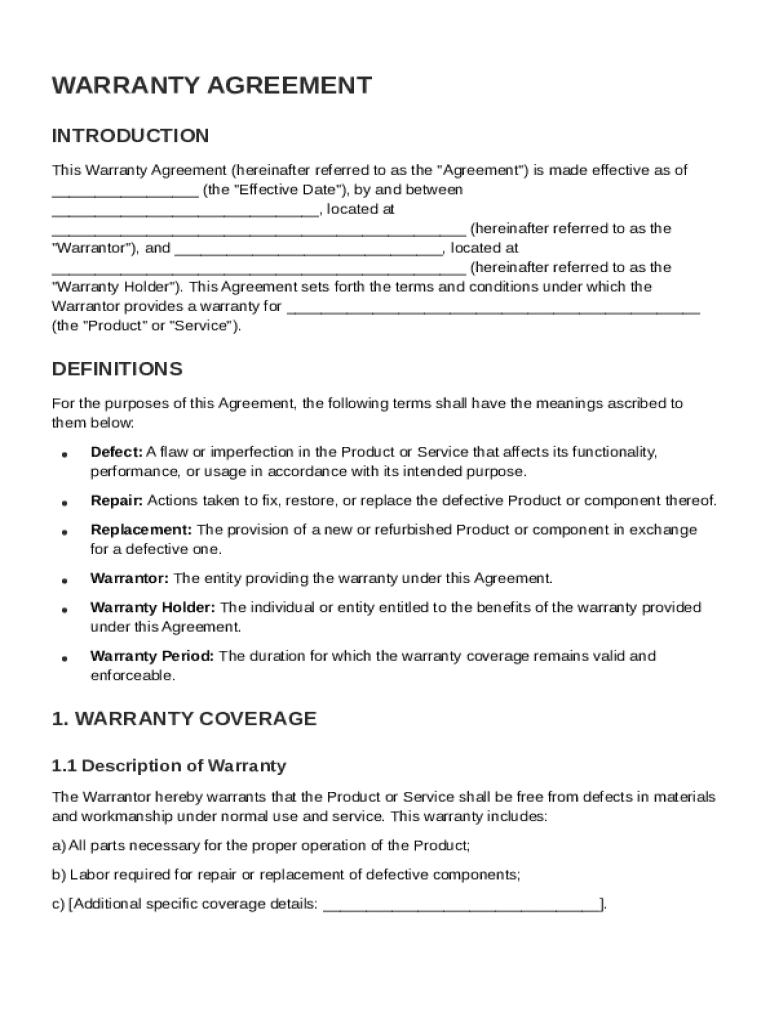







Definition and Meaning
The Warranty Contract Template is a document used to outline the terms and conditions under which a Warrantor provides warranty coverage for a specified product or service to a Warranty Holder. This template serves as a legal agreement detailing the scope of coverage, responsibilities of the parties involved, and any limitations or exclusions. The contract defines key terms such as "Warrantor," "Warranty Holder," and "Product" to ensure all parties have a clear understanding of the agreement. By specifying these details, the document acts as a protective measure for both the provider and the recipient of the warranty.
How to Use the Warranty Contract Template
To effectively utilize the Warranty Contract Template, follow a structured approach:
- Identify Parties: Clearly state the names and contact information of the Warrantor and Warranty Holder.
- Define Product or Service: Describe the item or service covered by the warranty, including model numbers or serial codes, if applicable.
- Detail Coverage: Outline the warranty's coverage, including repairs, replacements, or refunds. Specify what situations are covered and any associated costs.
- List Exclusions: Clearly mention the scenarios or damages not covered under the warranty.
- Determine Duration: State the warranty's validity period and any conditions for extensions.
- Specify Claims Process: Provide step-by-step instructions on how the Warranty Holder can claim benefits, including necessary documentation.
- Include Governing Law: Indicate which state’s laws will govern the warranty terms.
Key Elements of the Warranty Contract Template
A comprehensive Warranty Contract Template must contain the following critical sections:
- Coverage Terms: Explains the obligations for repair, replacement, or refund, including timeframes for service.
- Responsibility Clauses: Clearly defines both parties' responsibilities to ensure accountability, such as maintenance requirements for the Warranty Holder.
- Limitations and Exclusions: Details what the warranty does not cover, such as accidental damage or misuse.
- Amendment Provisions: Specifies how changes to the contract will be managed and communicated.
- Termination Conditions: Outlines scenarios where the warranty can be voided.
Legal Use of the Warranty Contract Template
The Warranty Contract Template functions as a legal document and must adhere to relevant state and federal laws. In the U.S., warranties must comply with the Magnuson-Moss Warranty Act, which governs consumer product warranties. Essential legal aspects include:
- Disclosure Requirements: All terms must be transparent and clearly communicated.
- Consumer Rights: Warranty terms cannot override basic consumer rights protected by law.
- Enforcement: The contract must outline the process for resolving disputes, including arbitration or court proceedings.
Important Terms Related to Warranty Contract Template
Understanding the following terms is crucial for interpreting the Warranty Contract Template:
- Warrantor: Entity offering the warranty, responsible for specified obligations.
- Warranty Holder: Individual or entity holding the warranty and eligible for its benefits.
- Limited Warranty: Offers restricted coverage, only under specified conditions.
- Express Warranty: Specific promises made regarding the quality or performance of a product or service.
- Implied Warranty: Unspoken, unwritten guarantee that the product is fit for its intended purpose.
Steps to Complete the Warranty Contract Template
Completing the Warranty Contract Template involves the following:
- Download Template: Obtain from a reputable source such as DocHub.
- Populate Template: Insert correct information regarding both parties and the product/service.
- Review Terms: Ensure all clauses reflect mutual understanding and agreement.
- Seek Legal Advice: Consult with a legal professional for compliance and comprehensiveness.
- Sign Off: Both parties review final document, approve, and sign electronically or on paper.
Who Typically Uses the Warranty Contract Template
This template is predominantly used by:
- Manufacturers: To provide customers with official warranty agreements for commercial products.
- Service Providers: To outline the terms of service warranties, especially for repairs or installations.
- Retailers: To offer warranties that enhance customer trust and add value to sold products.
- Independent Sellers: To formalize warranty offerings for buyers in online marketplaces.


Examples of Using the Warranty Contract Template
Real-world application scenarios include:
- Consumer Electronics: Outlining coverage for smart devices such as laptops and smartphones.
- Automobile Sales: Providing warranties on new or certified pre-owned vehicles.
- Appliance Retailers: Offering home appliance warranties detailing repair and replacement terms.
- Home Builders: Issuing structural warranties for newly built homes to cover construction defects.




