01. Edit your form online
Type text, add images, blackout confidential details, add comments, highlights and more.

Type text, add images, blackout confidential details, add comments, highlights and more.

Draw your signature, type it, upload its image, or use your mobile device as a signature pad.

Send it via email, link, or fax. You can also download it, export it or print it out.
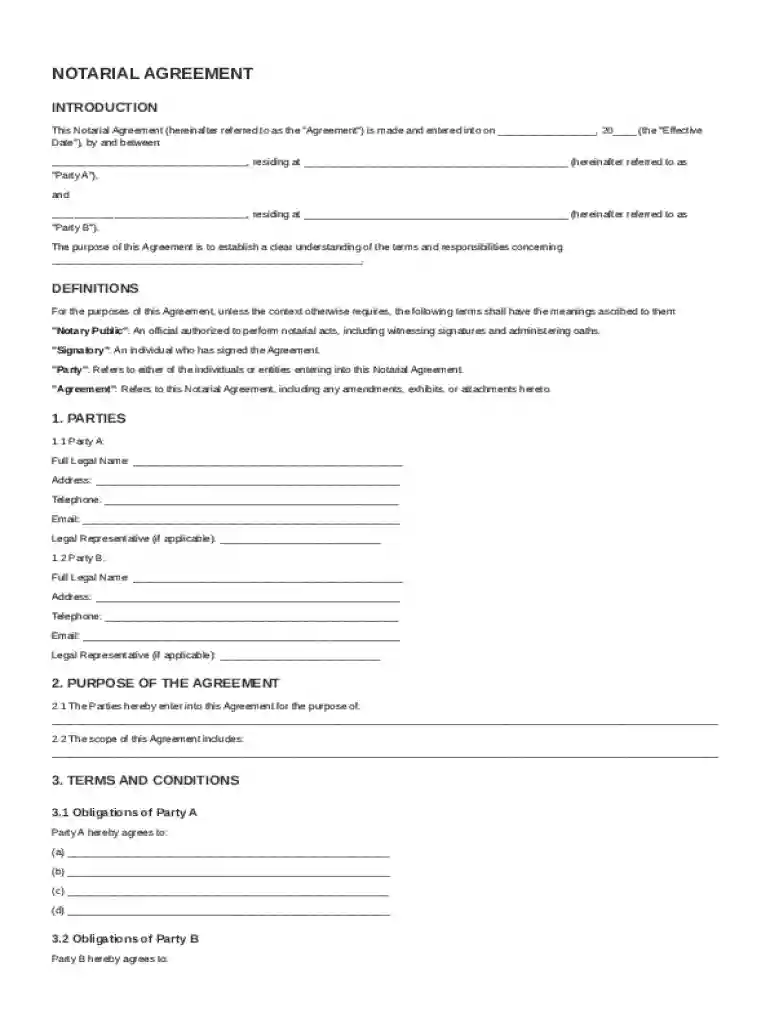
A notarial agreement template is designed to formalize arrangements between two parties, typically referred to as Party A and Party B. These documents often include crucial components that ensure the agreement is comprehensive and legally binding. Below are the key elements encapsulated in a notarial agreement template:
Definitions of Key Terms: A section dedicated to defining crucial terms used throughout the document, ensuring clarity and mutual understanding between the involved parties.
Obligations of Each Party: This part outlines the specific roles and responsibilities of Party A and Party B, detailing what each party is required to fulfill under the agreement.
Notarization Process: A detailed description of the steps involved in the notarization process, which is crucial for validating signatures and verifying the identities of the parties.
Governing Law: Specifies which jurisdiction's laws will apply to the agreement. This section is essential for determining how disputes will be resolved.
Amendments Clause: Provides guidelines on how the agreement can be modified or amended, ensuring any changes are documented and agreed upon by all parties.
Severability Clause: This clause ensures that if any part of the agreement is found to be unenforceable, the remaining sections will still be valid and effective.
Completing a notarial agreement template requires a thorough understanding of the document's structure and the specific obligations of each party. Here is a step-by-step guide to finalize the notarial agreement template:
Gather Required Information: Both parties should collect all necessary details, including names, addresses, and key terms relevant to the agreement.
Draft Initial Agreement: Begin by outlining the responsibilities, deadlines, and any contingencies that might affect the agreement's execution.
Review Definitions: Ensure that all key terms are clearly defined in the template to prevent misunderstandings.
Include Governing Law and Amendment Clauses: Specify the legal framework that will govern the agreement and conditions under which amendments can occur.
Seek Legal Review: Before notarization, it's advisable to have a legal expert review the agreement for any potential issues.
Undergo Notarization Process: Have the agreement duly notarized to verify the identities of the signing parties and validate the signatures.
Understanding the terminology within a notarial agreement template is essential for ensuring that both parties interpret the document correctly. Here are some crucial terms:
Party A/Party B: The two entities entering into the agreement. Each party's rights and obligations are extensively detailed in the document.
Notarization: The official process of certifying a document, which involves an impartial third party (a notary public) verifying the identities of the signatories.
Severability: A legal concept referring to the ability to enforce parts of an agreement even if one part is declared invalid.
Contractual Obligations: The specific duties, restrictions, or benefits assigned to each party involved in the agreement.
The primary legal function of a notarial agreement template is to serve as a binding contract that is enforceable in a court of law. Here are critical aspects of its legal use:
Validation of Signatures: The notarization process ensures that the signatures on the document are authentic and that the parties involved understand their commitments.
Identifying Parties: Legally identifies each party involved in the agreement and their respective roles and responsibilities.
Providing Legal Recourse: In case of a breach, the document serves as evidence of the agreed terms, aiding in resolving disputes through legal channels.
Notarial agreement templates are utilized by a wide array of individuals and entities seeking legal assurance in their agreements. Common users include:
Individuals: For personal matters such as loan agreements, property transactions, and prenuptial arrangements.
Businesses: Companies use these templates for partnership agreements, vendor contracts, and real estate transactions.
Legal Professionals: Lawyers and legal firms might draft or advise on notarial agreements as part of their services.


State laws can differ significantly; thus, users must be aware of specific requirements regarding notarial agreements in their jurisdiction. Considerations include:
Notary Qualifications: Requirements governing who can perform notarizations may vary, including commissions and certifications needed.
Document Requirements: Some states may require additional documentation or specific language to be included in notarial agreements.
Fee Structures: The cost structure for notarization services can differ between states, often influenced by regulatory limits.
Practical examples underscore the relevance of using a notarial agreement template in varied scenarios:
Real Estate Transactions: Legalizing purchase agreements and ensuring both buyer and seller understand the terms of the transfer.
Loan Agreements: Securing terms of personal loans between private parties, which may require agreements to be notarized.
Partnership Contracts: Formalizing business partnerships with clear delineation of roles, investment contributions, and profit sharing.
While a notarial agreement template serves many needs, there are alternatives or versions that cater to specific purposes:
Standard Contracts: For situations that do not require notarization, a simple contract might suffice.
Electronic Notarial Services: Digital alternatives offered by platforms like DocHub simplify the signing process via legally-binding electronic signatures.
Specific Template Variants: Specialized forms exist for different agreements, such as NDAs, leases, or service contracts, each with unique requirements.
At DocHub, your data security is our priority. We follow HIPAA, SOC2, GDPR, and other standards, so you can work on your documents with confidence.