






Definition and Meaning of Non-Disclosure for Potential Investors Agreement Template
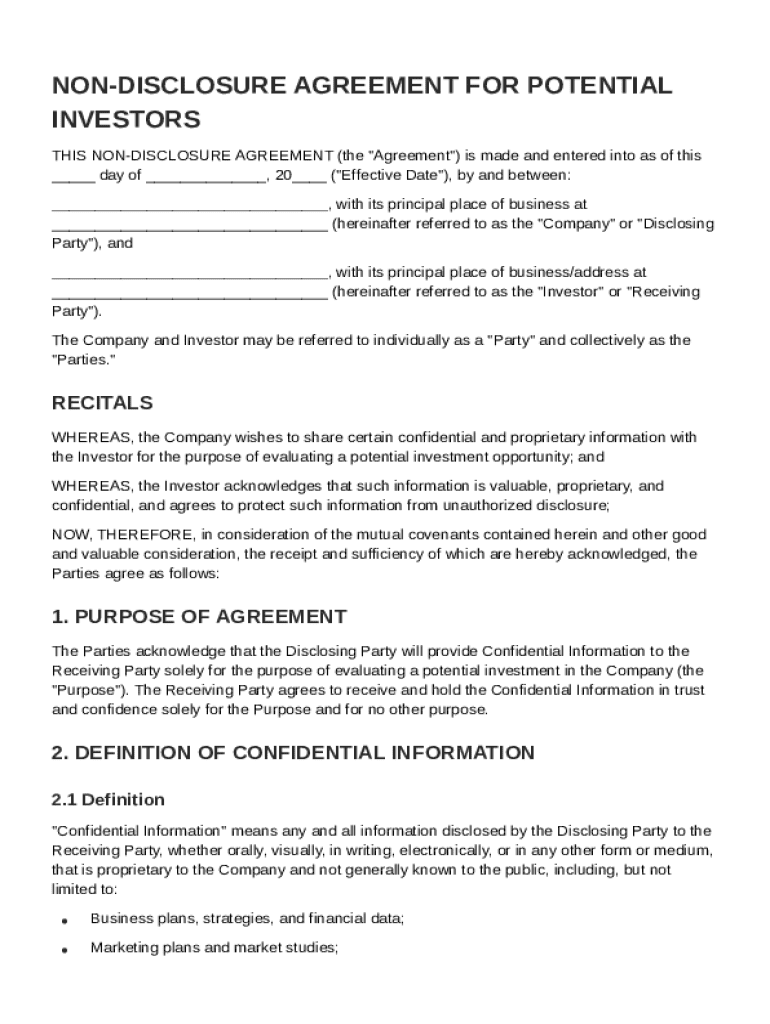
A Non-Disclosure Agreement (NDA) for potential investors serves as a legally binding contract between a company and an investor, defining the terms for sharing confidential information. This template outlines what constitutes 'Confidential Information' and establishes the obligations of the receiving party to maintain the confidentiality of the details shared. It restricts the use of such information strictly to the purpose of evaluating an investment opportunity, ensuring that sensitive data is not exploited for other business dealings or personal benefits. The agreement typically includes a fixed duration for confidentiality, specifying how long the disclosed information must remain protected.
Key Elements of the Non-Disclosure Agreement Template
A well-structured NDA template comprises several essential components to maintain legal robustness and clarity:
- Confidential Information Definition: Clearly outlines what information is deemed confidential, such as trade secrets, proprietary data, or intellectual property.
- Purpose of Information Sharing: Specifies the intent behind sharing confidential data, typically to assess potential investment opportunities.
- Obligations of Parties: Details the responsibilities of the receiving party, including preserving the secrecy of the information and limiting its use.
- Exclusions from Confidentiality: Lists information categories not covered by the NDA, such as publicly available data, information already known by the receiving party, or independently developed data without using confidential insights.
- Duration of Obligations: Defines the time frame during which the information must remain confidential, often extending beyond the end of negotiations.
- Return or Destruction of Materials: Obligates the receiving party to either return or destroy any confidential materials upon the termination of the agreement or upon request.
- Legal Clauses: Includes provisions for governing law, jurisdiction, and dispute resolution mechanisms.
Steps to Complete the Non-Disclosure for Potential Investors Agreement Template
- Identify Parties Involved: Clearly list the names and addresses of all parties entering the agreement, ensuring both entities are identified accurately.
- Define Confidential Information: Specify what constitutes confidential information, detailing the nature and form of the information shared.
- Outline Purpose and Obligations: State the purpose for which the confidential information is shared and the obligations of both parties.
- Set Exclusions and Duration: Clearly state what information is not considered confidential and specify the term during which confidentiality must be maintained.
- Include Legal Provisions: Add necessary legal clauses, such as governing law and dispute resolution methods, for enforceability.
- Provide for Material Return/Destruction: Include clauses detailing how confidential information should be handled upon the termination of the agreement.
- Signature Blocks: Allocate space for the signatures and dates from representatives of both parties to validate the agreement legally.
Who Typically Uses the Non-Disclosure for Potential Investors Agreement Template
The NDA for potential investors is primarily used by companies seeking to safeguard their sensitive information during discussions with potential investors. It is particularly common in sectors where intellectual property and proprietary information are crucial competitive assets, including:
- Start-ups seeking venture capital: Early-stage companies looking to secure funding while protecting innovative ideas and business strategies.
- Established businesses exploring new partnerships: Companies needing to share sensitive strategic details for potential alliances.
- Investment groups performing due diligence: Investment groups conducting thorough evaluations to ensure sound investing decisions.


Legal Use of the Non-Disclosure for Potential Investors Agreement Template
Legal enforceability is an essential aspect of NDAs. The legal use of this template involves:
- Ensuring Compliance with State Laws: The NDA must align with applicable state laws where the parties operate to ensure enforceability.
- Incorporating Mutual Agreement: The document should reflect a mutual understanding and consent to all terms, establishing a legally binding commitment.
- Including Clear and Unambiguous Terms: Legal enforceability is strengthened by precise language, avoiding ambiguity that can lead to disputes.
Important Terms Related to Non-Disclosure Agreement Templates
Understanding the commonly used terms in NDAs can aid in drafting and interpreting these documents effectively:
- Disclosing Party: The entity providing confidential information to the other party.
- Receiving Party: The entity obtaining confidential information subject to confidentiality obligations.
- Confidentiality Obligations: Duties of the receiving party to protect the information as specified in the NDA.
- Trade Secret: A category of confidential information that derives economic value from not being publicly known.
- Non-Compete Clause: A provision preventing the receiving party from engaging in business directly competitive with the disclosing party, often used in conjunction with NDAs.
State-Specific Rules for Non-Disclosure Agreements
While NDAs are universally recognized, their enforceability can vary by state due to differences in regional laws. It is crucial to consider:
- Differences in Definition of Confidential Information: Some states may have specific statutes detailing what constitutes confidential information.
- Variations in Legal Requirements for Enforceability: States might require different considerations or levels of specificity for terms to be enforceable.
- State-Specific Legal Precedents: Familiarity with case law within the state can impact how NDAs are interpreted and enforced by courts.
Examples of Using the Non-Disclosure for Potential Investors Agreement Template
Real-world scenarios demonstrate the applicability and utility of NDAs:
- Technology Startup with Proprietary Coding: A tech company shares its source code and project plans with potential investors under an NDA to prevent leakage of its competitive edge.
- Biotechnology Firm with Innovative Research: A biopharma entity safeguards its proprietary research processes and formulations during funding discussions.
- Retail Brand Launching a New Product Line: A retail company looking to launch new products shares its marketing plans and design blueprints with financial backers while securing its concept from early exposure.