






Definition and Meaning of the Redundancy Agreement Template
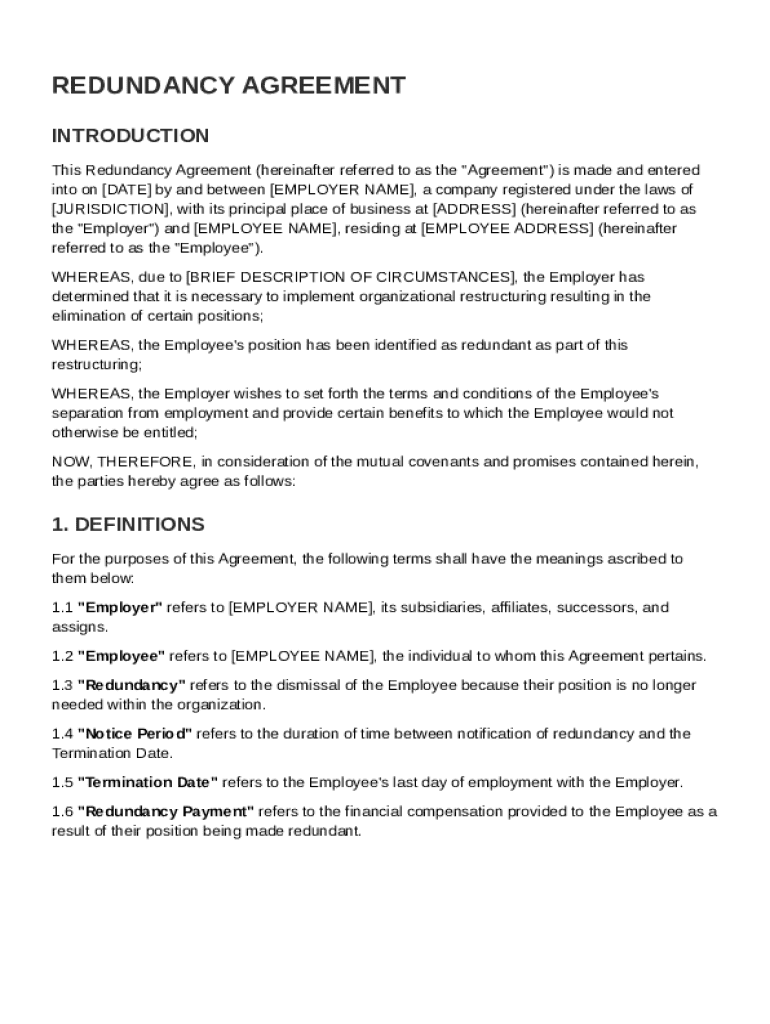
A Redundancy Agreement Template is a structured document used to outline the terms and conditions under which an employee's role is considered redundant. This document is essential in ensuring clarity during organizational restructuring. Key elements included are the effective termination date, notice period, and redundancy payments. The agreement also defines continued benefits, employee rights such as the right of appeal, and confidentiality obligations. By providing clear terms, the redundancy agreement ensures that employees receive benefits exceeding statutory minimums.
How to Use the Redundancy Agreement Template
To effectively use a Redundancy Agreement Template, organizations need to adapt the document to fit specific contexts. Begin by identifying the employee positions affected by redundancy. Insert relevant information such as the employee's name, position, and termination date. Customizing the redundancy payment calculation section for each employee is crucial. Ensure that all employee entitlements, including continued benefits and any additional support, are clearly detailed. Review the final version with legal counsel to ensure compliance with employment laws.
Customizing For Specific Needs
- Adjust notice period based on seniority or organizational policy.
- Include provisions for job search support or training opportunities.
- Detail any non-disclosure agreements relevant to the redundancy.
Key Elements of the Redundancy Agreement Template
Termination Details
- Effective Date: The exact date when employment terminates.
- Notice Period: Duration provided to the employee before the termination takes effect.
Financial Components
- Redundancy Payments: Calculation criteria, often based on tenure and salary.
- Continued Benefits: Information on benefits like healthcare or retirement plans.
Rights and Support
- Right of Appeal: Provides employees a process to contest the redundancy.
- Confidentiality Obligations: Ensures company information remains secure post-termination.
Steps to Complete the Redundancy Agreement Template
- Review Legal Requirements: Understand state and federal employment laws.
- Gather Employee Information: Collect personal and employment details for accuracy.
- Draft Initial Agreement: Use the template to create a first draft.
- Calculate Redundancy Payments: Use agreed formulas for precise financial details.
- Legal Review: Consult with employment law specialists.
- Employee Consultation: Discuss the agreement terms with affected employees.
- Finalize and Sign: Ensure both parties sign the agreement.
State-Specific Rules for Redundancy Agreements
Redundancy agreements must comply with state-specific labor laws. These regulations influence notice periods, payment calculations, and employee rights. For instance, California laws emphasize more extensive employer obligations than other states.
Variations Across States
- California: Requires detailed explanation of any severance pay.
- Texas: Enforces different notice periods based on industries.
- New York: Has unique rules on healthcare continuation benefits.
Legal Use of the Redundancy Agreement Template
A legally binding redundancy agreement ensures that all parties are aware of their rights and responsibilities during employment termination. It must comply with the Employment – ESIGN Act for electronic signatures to be valid in legal contexts. This legal foundation helps avoid disputes and ensures smooth transitions during organizational changes.
Compliance Requirements
- Adhere to federal and state employment laws.
- Ensure terms are clear and mutually agreed upon.
- Use legally recognized electronic signature solutions where applicable.
Examples of Using the Redundancy Agreement Template
Case Study: Tech Industry
In a tech company experiencing a merger, redundancies were necessary due to role duplications. The Redundancy Agreement Template helped standardize termination processes for various positions, ensuring fair redundancy payments and support for affected employees.
Practical Scenarios
- Merger/Acquisition: Address overlapping roles efficiently.
- Downsizing: Streamline changes during budget cuts.
- Restructuring: Align staffing with new organizational objectives.
Business Types That Benefit Most from Redundancy Agreements
Businesses undergoing rapid changes or those in industries with high merger and acquisition activity greatly benefit from redundancy agreements. Technology firms, large manufacturers, and financial services organizations are prime examples.
Specific Advantages
- Technology Firms: Frequently face structural changes.
- Manufacturers: Need to adapt staffing to production levels.
- Financial Institutions: Often reorganize departments due to regulatory changes.