Definition & Meaning
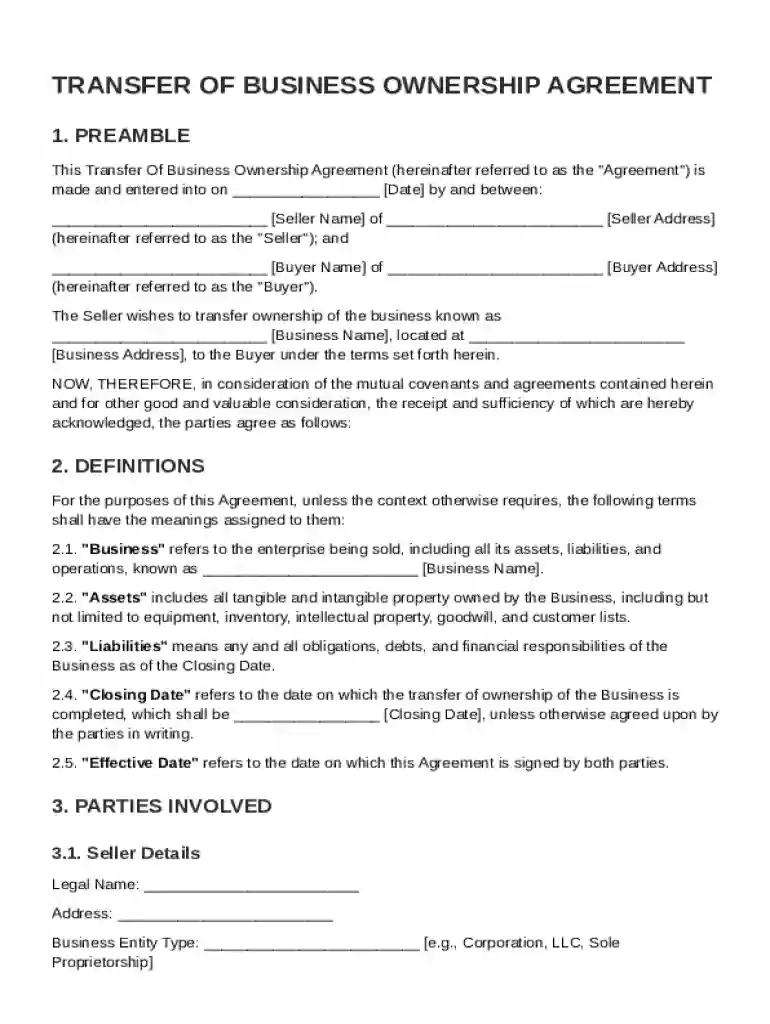
A "Transfer of Business Ownership Contract" is a formal agreement between a business Seller and a Buyer that outlines the terms for transferring ownership of a specific business entity. The contract delineates the responsibilities and expectations of both parties, ensuring a legally compliant exchange. Its primary function is to codify the conditions under which business assets, liabilities, and various interests are exchanged. This agreement accommodates a range of business types, including partnerships and corporations, and serves as a safeguard to provide clarity and minimize disputes during the transaction process.
Key Elements Defined
- Seller: The current owner of the business who transfers ownership.
- Buyer: The individual or entity purchasing the business.
- Purchase Price: The agreed-upon amount the Buyer will pay to acquire the business.
- Assets: Specific resources and properties included in the sale, such as equipment and inventory.
- Liabilities: Obligations the Buyer will assume, potentially impacting the sale's value.
- Representations and Warranties: Statements confirming the authenticity and condition of business components.
Key Elements of the Transfer of Business Ownership Contract Template
This contract includes several critical components necessary for a comprehensive agreement. These elements provide structure and detail, facilitating an effective transfer process.
Asset and Liability Allocation
- Asset List: Detailed inventory of included assets, such as real estate, supplies, and equipment.
- Liability Transfer: Documentation of debts, leases, and other obligations the Buyer assumes.
Payment and Financial Arrangements
- Payment Terms: Specifies down payments, installments, escrow arrangements, and final payment schedules.
- Financial Disclosures: Ensures transparency regarding the business's financial status, providing the Buyer with confidence and relevant information.
Legal Provisions and Compliance
- Governing Law: Identifies the jurisdiction under which the agreement is subject, ensuring legal alignment with local laws.
- Indemnification Clauses: Outlines protections against potential losses or legal claims post-transfer.
Steps to Complete the Transfer of Business Ownership Contract Template
Successfully completing the contract requires a structured approach to address all necessary components.
-
Identify Parties Involved:
- Clearly detail both the Seller and Buyer's legal names and addresses.
-
Define Purchase Terms:
- Specify the purchase price, payment methods, and schedules.
-
List Included Assets:
- Enumerate all the physical and intangible assets transferring to the Buyer.
-
Outline Assumed Liabilities:
- Describe ongoing obligations the Buyer will inherit following the transaction.
-
Incorporating Representations and Warranties:
- Provide necessary assurances about business conditions and ownership rights.
-
Draft and Review Legal Provisions:
- Focus on indemnifications, governing law, and conditions for contract termination.
-
Finalization:
- Obtain signatures from both parties and any legal witnesses, completing the binding agreement.
Important Terms Related to Transfer of Business Ownership Contract Template
Understanding specific terminology within the contract can provide greater clarity and prevent misinterpretations.
Common Terms Explained
- Escrow: A neutral third party holds the purchase funds until all terms are met.
- Due Diligence: A critical evaluation period where the Buyer assesses business operations and financials.
- Covenant: A formal promise within the document on which conditions both parties must comply.
Specialized Terms for Legal Assurances
- Force Majeure: Protects against unforeseen events like natural disasters impacting contract performance.
- Non-disclosure Agreements (NDAs): Ensures proprietary information is protected during negotiations and post-sale.
Legal Use of the Transfer of Business Ownership Contract Template
This contract serves as a legally binding agreement intended to facilitate the smooth transition of business ownership, minimizing risks through detailed legal frameworks.
Compliance with Legal Standards
- Adherence to the ESIGN Act: Electronic signatures used within DocHub are legally valid, offering an efficient agreement process without paper.
- Jurisdictional Variability: The contract must conform to differing state laws, particularly around taxation and corporate governance statutes.
Protection and Assurance
By establishing a mutual understanding of expectations and responsibilities, this document acts as a safeguard to both Seller and Buyer, providing structures for addressing disputes and ensuring accountability.
State-Specific Rules for the Transfer of Business Ownership Contract Template
Localized laws may affect the contract's viability and terms. Businesses must consider state-specific nuances when crafting the agreement.
Variations Across States
- Tax Considerations: Different states impose varying tax obligations on business sales, necessitating localized advice to optimize financial outcomes.
- Registration and Compliance Rules: Some states require business ownership changes to be reported to state agencies, impacting timelines and procedures.
Consultation and Adaptation
Engaging with legal professionals familiar with state-specific regulations ensures alignment with all legal requirements, reducing the risk of delays or contract invalidation.
Examples of Using the Transfer of Business Ownership Contract Template
Real world scenarios illustrate the contract's application across different contexts and business environments.
Practical Applications
- Small Business Sales: A café owner in California uses the contract to transfer ownership to another business entrepreneur, detailing all equipment and lease arrangements.
- Corporate Transactions: A corporation employs the template to divest a subsidiary, incorporating specific financial and strategic considerations.
Adaptability and Scalability
The contract's design allows it to be tailored to various business models and transaction scales, providing flexibility and detailed oversight for diverse sale scenarios.