






Definition and Meaning
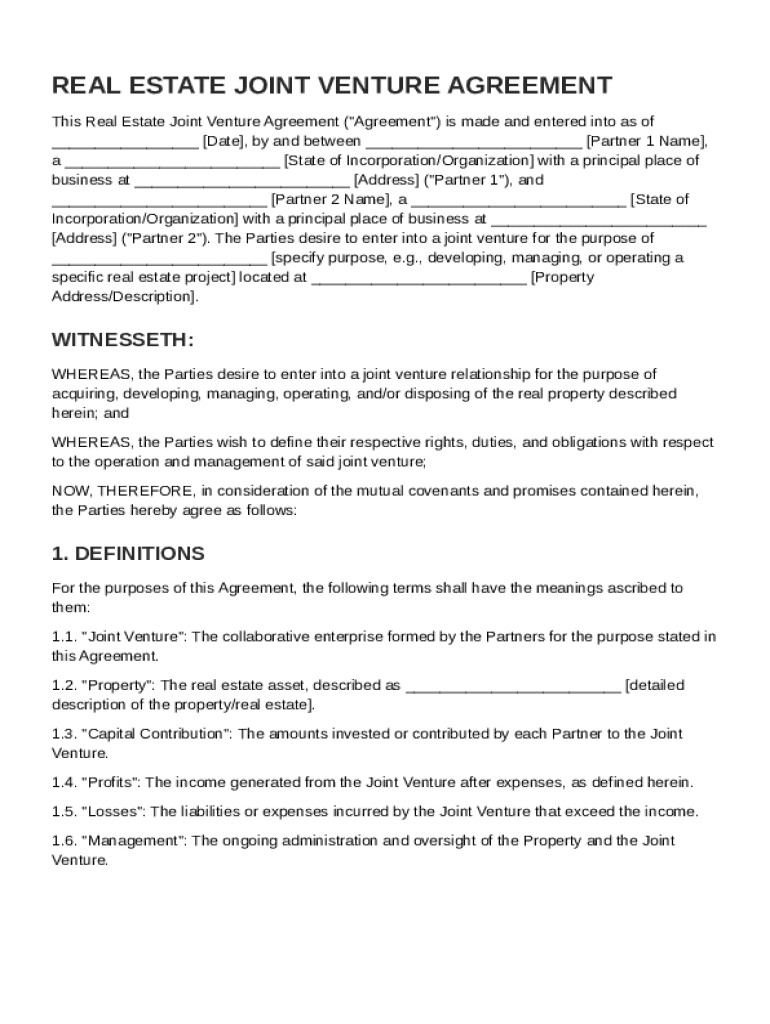
A Real Estate Joint Venture Agreement is a legally binding contract that outlines the collaboration terms between two or more parties involved in a real estate project. This agreement specifies the roles, responsibilities, and rights of each partner. It details how the parties will contribute financially and operationally to the project and how profits or losses will be distributed. Such agreements are crucial for protecting interests and ensuring smooth cooperation among involved parties in property acquisition, development, management, and operations.
Key Elements of the Real Estate Joint Venture Agreement Template
The template for a Real Estate Joint Venture Agreement typically incorporates several critical components to ensure clarity and mutual understanding:
- Capital Contributions: Outlines the specific financial or asset contributions each party is expected to make.
- Profit and Loss Distribution: Details how any profits or losses resulting from the venture will be shared among partners.
- Management Structure: Establishes how the joint venture will be managed and who is responsible for various tasks and decisions.
- Dispute Resolution: Provides mechanisms for resolving disagreements, such as mediation or arbitration.
- Decision-Making Protocols: Defines the procedures for making decisions involving the joint venture's operations.
These elements collectively guide the partners in aligning their efforts and achieving the joint venture's objectives.
Steps to Complete the Real Estate Joint Venture Agreement Template
Achieving a complete Real Estate Joint Venture Agreement involves several critical steps:
- Gather Necessary Information: Collect detailed information about each party involved, including their contributions and expected roles.
- Define Objectives and Scope: Establish the goals of the joint venture and the specific responsibilities of each party.
- Draft the Agreement: Using the template, fill in the gathered information, ensuring all sections are complete and accurate.
- Review and Revise: Each party should review the agreement to ensure clarity and comprehensiveness, making revisions as necessary.
- Obtain Legal Review: Engage a legal professional to review the document for compliance with local laws and accuracy.
- Sign and Execute: Once all parties agree to the terms, sign the document to make it legally binding.
Who Typically Uses the Real Estate Joint Venture Agreement Template
The template is generally used by:
- Real Estate Developers: Seeking to partner with investors or landowners to develop properties.
- Investors: Interested in pooling resources with other parties for a specific project.
- Corporations: Looking to expand real estate holdings in collaboration with other companies.
- Individuals and Families: Participating in residential or commercial property projects as a group.
These parties use the agreement to formally establish and document their collaboration's terms and expectations.


Important Terms Related to the Real Estate Joint Venture Agreement Template
Understanding specific terms is crucial for a comprehensive grasp of the Real Estate Joint Venture Agreement:
- Joint Venture: A business arrangement where two or more parties agree to pool resources for a specific objective while maintaining independent identities.
- Equity Financing: Contribution of capital in exchange for an ownership interest in the venture.
- Limited Liability: Protection for partners, limiting their financial losses to their investment in the joint venture.
- Due Diligence: The process of verifying and assessing both the opportunities and risks involved before committing to the partnership.
These terms help clarify the roles and risks associated with the joint venture.
Legal Use of the Real Estate Joint Venture Agreement Template
Using a Real Estate Joint Venture Agreement Template involves legal considerations, such as:
- Compliance: Ensuring that the agreement complies with national and state laws in the United States.
- Binding Nature: Once signed, the agreement becomes enforceable by law, obliging parties to adhere to the outlined terms.
- Intellectual Property Rights: May include provisions to protect the intellectual property and proprietary information shared during the venture.
- Modification Clauses: Specify how and under what conditions the agreement can be amended, requiring mutual consent of the parties involved.
These factors contribute to the legitimacy and enforceability of the agreement.
State-Specific Rules for the Real Estate Joint Venture Agreement Template
State-specific rules can impact the Real Estate Joint Venture Agreement's applicability and execution:
- Regulatory Environment: Each state may have unique real estate licensing requirements and tax regulations that affect the joint venture.
- Property Laws: Differences in property transfer and registration might necessitate adjustments to the agreement.
- Construction Standards: States may have varied building codes and environmental regulations impacting development phases.
Understanding and accommodating these state-specific rules are vital for the agreement's validity and operation.
Examples of Using the Real Estate Joint Venture Agreement Template
Examples of how the template might be used include:
- Residential Development: Partnering with local developers to construct a new housing estate, delineating roles and capital distribution in the agreement.
- Commercial Property Acquisition: An investor team joining resources to purchase and manage a shopping center, specifying management duties and profit-sharing protocols.
- Mixed-Use Projects: Collaborations that require intricate planning and shared resources detailed explicitly in the agreement.
These examples illustrate diverse applications and benefits of using the Real Estate Joint Venture Agreement Template.