Key Elements of the Monetary Agreement Template
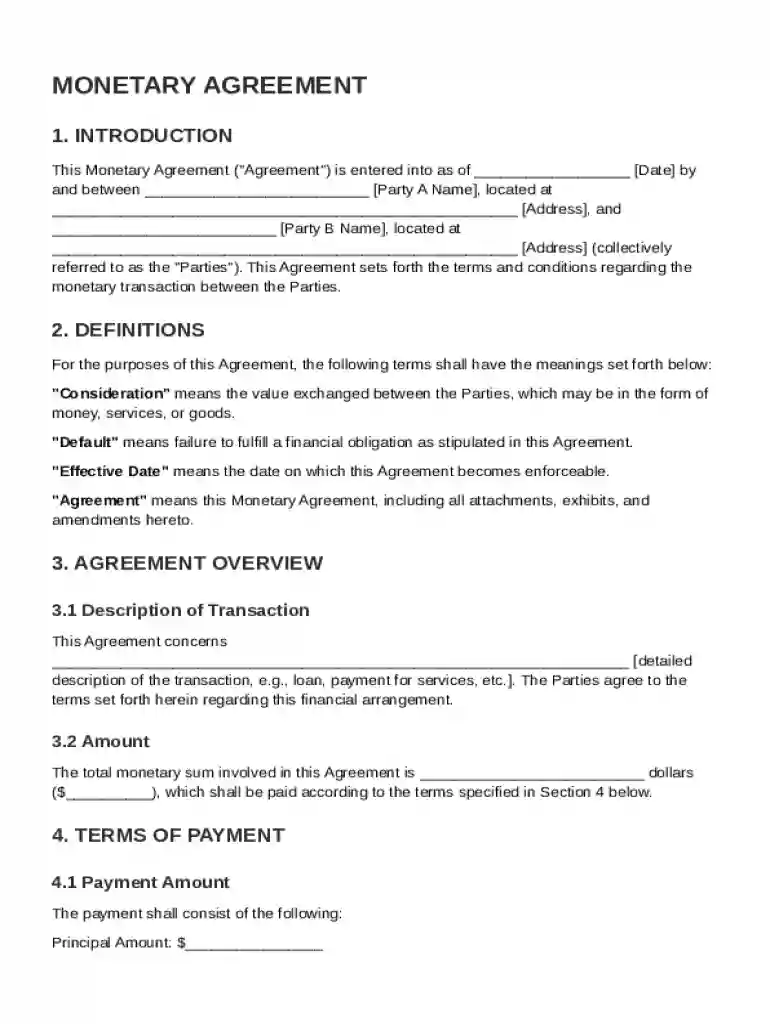
The Monetary Agreement Template outlines vital components to structure a financial arrangement between two parties. The template typically includes:
- Parties Involved: Clearly defines the entities participating in the agreement, including their names and roles.
- Payment Terms: Specifies the amount, schedule, and method of payment. This could include one-time payments, installments, or recurring fees.
- Interest Rates: Details any interest to be applied on unpaid amounts, delineating how it will be calculated and when it applies.
- Default Conditions and Remedies: Describes what constitutes a default and the actions that can be taken if a default occurs, such as late fees, interest escalation, or legal action.
- Governing Law: States the jurisdiction under which the agreement will be interpreted and enforced, which can be critical in resolving disputes.
- Miscellaneous Provisions: Includes any additional clauses that address specific situations that could affect the agreement, ensuring comprehensive coverage of potential scenarios.
How to Use the Monetary Agreement Template
Using the Monetary Agreement Template involves a series of straightforward steps to ensure its effectiveness in capturing all necessary details of a financial transaction:
- Download the Template: Obtain the template from a reputable source or create one using a document editing tool that supports contract management.
- Customize the Sections: Amend the template sections to reflect the specific details of your agreement, such as parties involved and payment details.
- Review Legal Terms: Ensure all legal terminologies are clear and understandable, potentially consulting a legal professional for clarification.
- Incorporate Exhibits and Attachments: Attach any supplementary documents or exhibits that form part of the agreement.
- Finalize and Share: Once completed, review the entire document with all parties involved, make any necessary revisions, and obtain signatures to formalize the agreement.
Steps to Complete the Monetary Agreement Template
Completing a Monetary Agreement Template requires careful attention to detail and a structured approach:
- Begin with Basic Information: Include the date, the names of the parties, and a brief introduction of the agreement's purpose.
- Define Payment Obligations: Clearly articulate who is paying whom, along with the amount, frequency, and method of payment.
- Describe Default Scenarios: Provide detailed descriptions of circumstances that would be considered a default, along with consequences.
- Specify Additional Terms: Incorporate additional terms that may be relevant, like confidentiality clauses or conditions for termination.
- Review and Verify: Carefully review each section to ensure accuracy and completeness.
- Obtain Signatures: Have all parties sign the agreement, ensuring that digital signatures are used if the document is completed electronically.
Who Typically Uses the Monetary Agreement Template
This template is versatile and can be utilized by various parties:

- Businesses: Companies entering into transactions, such as loans or service agreements, can benefit from this template.
- Individuals: For personal loans or financial agreements between private entities, this template provides clarity.
- Legal Professionals: Lawyers may use these templates as a foundation for drafting comprehensive and enforceable agreements.
- Financial Institutions: Banks and lenders often rely on these templates to standardize loan agreements.
Legal Use of the Monetary Agreement Template
The legal framework of this template is crucial for its enforceability:
- Compliance with Laws: Ensures the agreement adheres to federal, state, and local laws, which is paramount for validity.
- Legally Binding: Proper use and completion make it a legally binding document that can be used in a court of law if necessary.
- Consents and Disclosures: Incorporates necessary consents and disclosures required by law to protect parties' rights.
- Signature Validity: Ensures that signatures, whether handwritten or electronic, meet legal standards for authenticity.
State-by-State Differences
While the core elements of a Monetary Agreement Template remain consistent, there can be differences based on state-specific regulations:
- Interest Rate Limitations: Some states impose caps on permissible interest rates for loans.
- Governing Law Requirements: Each state may have unique laws affecting the governing law clause selection and enforcement.
- Consumer Protection Laws: Variations in consumer protection laws can affect default terms and repayment terms.
- Filing Requirements: Certain states may require registration or filing of such agreements for them to be recognized legally.
Advantages of a Monetary Agreement Template
Using a Monetary Agreement Template provides several benefits:
- Clarity: Offers well-defined terms that minimize misunderstandings.
- Efficiency: Streamlines the negotiation process by providing a starting point that requires minimal adjustments.
- Consistency: Ensures a standard format that can be reused and adapted for different transactions.
- Legal Assurance: Provides a framework that can help ensure compliance with applicable laws and regulations.
Digital vs. Paper Version
The choice between a digital and paper version of the template can impact the document's utility:
- Digital Version: Offers ease of editing, sharing, and signing via electronic means, ideal for remote transactions.
- Paper Version: May be necessary for physical signatures in jurisdictions where electronic signatures are not recognized or for those who prefer hard copies for record-keeping.
Who Issues the Form
While monetary agreements are generally drafted individually, specific entities may issue standardized templates:
- Legal and Financial Firms: Offer pre-made templates that conform to legal standards.
- Online Platforms: Provide downloadable templates for use.
- Government Agencies: Occasionally offer templates for specific types of regulated financial transactions.