
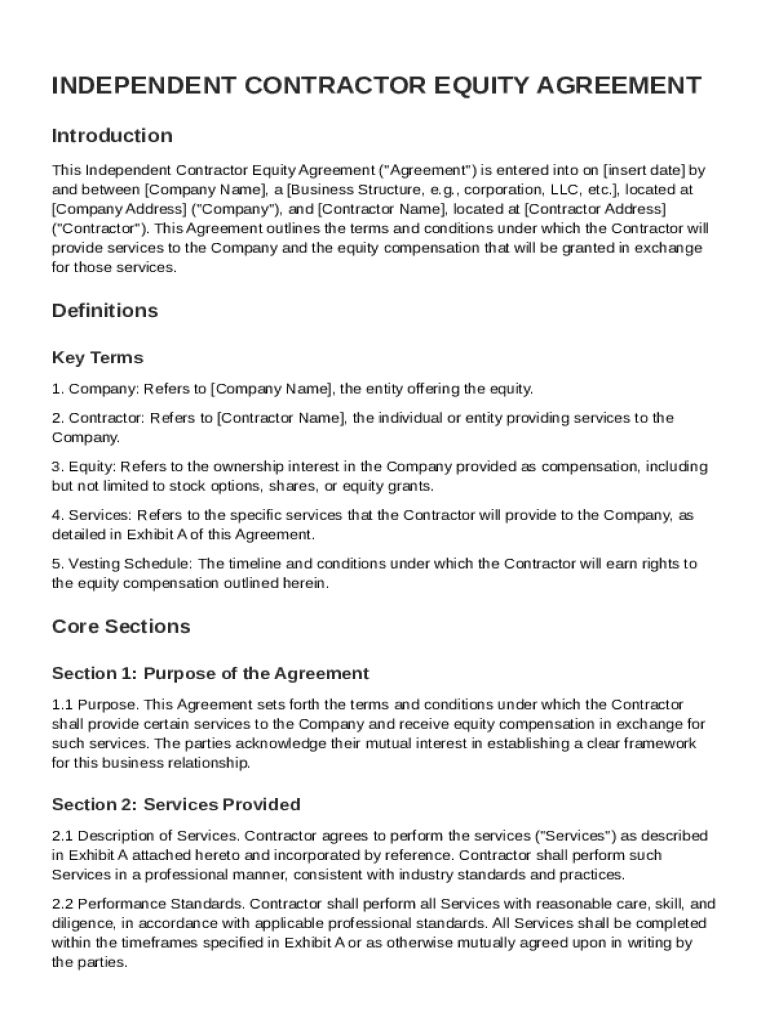







Definition & Meaning
The Independent Contractor Equity Agreement Template is a legal document used to outline the terms under which an independent contractor provides services to a company in return for equity compensation. This agreement serves as a cornerstone for establishing the business relationship between the company and the contractor, detailing the nature of services, compensation structure, and other pertinent terms. It ensures clarity and reduces potential disputes by creating a mutual understanding of expectations and responsibilities.
Key Components
- Service Description: The agreement precisely explains the services the contractor is expected to perform.
- Equity Compensation: Details on how compensation in the form of equity will be handled, including shares or stock units.
- Vesting Schedule: Outlines the timeline and conditions under which the contractor earns the equity awarded.
- Confidentiality Clause: Ensures sensitive information is protected during and after the term of the agreement.
- Governing Law: Specifies the legal framework that will govern the agreement, often aligned with the state's law where the company is based.
How to Use the Independent Contractor Equity Agreement Template
Using the Independent Contractor Equity Agreement Template involves customizing the document to fit specific circumstances and agreements between the contractor and the company.
Steps to Utilize the Template
- Download the Template: Obtain the template from a reliable source such as an online document service or legal advisor.
- Customize the Agreement: Insert specific details such as contractor's name, service description, compensation details, and other clauses.
- Consult with Legal Counsel: Ensure all legal requirements are met and the agreement protects the interests of both parties.
- Review with the Contractor: Discuss the terms with the contractor to confirm mutual understanding and agreement.
- Finalize with Signatures: Once both parties consent to the terms, add signatures to make the agreement legally binding.
Tips for Effective Use
- Tailor the Language: Reflect the specific nature of the work and conditions unique to each agreement.
- Include Detailed Timelines: Specify start and end dates for services and vesting periods accurately.
Key Elements of the Independent Contractor Equity Agreement Template
The Independent Contractor Equity Agreement Template consists of multiple crucial sections designed to ensure all terms are clearly defined and legally enforceable.
Essential Sections
- Introductory Clause: Lists the parties involved and the purpose of the agreement.
- Scope of Work: Describes the services to be delivered to the company.
- Equity Distribution: Explains how equity compensation is structured, including any conditions for issuance.
- Confidentiality and Non-Compete: Protects sensitive information and may restrict the contractor from working with competitors.
- Termination Terms: Provides conditions under which the agreement can be ended prematurely.
- Responsibilities and Obligations: Clarifies the duties of both parties beyond the initial scope of work.
Steps to Complete the Independent Contractor Equity Agreement Template
Completing the Independent Contractor Equity Agreement Template is a structured process requiring careful attention to detail.
Detailed Completion Process
- Information Gathering: Collect all necessary information from both the company and the contractor.
- Inserting Details: Enter specifics such as names, addresses, and the particular services expected.
- Defining Equity Terms: Clearly articulate the principles of equity compensation, including any vesting specifics.
- Draft Review: Go through the draft to ensure clarity, completeness, and correctness.
- Legal Review: Consult with a legal professional to confirm compliance with legal standards.
- Final Approval: Obtain mutual consent from both parties, followed by actual signing to formalize the agreement.
Final Checklist
- Verify All Details: Double-check all the inserted information for accuracy.
- Confirm Legal Adequacy: Ensure the contract meets all applicable laws and business requirements.
- Secure Signatures: Capture authorized signatures to initiate the validity of the contract.
Legal Use of the Independent Contractor Equity Agreement Template
Adherence to legal standards is crucial for the enforceability of the Independent Contractor Equity Agreement Template.
Legal Considerations
- Compliance with State Laws: Regulations and legal requirements can differ by state; ensure the agreement aligns with local laws.
- Equity Laws: Understand the legal implications of issuing equity to contractors versus employees.
- Contractual Validity: Confirm that all essential elements of a contract are present, such as offer, acceptance, and consideration.
Potential Legal Pitfalls
- Ambiguous Terms: Vague language can lead to disputes; use clear and precise terms.
- Failure to Document Changes: Any amendments should be documented and signed by both parties to reinforce legal standing.
Who Typically Uses the Independent Contractor Equity Agreement Template
The Independent Contractor Equity Agreement Template is commonly used by organizations navigating specific business relationships with non-employee partners.


Typical Users
- Startups: Seeking flexibility by offering equity in lieu of cash to conserve capital.
- Technology Firms: Frequently offer equity to contractors working on proprietary technology or projects.
- Consultancy Firms: Engaging specialists for focused, time-bound projects.
Key Benefits
- Cost Management: Helps companies manage cash flow by compensating with equity rather than immediate cash outlays.
- Talent Acquisition: Attraction of skilled talent through the potential upside of equity ownership.
Important Terms Related to the Independent Contractor Equity Agreement Template
Several critical terms should be defined and understood when handling the Independent Contractor Equity Agreement Template.
Definitions
- Equity Compensation: Remuneration provided in the form of stock options or shares.
- Vesting Schedule: Timeline over which equity can be earned or claimed.
- Confidentiality Clause: Legal obligation to maintain secrecy of proprietary information.
- Non-Compete Agreement: Prevents the contractor from engaging with direct competitors during and after the term of the agreement.
Considerations of Terminologies
- Common Stock vs. Preferred Stock: Understanding the type of equity being offered helps in assessing true value.
- Geographical Scope: Necessary for interpreting non-compete and confidentiality clauses.
State-Specific Rules for the Independent Contractor Equity Agreement Template
State laws can significantly affect the execution and obligations under the Independent Contractor Equity Agreement Template.
Variations by State
- Employment Law Differences: States like California have rigorous rules around independent contracting and non-compete clauses.
- Tax Implications: Equity compensation can have different tax treatments based on state-specific rules.
Navigating State Laws
- Consult Local Legal Resources: Engage with legal counsel familiar with state regulations for accurate advice.
- Update Agreements: Regularly review and adjust agreements to remain compliant with evolving state laws.
Business Types That Benefit Most from the Independent Contractor Equity Agreement Template
Certain types of businesses may find greater utility and advantage in employing the Independent Contractor Equity Agreement Template.
Ideal Business Models
- Small Businesses and Startups: Often use equity agreements to attract top talent without heavy upfront costs.
- Research and Development Firms: Engage contractors for specialized projects where intellectual property is critical.
- Creative Industries: Typically contract freelancers for project-based work that benefits from flexibility in payment through equity.
Advantages for Specific Industries
- Flexibility and Scalability: Equity agreements allow businesses to scale and pivot without significantly altering cash flow.
- Innovation Incentivization: Encourages contractors to deliver top-quality work with the prospect of shared growth.




