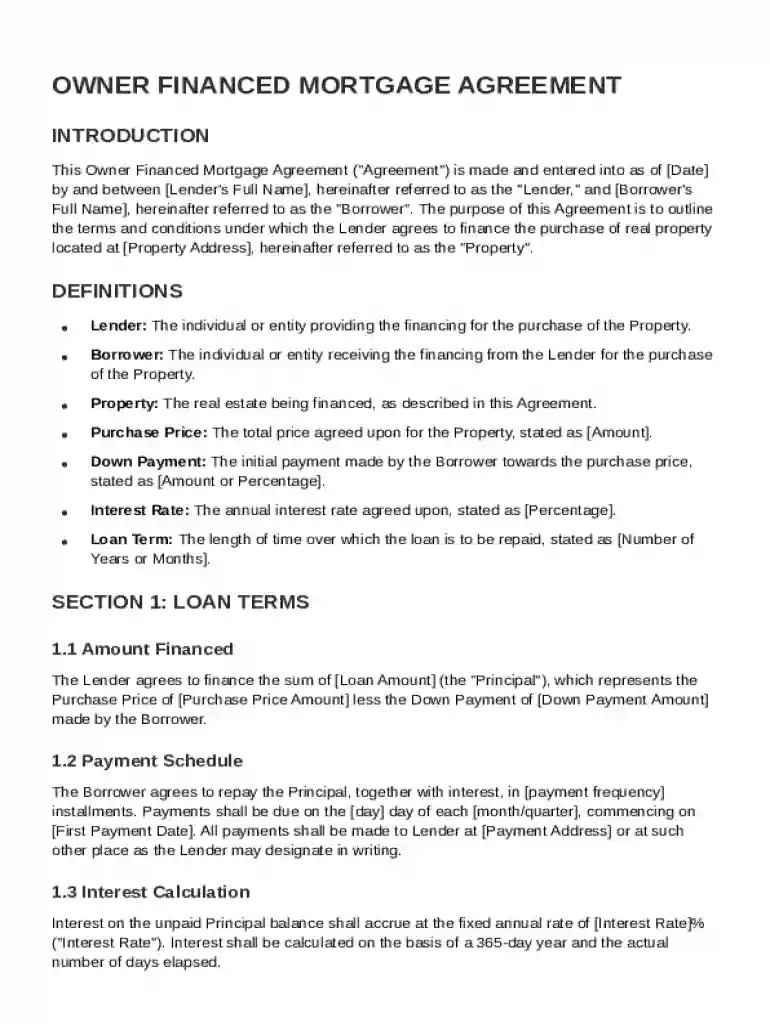
Owner Financ Mortgage Contract Template 2026

Get Form
Owner Financ Mortgage Contract Template Preview on Page 1

Here's how it works

01. Edit your form online
Type text, add images, blackout confidential details, add comments, highlights and more.

02. Sign it in a few clicks
Draw your signature, type it, upload its image, or use your mobile device as a signature pad.

03. Share your form with others
Send it via email, link, or fax. You can also download it, export it or print it out.

Definition & Meaning

An Owner Financed Mortgage Agreement is a crucial document used in real estate transactions where the property's seller provides financing to the buyer. Unlike traditional mortgage agreements, where a financial institution acts as the lender, this contract allows the seller to extend credit to the buyer directly. This arrangement can be advantageous in situations where the buyer might not qualify for a standard mortgage. The contract typically delineates key terms such as the loan amount, interest rate, repayment schedule, and maturity date. By capturing these elements, the agreement ensures both parties have a clear understanding of their obligations and protections, thus fostering a transparent transaction process.

Key Elements of the Owner Financ Mortgage Contract Template

The Owner Financed Mortgage Agreement is composed of several critical elements, which detail the responsibilities and expectations of both parties:

  • Loan Amount: The total amount of money financed by the seller.
  • Interest Rate: The percentage of interest applied to the outstanding loan balance.
  • Payment Schedule: Specifies due dates, payment amounts, and frequency (e.g., monthly, quarterly).
  • Maturity Date: The date by which the loan must be fully repaid.
  • Borrower Obligations: Duties like maintaining property insurance, regular property maintenance, and timely payment of property taxes.
  • Default Clauses: Definitions of default and remedies available to the lender, including potential property foreclosure.
  • Governing Law: Which jurisdiction's laws will be applied in disputes.
  • Amendments: Procedures for altering terms after the agreement is in effect.

Each of these components contributes to a comprehensive legal framework that governs the relationship between the buyer and seller throughout the loan's life cycle.

Steps to Complete the Owner Financ Mortgage Contract Template

Filling out the Owner Financed Mortgage Agreement involves several methodical steps to ensure accuracy and comprehensiveness:

  1. Gather Necessary Information: Collect all relevant details from both parties, including names, contact information, and property specifics.
  2. Specify Loan Terms: Determine the total loan amount, interest rate, and duration of the loan.
  3. Outline Repayment Details: Establish a payment plan detailing frequency, amount, and method of payments.
  4. Include Property Obligations: Detail the borrower's responsibility for maintaining insurance, mortgage, and other relevant fees.
  5. Define Default Terms: Clearly outline what constitutes a default and the resultant actions.
  6. Review Legal Provisions: Ensure all applicable state and federal laws are incorporated and accurately reflect governing jurisdictions.
  7. Finalize and Sign: After thorough review, both parties should sign the agreement to validate its terms legally.

Important Terms Related to Owner Financ Mortgage Contract Template

Understanding specific terminology is essential for navigating an Owner Financed Mortgage Agreement effectively:

  • Promissory Note: A legal agreement where the borrower promises to repay borrowed money.
  • Lien: A legal right or interest that a lender has in the borrower's property, granted until the debt is paid off.
  • Amortization: Gradual repayment of a loan through scheduled payments of principal and interest.
  • Balloon Payment: A large payment due at the loan's maturity if not fully amortized.
  • Escrow: An arrangement where a third party holds funds or property until specific conditions are met.

Grasping these terms ensures all stakeholders comprehend their roles and legal standings within the agreement.

Legal Use of the Owner Financ Mortgage Contract Template

Ensuring the legality of an Owner Financed Mortgage Agreement requires adherence to specific guidelines:

  • Compliance with State Laws: Varies significantly in terms of interest rate caps, foreclosure proceedings, and required disclosures.
  • Disclosure Requirements: Mandated by federal and state laws to provide transparent transaction terms.
  • Recording the Agreement: Often necessary to record with local government offices to establish a public record of the transaction.
  • Enforceability: Ensuring the contract is executed with voluntary consent and appropriate jurisdictional clauses to prevent challenges in court.

By following these principles, the agreement remains enforceable and legally compliant.

State-Specific Rules for the Owner Financ Mortgage Contract Template

Each state in the U.S. may impose unique requirements that affect an Owner Financed Mortgage Agreement. For example, some states have stricter usury laws regulating maximum allowable interest rates. States like Texas might have specific provisions on homestead laws impacting foreclosure procedures, while California requires detailed disclosure statements. Comprehending these differences is vital for legal compliance and successful execution of the agreement, necessitating consultation with a local legal expert or real estate attorney to incorporate these state-specific nuances adequately.

Who Typically Uses the Owner Financ Mortgage Contract Template

Owner Financed Mortgage Agreements are commonly utilized by various participants in the real estate market:

  • Property Sellers: Who wish to provide flexible financing options to potential buyers.
  • Real Estate Investors: Seeking to broaden potential buyer pools by offering financing leads.
  • Buyers with Poor Credit: Who may struggle to secure traditional mortgages from banks but can afford alternative financing arrangements.
  • Real Estate Brokers and Agents: Facilitating transactions where seller financing is preferred.

These users benefit from the flexibility and accessibility that this type of financing arrangement offers, allowing them to close deals that might otherwise be difficult to finalize.


decoration image ratings of Dochub

Examples of Using the Owner Financ Mortgage Contract Template

Real-world applications of Owner Financed Mortgage Agreements illustrate their versatility:

  • Rural Area Transactions: In places where banks might be reluctant to finance properties, owner financing can bridge this gap.
  • Market Downturns: When traditional lenders tighten lending standards, sellers can facilitate sales through flexible financing terms to attract buyers.
  • Investment Opportunities: Real estate investors can leverage owner financing to purchase property, potentially converting it to rental or resale entities later.

These examples show how owner financing aids in diverse scenarios, providing viable pathways to property ownership and sale.

Versions or Alternatives to the Owner Financ Mortgage Contract Template

While the Owner Financed Mortgage Agreement is a popular tool, other formats or versions can be considered based on specific needs:

  • Lease-to-Own Agreements: Allows potential buyers to lease the property with the option to purchase at a later date.
  • Contract for Deed: Similar to owner financing but involves holding the deed until full payment is made.
  • Rent-to-Own Agreements: Tenants can apply a portion of their monthly rent towards eventual property purchase.

These alternatives provide flexibility across various transaction scenarios, accommodating different buyer and seller needs within the real estate finance spectrum.

be ready to get more

Complete this form in 5 minutes or less

Get form

Got questions?

We have answers to the most popular questions from our customers. If you can't find an answer to your question, please contact us.
Contact us
A loan is an example of a type of financing agreement. Financing agreements are often used by businesses that need capital for expansion or new equipment but dont have enough cash on hand or cant get traditional loans from banks because they are not credit-worthy.
Whats included in a Loan Agreement Lender and borrower contact information. Include details of both the lender and the borrower, including their full names and addresses. Loan amount and date. Interest rate. Repayment method and schedule. Late fees and penalties. Co-signer information. Collateral. Additional clauses.
At a minimum, your contract should include the following: The names of the buyer and seller. A description of the property being sold. The purchase price. The down payment amount. The interest rate. The repayment schedule. The start and end dates of the loan. Closing costs.
Its not always necessary to involve a solicitor in drafting a loan agreement, but it can be helpful, particularly for larger loans or more complex situations. While on the face of it engaging with a solicitor can feel like a formal step, it can take the pressure off both of you and ensure the terms are fair.
Like a mortgage from a bank, the buyer and seller agree on a down payment, the amount of monthly payments, the interest rate, and the length of the financing term. Then both parties sign a promissory note outlining the agreed-upon terms. The seller typically holds on to the title until the property is paid in full.

Security and compliance

At DocHub, your data security is our priority. We follow HIPAA, SOC2, GDPR, and other standards, so you can work on your documents with confidence.

Learn more
ccpa2
pci-dss
gdpr-compliance
hipaa
soc-compliance

People also ask

How to write a mortgage agreement? Include the loan amount, interest rate, repayment schedule, property details, default clauses, and any applicable legal requirements. Ensure it is signed, dated, and recorded as required by law.
Seller financing is when you get a mortgage to buy a home from the homes seller instead of a bank. Lets review the pros and cons for buyers and sellers. Written byVivian Tejada|December 21, 2024. Financing is often the most challenging aspect of buying a home.

Related links