






Definition & Meaning
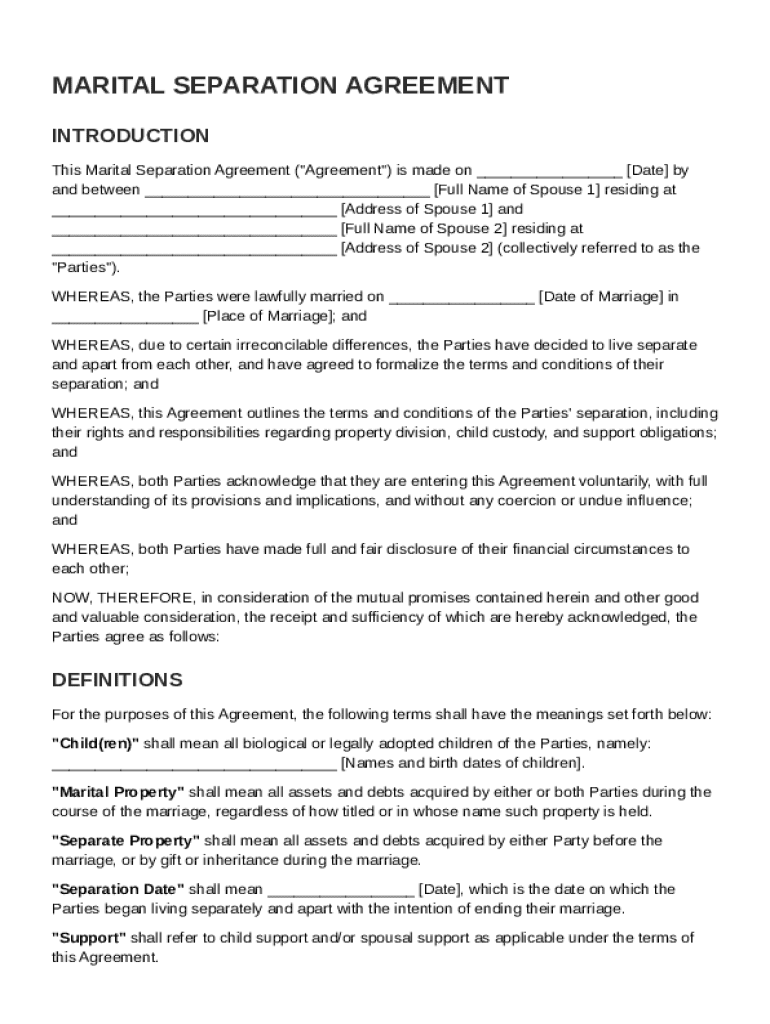
The Marital Separation Agreement, often called the Marriage Separation Agreement Template, formalizes the arrangement between spouses who elect to live apart. This legal document outlines various terms of separation, including property division, child custody arrangements, spousal support, and other relevant issues. By clearly detailing each party's rights and responsibilities, the agreement ensures a mutual understanding during the separation period. It emphasizes that both parties engage willingly, with full transparency regarding their financial situations.
Key Elements of the Marital Separation Agreement
A well-structured Marital Separation Agreement includes several critical components:
-
Property Division: This section specifies how assets and liabilities will be split between the spouses. It may include real estate, vehicles, retirement accounts, and other marital property.
-
Child Custody and Support: The agreement outlines both legal and physical custody arrangements, defining how parental responsibilities are shared. It also addresses child support payments, covering essential expenses like education and healthcare.
-
Spousal Support (Alimony): Detailed provisions for spousal support involve the amount, duration, and conditions under which one spouse may provide financial assistance to the other.
-
Health Insurance Coverage: Terms related to maintaining health insurance for both parties, especially the dependent spouse and children.
-
Dispute Resolution: Mechanisms for resolving any disagreements that may arise, possibly through mediation or arbitration.
Legal Use of the Marital Separation Agreement
This agreement acts as a legally binding contract, subject to the laws of the state where it is enacted.
-
Enforceability: Courts typically uphold these agreements provided they meet legal standards, such as fair disclosure and absence of coercion during signature.
-
Modification: Changes to the agreement can be made by mutual consent, often requiring court approval, especially in matters relating to child support and custody.
-
Termination: The agreement can be terminated if the spouses reconcile or proceed with divorce, transitioning the obligations into divorce settlement terms.
Steps to Complete the Marital Separation Agreement Template
Filling out a Marital Separation Agreement involves a thorough approach to ensure clarity and legal correctness:
-
Gather Information: Collect all necessary financial documents, including income statements, asset valuations, and debt records.
-
Settle on Terms: Together with your spouse, negotiate the terms of separation, including custody, support, and property division.
-
Draft the Agreement: Use the template to draft the agreement, aligning it with the terms both parties have agreed upon.
-
Review Legal Requirements: Verify that the agreement complies with state laws and includes all required information.
-
Seek Legal Advice: Consult with an attorney to review the agreement and ensure it meets all legal criteria.
-
Sign the Agreement: Both spouses should sign the document in the presence of a notary public to formalize it.
Important Terms Related to Marital Separation
Understanding key terms reduces confusion and enhances the agreement's effectiveness:
-
Physical Custody: Refers to where the child lives and daily caretaking responsibilities.
-
Legal Custody: Involves decision-making authority regarding the child's welfare, education, and healthcare.
-
Community Property: In many states, this represents assets acquired during the marriage, which are typically divided equally.
-
Equitable Distribution: A legal standard guiding fair division of marital property based on various factors beyond a simple 50/50 split.
Who Typically Uses the Marital Separation Agreement Template
This template serves various individuals and situations:
-
Couples Seeking Trial Separation: Those considering a temporary separation to evaluate the future of their marriage.
-
Non-Divorcing Couples: Partners who opt for permanent separation without legal divorce, often for religious or personal reasons.
-
Pre-Divorce Arrangements: Couples preparing for divorce and wishing to outline separation terms in advance.


State-Specific Rules for the Marital Separation Agreement
Different states may have unique laws affecting marital separation:
-
Residency Requirements: Some states demand a certain period of residence before filing a separation agreement.
-
Content Requirements: Certain provisions, particularly around child support, may need to adhere to state-specific formulas and legal standards.
-
Approval and Filing: Variations exist regarding whether the document must be filed with the court and approved by a judge.
Examples of Using the Marital Separation Agreement Template
Practical scenarios where the template is essential:
-
High Net-Worth Individuals: Using clear agreements to protect complex financial interests and investments.
-
Families with Children: Arranging detailed custody and support plans tailored to children's needs.
-
Long-Distance Separations: Managing assets and responsibilities when one spouse relocates for work or other reasons.