






Definition & Meaning of the One Year Contract Template
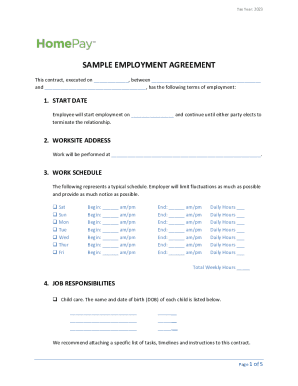
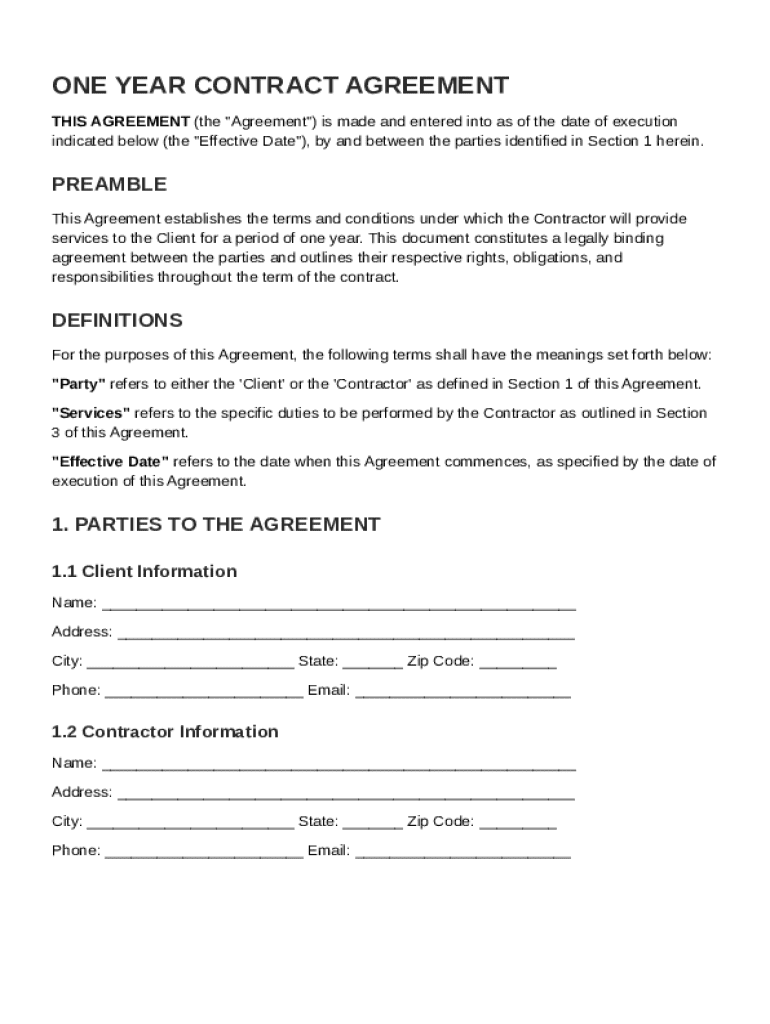
The One Year Contract Template is a formal agreement used to outline the terms and conditions between a Client and a Contractor for the provision of services over a one-year period. This template serves as a comprehensive guide to recording the responsibilities, roles, and expectations of both parties involved. It typically includes details about the scope of work, duration, payment terms, confidentiality agreements, and procedures for dispute resolution. The template is a vital tool for establishing clear professional relationships, ensuring all terms are understood and adhered to by both parties.
Key Elements of the One Year Contract Template
Understanding the core components of a One Year Contract Template is crucial for effectively utilizing it:
- Parties Involved: Clearly identify the Client and Contractor, including legal names and contact information.
- Scope of Work: Detail the specific services to be provided, including any deadlines and deliverables.
- Duration: States the start and end dates of the contract period.
- Compensation: Outlines payment terms, including amounts, payment dates, and accepted methods of payment.
- Confidentiality: Defines the terms for handling sensitive information shared between parties.
- Termination Rights: Provides conditions under which either party can terminate the agreement.
- Dispute Resolution: Specifies methods for resolving conflicts, such as mediation or arbitration.
- Miscellaneous Provisions: Includes other relevant terms that do not fit into the categories above, such as governing law or amendment procedures.
Steps to Complete the One Year Contract Template
Completing a One Year Contract Template effectively requires a step-by-step approach:
- Gather Information: Collect all relevant details about your business and the other party involved.
- Define the Scope of Work: Clearly articulate the tasks, responsibilities, and expectations for both parties in concrete terms.
- Set Timeframes: Specify the start date and end date, as well as any interim deadlines or milestones.
- Determine Compensation: Detail the payment structure, including timing, amounts, and delivery method.
- Address Confidentiality: Include clauses to protect sensitive information exchanged during the contract term.
- Plan for Termination: Outline the conditions and processes through which the contract can be ended by either party.
- Resolve Disputes: Agree on methods to manage potential conflicts or discrepancies.
- Review and Sign: Have both parties carefully review the document, make necessary changes, and sign to agree on terms.
Who Typically Uses the One Year Contract Template
A wide range of professionals and businesses may find the One Year Contract Template beneficial:
- Freelancers and Independent Contractors: To ensure clarity in responsibilities and payment terms.
- Small to Medium-Sized Businesses (SMBs): For engaging service providers without administrative overhead.
- Consulting Firms: To establish clear agreements with new clients.
- Creative Agencies: For project-based work with clients or subcontractors.
- Corporations: When entering temporary engagement with specialists or consultants.


Important Terms Related to One Year Contract Template
When working with a One Year Contract Template, be familiar with the following terms:
- Breach of Contract: Occurs when a party fails to fulfill their obligations as outlined.
- Force Majeure: Clause that frees both parties from liability when an event outside their control prevents them from fulfilling the contract.
- Amendment: Modification of the original contract terms agreed by both parties.
- Confidential Information: Any information designated as confidential by either party which must be kept secret.
- Indemnification: A provision where one party agrees to compensate the other for any harm or loss arising from the contract.
Legal Use of the One Year Contract Template
The One Year Contract Template must adhere to various legal standards to ensure its enforceability:
- Compliance with Laws: Ensures the contract aligns with federal, state, and local laws, including employment and non-discrimination laws.
- Signatures: Legally binding when signed by both parties. Electronic signatures are acceptable under the ESIGN Act.
- Documentation: Retain copies of the signed contract in both digital and paper formats for record-keeping and legal purposes.
- Amendments: Any changes to the contract must be documented and signed by both parties to remain legally binding.
Software Compatibility and Digital Usage
Digital versions of the One Year Contract Template can be seamlessly integrated into various software and platforms:
- DocHub: Offers editing and signing tools ideal for creating and managing digital contracts.
- Google Workspace: Integrates smoothly with Google Drive for storage and collaboration.
- Microsoft Office Suite: Compatible with Word for creating and editing document templates.
- Cloud Storage Services: Supports Dropbox, OneDrive, and other services for secure storage and sharing.
Examples of Using the One Year Contract Template
Consider these practical scenarios where a One Year Contract Template might be employed:
- A marketing consultant enters into a one-year agreement with a small business to create and implement a content strategy.
- An IT service provider contracts with a corporation to offer ongoing support and maintenance for their internal systems.
- A freelance graphic designer signs a contract with a start-up to produce marketing materials on a project basis over one year.
- A web development agency agrees to build and update an e-commerce site for a client, with terms spanning a year for regular check-ins and updates.
State-Specific Rules for the One Year Contract Template
While the template provides a general structure, it is essential to tailor it according to specific state regulations:
- Governing Law: Contracts often include a clause specifying which state's laws will govern the agreement to simplify legal proceedings in disputes.
- Local Compliance: Verify that the contract meets specific regional requirements, such as employment regulations or service standards.
- Notarization Needs: Some states may require contracts to be notarized or registered to be considered legally binding.
By understanding and utilizing the One Year Contract Template efficiently, parties can safeguard their interests, clarify their responsibilities, and foster professional relationships built on trust and transparency.