




01. Edit your form online
Type text, add images, blackout confidential details, add comments, highlights and more.

Type text, add images, blackout confidential details, add comments, highlights and more.

Draw your signature, type it, upload its image, or use your mobile device as a signature pad.

Send it via email, link, or fax. You can also download it, export it or print it out.
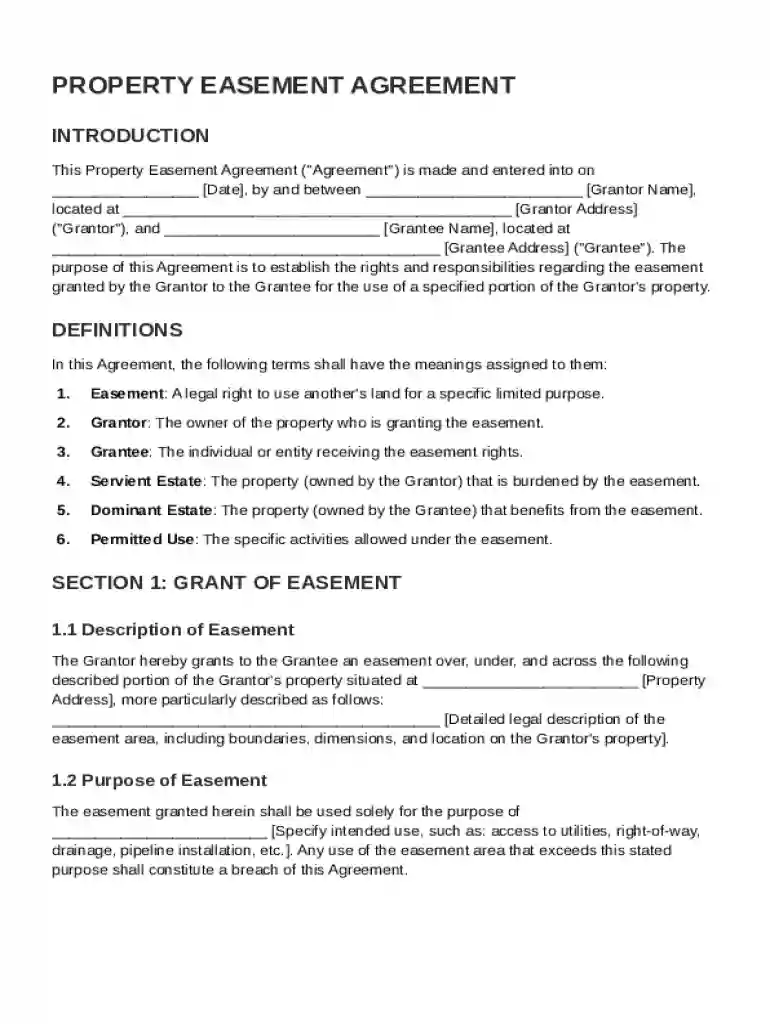
The Property Easement Agreement Template is a document used to establish the terms and conditions under which a property owner, known as the Grantor, grants usage rights over a portion of their property to another party, referred to as the Grantee. This agreement specifies the purpose of the easement, outlines the rights and responsibilities of both parties, and includes essential details such as the duration of the easement and any compensation involved. It serves as a legally binding framework to ensure that both the Grantor and the Grantee understand their obligations and rights, thereby preventing disputes and misunderstandings.
A comprehensive Property Easement Agreement Template includes several critical components:
Definitions: Clearly define the terms used throughout the agreement, such as "Grantor," "Grantee," "Easement Area," and "Effective Date."
Rights and Responsibilities: Specify the rights of the Grantee to use the designated property area and the obligations of the Grantor to allow such use.
Easement Duration: Indicate how long the easement is intended to last, whether it is temporary or perpetual.
Compensation Details: Outline any financial or other compensation provided in exchange for the easement rights.
Indemnity Provisions: Address liability issues and the responsibilities of each party in case of damages or legal disputes.
Dispute Resolution: Include mechanisms for resolving potential conflicts, such as mediation or arbitration clauses.
When using the Property Easement Agreement Template, follow these steps for effective utilization:
Review the Template: Begin by thoroughly reviewing the template to understand its structure and the information it requires.
Customize the Agreement: Tailor the document to meet the specific needs of your easement agreement by adjusting terms related to rights, responsibilities, and compensation.
Consult Legal Professionals: It is advisable to consult with a lawyer to ensure the agreement complies with state laws and fully protects your interests.
Gather Necessary Information: Compile all required details, such as the legal description of the property, contact information for both parties, and any maps or diagrams.
Finalize the Document: Review the completed agreement with all parties involved for accuracy and clarity before signing.
To complete the Property Easement Agreement Template effectively:
Insert Personal Details: Fill in the names and contact details of both the Grantor and the Grantee.
Describe the Easement: Clearly outline the purpose of the easement and the specific property area it covers.
Set Terms and Conditions: Specify the rights granted to the Grantee and the obligations of the Grantor, along with any restrictions or conditions.
Define the Term: Specify the start date and duration of the easement, including any renewal options.
Outline Compensation Terms: Detail any payments or considerations exchanged between the parties.
Include Signatures: Ensure both parties sign and date the agreement to make it legally binding.
Understanding the following terms is crucial when dealing with a Property Easement Agreement:
Grantor: The property owner who grants the easement rights to another party.
Grantee: The party receiving easement rights to use a portion of the Grantor's property.
Easement Area: The specific portion of the property subject to the easement.
Temporary Easement: An easement with a defined duration that expires after a certain period.
Perpetual Easement: An easement that continues indefinitely without an end date.
The Property Easement Agreement must comply with relevant legal requirements to ensure it is enforceable. This typically includes:
State Laws: Understanding and adhering to specific state laws governing easements.
Land Use Regulations: Complying with zoning and land use restrictions in the area where the property is located.
Recording Requirements: Recording the easement with the appropriate local governmental authority to protect the Grantee's rights.
Easement agreements can vary significantly based on the state in which the property is located. Key considerations include:
Recording Requirements: Some states require that easements be recorded with local authorities to be enforceable.
Property Tax Implications: Certain states may have specific tax treatments related to land use changes stemming from easement grants.
Zoning Regulations: State and local zoning laws can impact the permissible uses of an easement area.
Examples of real-world scenarios where the Property Easement Agreement Template might be applied include:
Utility Companies: Granting easements to allow utility companies to install and maintain infrastructure on private property.
Right of Way: Providing neighbors or businesses access through a property to reach another location.
Commercial Developments: Enabling developers to use a portion of adjacent land for construction-related purposes.
By employing the Property Easement Agreement Template effectively, parties can structure a transparent and legally sound arrangement that safeguards the interests of all stakeholders.
At DocHub, your data security is our priority. We follow HIPAA, SOC2, GDPR, and other standards, so you can work on your documents with confidence.



WHEREAS the parties hereto have agreed that the GRANTOR will convey to the COMMONWEALTH occasional flowage easements that it has acquired in order to comply
Grantor hereby grants to Grantee a nonexclusive easement [over, under, on, and/or across][specify as applicable] the Easement Area for so long as the Easement
This agreement grants a nonexclusive easement for a 20-inch pipeline, with a 50-foot easement width, and a 25-foot temporary construction easement.


