Legal Property Agreement Template 2026

Get Form
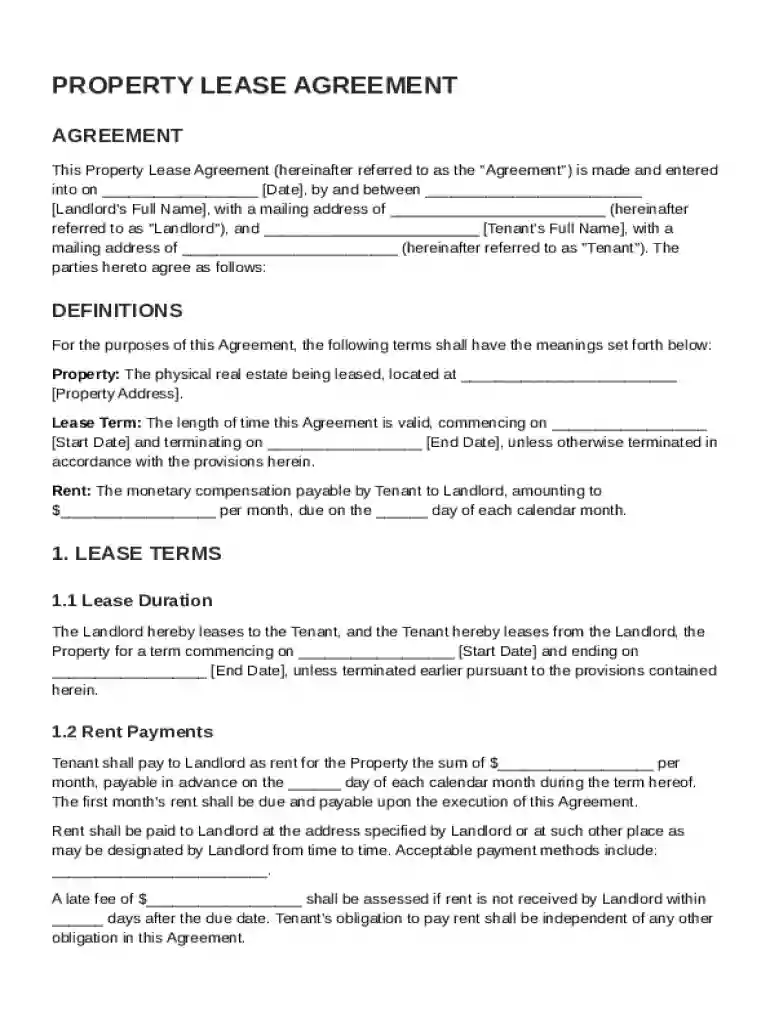
Legal Property Agreement Template Preview on Page 1

Here's how it works

01. Edit your form online
Type text, add images, blackout confidential details, add comments, highlights and more.

02. Sign it in a few clicks
Draw your signature, type it, upload its image, or use your mobile device as a signature pad.

03. Share your form with others
Send it via email, link, or fax. You can also download it, export it or print it out.

Definition and Purpose of a Legal Property Agreement Template

A Legal Property Agreement Template is a standardized document that outlines the terms and conditions under which property rights are transferred or utilized. It is typically used to formalize agreements between parties such as landlords and tenants, buyers and sellers, or lessors and lessees. The template serves as a foundational document that ensures all parties have a clear understanding of their rights and obligations. Its primary purpose is to mitigate disputes by providing a legally binding reference framework.

Key Features

  • Structure: The template typically covers essential sections such as property description, duration of the agreement, payment terms, and responsibilities of the involved parties.
  • Legality: It ensures compliance with local laws and regulations, making the agreement legally enforceable in a court of law.
  • Clarity: By providing clear definitions and specifications, the template helps prevent misunderstandings and misinterpretations.

How to Use the Legal Property Agreement Template

Using a Legal Property Agreement Template involves several methodical steps to ensure that the document meets the specific needs of the parties involved. This process allows for the customization necessary to reflect unique circumstances.

Step-by-Step Guide

  1. Review the Template: Begin by thoroughly examining the template to understand its structure and content. This step is crucial for identifying sections that require customization.
  2. Customize Content: Input specific information such as the names of all parties, property details, and agreed terms. Tailor the standard clauses to accommodate any unique agreements.
  3. Legal Compliance: Ensure that all sections comply with state laws and regulations relevant to the type of property and agreement.
  4. Consult Legal Advice: It is often advisable to consult with a legal professional to ensure that all contractual terms are fair, legal, and enforceable.
  5. Finalize and Sign: Once all customizations and checks are complete, all parties should review the document. Signatures from all parties are then collected to validate the agreement.

Key Elements of the Legal Property Agreement Template

Understanding the components of a Legal Property Agreement Template is crucial for its effective utilization. Each element serves a distinct purpose aimed at safeguarding the interests of both parties involved.

Core Components

  • Property Description: A detailed description of the property involved in the agreement, including size, location, and legal identifiers.
  • Term and Duration: Specifies the start and end dates of the agreement, including conditions for renewal or termination.
  • Payment Terms: Outlines the agreed-upon financial obligations, including rent, security deposits, and due dates.
  • Maintenance Responsibilities: Details which party is responsible for property maintenance and repairs.
  • Contingencies: Defines conditions under which the agreement may be altered or voided.

Legal Use of the Legal Property Agreement Template

A Legal Property Agreement Template is used to formalize the transfer or use of property rights under stipulated conditions, preventing legal disputes and ensuring compliance with legislative requirements.

Compliance and Enforcement

  • Supporting Documentation: Ensure accompanying documents like identification proofs and property titles support the agreement.
  • Enforcement: With signatures, the template becomes a legally binding document that can be enforced in judicial proceedings if any disputes arise.
  • Dispute Resolution: Many templates include clauses on how disputes will be resolved, such as through mediation or arbitration before pursuing legal action.

Who Typically Uses the Legal Property Agreement Template

Different parties use Legal Property Agreement Templates depending on the nature of the property transaction or arrangement. Understanding the typical users ensures proper alignment of the template with their needs.


decoration image ratings of Dochub

Common Users

  • Landlords and Tenants: Primarily used for rental agreements detailing terms of occupancy.
  • Buyers and Sellers: Used in sales agreements to outline transfer terms and financial transactions.
  • Businesses and Individuals: Can be used by businesses leasing space or equipment, and individuals engaging in complex property transactions.
decoration image

Important Terms Related to the Legal Property Agreement Template

Familiarity with key terms associated with a Legal Property Agreement Template enhances clarity and reduces misunderstandings among parties.

Essential Terminology

  • Lessor/Lessee: The party who leases the property and the party who receives the lease, respectively.
  • Covenants: Legally binding promises within the agreement that detail specific obligations.
  • Default: Conditions under which a party fails to meet their responsibilities under the agreement.
  • Indemnity: A clause detailing compensation for damages or losses incurred by one party due to another’s actions.

State-Specific Rules for the Legal Property Agreement Template

State regulations can substantially affect the composition and enforcement of property agreements, making it essential to incorporate state-specific provisions into the template.

Considerations and Adjustments

  • Property Laws: Different states have unique landlord-tenant laws, such as those governing eviction processes and security deposit management.
  • Tax Implications: State taxes on property transactions should be considered and reflected in the agreement.
  • Disclosure Requirements: Some states mandate specific disclosures, such as regarding property defects or environmental hazards.

Examples of Using the Legal Property Agreement Template

To understand the practical application of Legal Property Agreement Templates, examining real-world scenarios offers valuable insights into its versatility and utility.

Illustrative Case Studies

  • Rental Agreement: A landlord uses the template to outline terms with a new tenant, specifying monthly rent, deposit, and maintenance duties.
  • Sales Contract: A homeowner selling property employs the template to formalize the sale, detailing payment schedules and contingencies related to home inspection results.
  • Commercial Lease: A business uses it to lease office space, specifying permitted use of the property, modification rules, and shared areas.

Each block above has been crafted to provide in-depth insights into various aspects of utilizing a Legal Property Agreement Template, catering to a U.S.-based audience by considering culturally and legally pertinent details.

be ready to get more

Complete this form in 5 minutes or less

Get form

Got questions?

We have answers to the most popular questions from our customers. If you can't find an answer to your question, please contact us.
Contact us
Legally binding agreements can be used in official legal proceedings. Both parties must accept the terms in the contract for the agreement to be legally binding. Examples of legally binding agreements include business contracts, privacy policies, and terms and conditions.
4 Common Types of Contracts Non-Disclosure Agreement. Companies often request or provide a Non-Disclosure Agreement (NDA) when they have sensitive or confidential information to disclose. Master Services Agreement. Order Form. Buy-Side Contracts.
How to draft a contract in 13 simple steps Start with a contract template. Understand the purpose and requirements. Identify all parties involved. Outline key terms and conditions. Define deliverables and milestones. Establish payment terms. Add termination conditions. Incorporate dispute resolution.
To make a contract legally binding, it needs to include several key elements: Offer and acceptance One party needs to offer something (money, services, rights, etc.), and the other party needs to accept the offer. Consideration The benefit that both parties receive.
Key requirements for a contract Agreement. First, there must be agreement an offer made by one side, and acceptance by one or more others. An exchange of economic value. Secondly, contracts under hand must have consideration something of value exchanged between the parties. Intention to enter into legal relations.

Security and compliance

At DocHub, your data security is our priority. We follow HIPAA, SOC2, GDPR, and other standards, so you can work on your documents with confidence.
Learn more
ccpa2
pci-dss
gdpr-compliance
hipaa
soc-compliance
be ready to get more

Complete this form in 5 minutes or less

Get form

People also ask

Generally, to be legally valid, most contracts must contain two elements: All parties must agree about an offer made by one party and accepted by the other. Something of value must be exchanged for something else of value. This can include goods, cash, services, or a pledge to exchange these items.
How do I create a Real Estate Purchase Agreement? Add general information. State what type of property is being sold. Establish the sale details. Set conditions for the sale. Describe the property. Provide buyer and seller details. Add final details. Outline tactics for conflict resolution.

Related links