




01. Edit your form online
Type text, add images, blackout confidential details, add comments, highlights and more.

Type text, add images, blackout confidential details, add comments, highlights and more.

Draw your signature, type it, upload its image, or use your mobile device as a signature pad.

Send it via email, link, or fax. You can also download it, export it or print it out.
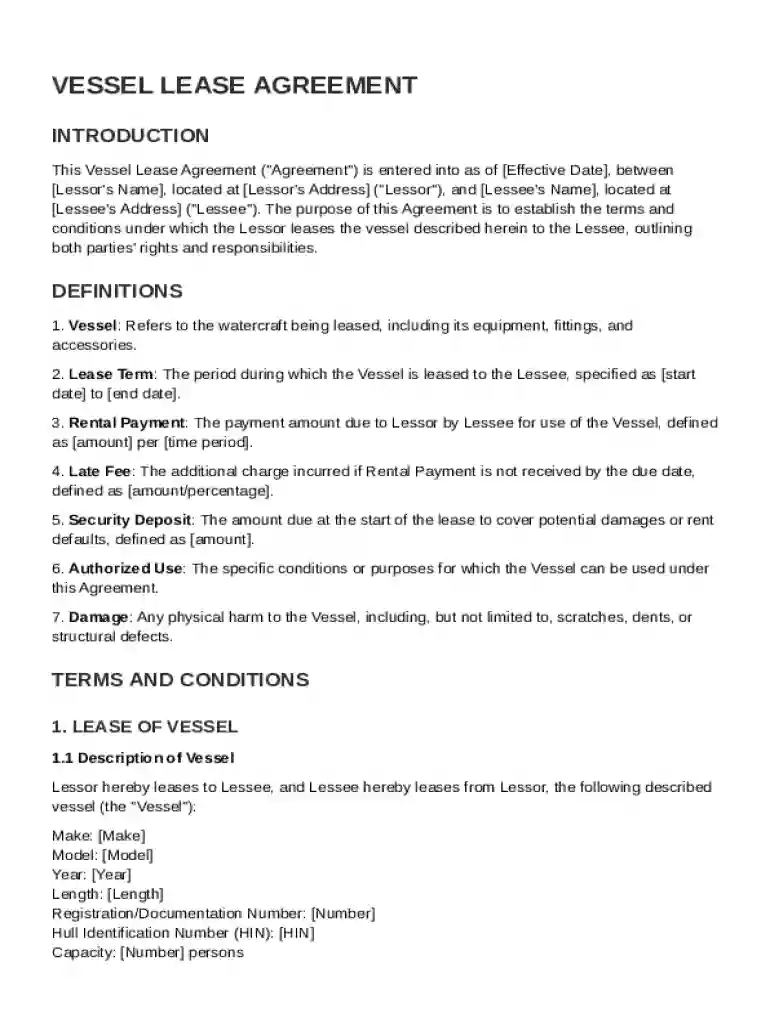
A Vessel Lease Agreement Template is a formalized document outlining the legal terms and conditions between a lessor (the owner of the vessel) and a lessee (the party renting the vessel). This template includes essential clauses about lease duration, payment details, usage limitations, and maintenance responsibilities. It serves as a safeguard for both parties, ensuring clarity and mutual understanding. For example, a charter company offering yachts for seasonal rentals will rely on this agreement to protect its assets and outline expectations clearly for lessees. Such agreements also help in preventing disputes by setting clear expectations and obligations from the outset.
The core components of the Vessel Lease Agreement Template include several critical sections, each addressing a specific aspect of the leasing arrangement:
Utilizing the Vessel Lease Agreement Template involves several steps to ensure it is legally binding and accommodating for both parties. Firstly, the parties involved should review and customize the template to fit their specific circumstances, such as tailoring the authorized activities to the type of vessel and intended usage. Secondly, it is crucial to fill in all necessary details—names, addresses, lease duration, and payment terms—ensuring no section is left incomplete. Reviewing this document with legal counsel can also help ensure compliance with relevant local laws, especially regarding liability and insurance. Upon agreement, both parties should sign the document, preferably in the presence of a witness or notary to enhance legal validity.
Completing the Vessel Lease Agreement Template involves a systematic approach:
The legal enforceability of the Vessel Lease Agreement Template hinges on its compliance with maritime and contract laws within relevant jurisdictions. It should adhere to federal and state regulations within the United States, ensuring that all lease agreements are fair and equitable. The agreement should clearly articulate all terms to avoid potential disputes, with sections on mediation or arbitration included for conflict resolution. Including indemnity and liability clauses also shields the lessor from unforeseen liabilities, transferring specific risks to the lessee during the lease term.
While the Vessel Lease Agreement Template can broadly apply across the United States, state-specific provisions may alter some sections. For instance, certain states might require additional disclosures related to environmental compliance if the vessel operates in protected waters. States like California may impose more stringent liability and insurance requirements to protect local waterways. Lessors should review their state's laws to incorporate any mandatory clauses to ensure the template’s legal validity and applicability.
The versatility of the Vessel Lease Agreement Template is evident across various scenarios:
These examples demonstrate how the template adapts to different needs and stipulations based on the vessel's use case.
Understanding critical terms within the Vessel Lease Agreement Template enhances user comprehension and effective use:
This vocabulary lays a foundational understanding necessary for negotiating and setting realistic expectations in a vessel lease context.
At DocHub, your data security is our priority. We follow HIPAA, SOC2, GDPR, and other standards, so you can work on your documents with confidence.



LOA standard terms and conditions are integral to FMS LOAs, categorized into seven sections, and establish rights and responsibilities for each party.
The International Civil Aviation Organization (ICAO) is a specialized agency of the United. Nations and was created with the signing in Chicago,


