






Definition & Meaning
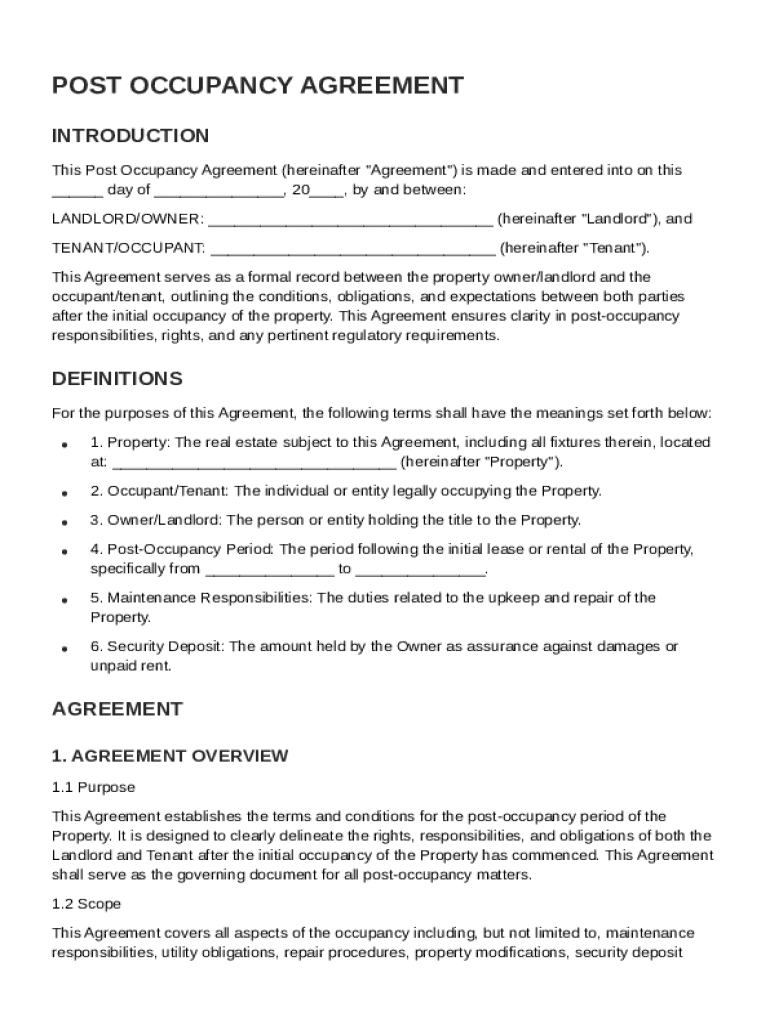
The Post Occupancy Agreement Template defines the relationship between a landlord and a tenant after the initial occupancy of a property. This document outlines specifics regarding responsibilities, such as maintenance, utilities, and modifications, ensuring both parties have a clear understanding of their roles. Security deposits are also addressed, providing a framework for their use and return. The agreement is crucial for establishing a dispute resolution process, which aids in resolving conflicts efficiently. By setting clear obligations and rights, it protects both the tenant and the landlord during the post-occupancy period.
Key Elements of the Post Occupancy Agreement Template
The post-occupancy agreement includes several key elements critical for its effectiveness:
- Maintenance Responsibilities: Specifies which party is responsible for maintenance tasks like landscaping or repairing fixtures.
- Utility Payments: Details who is accountable for paying utilities such as water, electricity, and gas.
- Security Deposits: Offers guidelines on the management and return of security deposits, including conditions for deductions.
- Modifications: Outlines permissions for alterations or improvements to the property.
- Dispute Resolution: Establishes the protocol for resolving disagreements, which may include mediation or arbitration.
- Term Duration: Specifies the duration of the agreement and conditions for its renewal or termination.
Understanding these elements helps ensure comprehensive coverage of the tenant's and landlord's rights and obligations.
Steps to Complete the Post Occupancy Agreement Template
Completing the post occupancy agreement template involves a structured approach:
- Review Existing Lease: Assess the original lease agreement to ensure continuity and compatibility with the post-occupancy terms.
- Fill Out Contact Information: Include complete details of both the landlord and tenant.
- Define Terms: Clarify the duration, renewal conditions, and termination clauses.
- Assign Maintenance Duties: Specify responsibilities for upkeep and repairs.
- Detail Utility Arrangements: Outline the payment responsibility for each utility service.
- Set Security Deposit Terms: Define how the deposit will be managed and conditions for its return.
- Include Dispute Resolution Process: Add clauses for handling potential disputes.
- Obtain Signatures: Secure signatures from both parties to validate the agreement.
Ensuring accuracy in these steps guarantees that the form meets legal requirements and protects both parties' interests.
Who Typically Uses the Post Occupancy Agreement Template
This template is primarily used by:
- Landlords: To protect their property interests and clarify tenant responsibilities.
- Tenants: To ensure their rights are well-defined and safeguarded during the post-occupancy phase.
- Property Managers: To manage rental properties effectively for property owners.
- Real Estate Agents: To facilitate smooth transactions and ensure all parties understand their obligations.
- Legal Advisors: To draft and review agreements for compliance with legal standards.
These stakeholders utilize the template to create a legally sound and mutually beneficial agreement.


Legal Use of the Post Occupancy Agreement Template
The template is designed to comply with legal standards in the U.S., making it suitable for:
- Establishing Tenant and Landlord Rights: Legally binding terms protect the interests of both parties.
- Providing Litigation Protection: Clearly defined terms and conditions reduce the likelihood of disputes and legal challenges.
- Facilitating Compliance: Aligns with state and federal housing regulations.
The agreement's legal enforceability is critical in maintaining accountability and preventing legal disputes.
State-Specific Rules for the Post Occupancy Agreement Template
Understanding state-specific regulations is essential for adapting the agreement as needed:
- Deposit Handling: Some states require deposits to be held in separate, interest-bearing accounts.
- Notice Periods: Varying notice requirements exist for ending or modifying the agreement.
- Dispute Resolution: States may offer different mediation or small claims court options.
Customization according to state rules ensures the legality and effectiveness of the agreement.
Important Terms Related to Post Occupancy Agreement Template
Familiarizing yourself with key terms enhances understanding:
- Tenancy at Will: A rental agreement that may be terminated by either party at any time.
- Lease Extension: Continuation of the lease terms beyond the original end date.
- Holdover Tenant: A tenant who remains in the property after the lease has expired without renewing.
- Sublease: Allowing another person to rent the property under the primary tenant's lease terms.
Recognizing these terms helps clarify the agreement's conditions and legal implications.
Examples of Using the Post Occupancy Agreement Template
Practical scenarios illustrate its real-world application:
- Example 1: A tenant wishes to remain until their new property is ready; the template formalizes an extended stay with agreed-upon rent.
- Example 2: A landlord requires temporary tenants before selling a property; the template defines short-term occupancy details.
- Example 3: Two roommates decide to stay on the property; the template modifies terms to account for changes in tenant composition.
These examples underscore the template's flexibility and functionality in various situations.