






Definition & Meaning
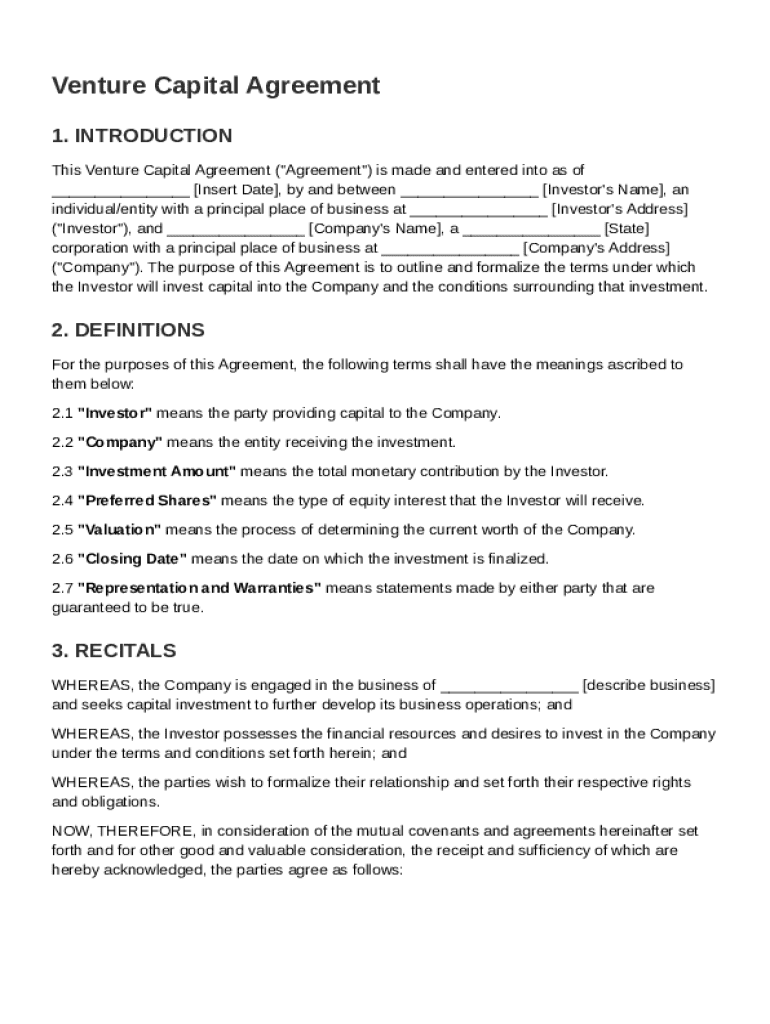
The Venture Capital Agreement Template is a structured document that outlines the terms and conditions under which investors provide capital to a company in return for equity. This agreement serves as a foundation for formalizing the relationship between venture capitalists and startups or emerging companies. It typically includes critical components such as definitions of key terms, investment specifics, and legal considerations.
In practice, these agreements establish binding obligations and underscore the commitment of both parties. It is designed to protect the interests of investors by ensuring that they secure a stake in the company. Simultaneously, it provides the invested company with the necessary capital to fuel growth and development. The agreement’s precise language and legal nomenclature are essential in mitigating risks and preventing disputes, thereby fostering a productive partnership.
Key Elements of the Venture Capital Agreement Template
The Venture Capital Agreement Template comprises several key elements that provide a comprehensive framework for collaboration between the investor and the company. These elements ensure a transparent and equitable arrangement.
- Equity Terms: Defines the percentage of ownership that the investor will hold following the agreement. This typically involves a detailed breakdown of shares, their valuation, and potential dilution.
- Investment Amount: Specifies the total capital to be invested by the venture capitalist. This section often includes timing for the release of funds.
- Conditions Precedent: Outlines specific conditions that must be met before the investment is made, such as satisfactory completion of due diligence and regulatory approvals.
- Covenants: Details responsibilities such as financial reporting, confidentiality obligations, and clauses ensuring that company operations align with investor interests.
- Governance Rights: Ensures investor influence in key company decisions, often through board representation and strategic oversight.
- Exit Strategies: Discusses potential exit mechanisms, such as an IPO or acquisition, and how returns will be managed.
- Indemnification Clauses: Protects both parties against potential legal liabilities and financial losses due to breaches of the agreement.
Steps to Complete the Venture Capital Agreement Template
Completing the Venture Capital Agreement Template requires a meticulous approach to ensure all critical areas are addressed accurately. Here is a step-by-step guide:
- Initial Review: Begin by understanding the template’s structure and the specific clauses that need customization based on the company and investor requirements.
- Define Key Terms: Clearly articulate definitions important to the agreement, including terms such as “shares,” “stake,” “control,” and “valuation.”
- Investment Details: Accurately specify the investment amount and the type and number of shares or securities being issued.
- Outline Conditions Precedent: List any preconditions that must be met, ensuring they are realistic and clearly outlined.
- Draft Covenants and Obligations: Specify what both parties commit to, including reporting schedules, confidentiality, and compliance measures.
- Assign Roles and Governance: Detail governance rights, including board seats or special voting rights for investors.
- Specify Exit Terms: Outline how both parties will handle potential exits, ensuring clarity in profit-sharing and responsibilities.
Who Typically Uses the Venture Capital Agreement Template
The Venture Capital Agreement Template is commonly utilized by various stakeholders in the investment and business ecosystem, primarily focused on fostering innovation and growth.
- Venture Capitalists: Professional investors or investment firms seeking to invest in high-growth startups.
- Entrepreneurs and Startups: Early-stage companies searching for capital infusion to expand operations and enter new markets.
- Corporate Legal Teams: Professionals tasked with drafting and negotiating complex financial agreements.
- Business Consultants: Advisors who facilitate strategic partnerships and provide guidance on capital acquisition.
Each user engages with the template to ensure that investment activities align with strategic goals, market practices, and regulatory standards.


Legal Use of the Venture Capital Agreement Template
The Venture Capital Agreement Template serves a dual role as both a strategic and a legal instrument. Its creation requires a deep understanding of the legal framework governing such investments.
- Regulatory Compliance: Ensures adherence to local and national regulations, including the U.S. Securities and Exchange Commission guidelines.
- Intellectual Property Protection: Safeguards company’s intellectual assets through confidentiality agreements and legal protections.
- Conflict Resolution: Provides mechanisms for resolving disputes through mediation or arbitration, aiming to minimize litigation.
Legal counsel is typically involved in finalizing the agreement to ensure all statutory obligations are met and rights protected.
Important Terms Related to the Venture Capital Agreement Template
Understanding the terminology used in the Venture Capital Agreement Template is crucial for all parties involved. Here are key terms often included:
- Valuation Cap: The ceiling set on a convertible security to limit conversion price.
- Liquidation Preference: Specifies the order of payments in case of liquidation, ensuring investors recover funds before other shareholders.
- Cap Table: Details the ownership stakes in the company, listing all shareholders and the number of shares held.
- Drag-Along Rights: Allows major shareholders to mandate minority shareholders to sell their shares in a potential acquisition.
- Cliff Vesting: A method of vesting equity over time, often with an initial period where no equity vests (the "cliff").
Understanding these terms is critical for interpreting obligations and opportunities under the agreement.
State-Specific Rules for the Venture Capital Agreement Template
While the Venture Capital Agreement Template is primarily governed by federal regulations, state-specific nuances can influence its components.
- California: Emphasizes strong employee rights, which may impact stock option agreements and employment terms within the template.
- Delaware: Known for business-friendly courts, making it a preferred state for incorporation and dealing with venture capital agreements due to its comprehensive business laws.
- New York: Holds specific regulatory requirements for securities and investments, affecting how venture capital activities are conducted.
Companies should consider the legal environment of the specific state when drafting and negotiating these agreements.
Examples of Using the Venture Capital Agreement Template
Real-world scenarios exemplify how the Venture Capital Agreement Template can be applied.
- A technology startup in Silicon Valley uses the template to secure a $2 million investment from a leading venture capital firm. The agreement outlines board appointments and an eventual IPO exit strategy.
- A renewable energy company based in New York leverages the agreement to document a $500,000 seed round, focusing on fast-tracking product development with investor oversight.
These examples highlight the versatility of the template across industries and its ability to cater to different capital and strategic goals.