Joint Agreement Template 2026

Get Form
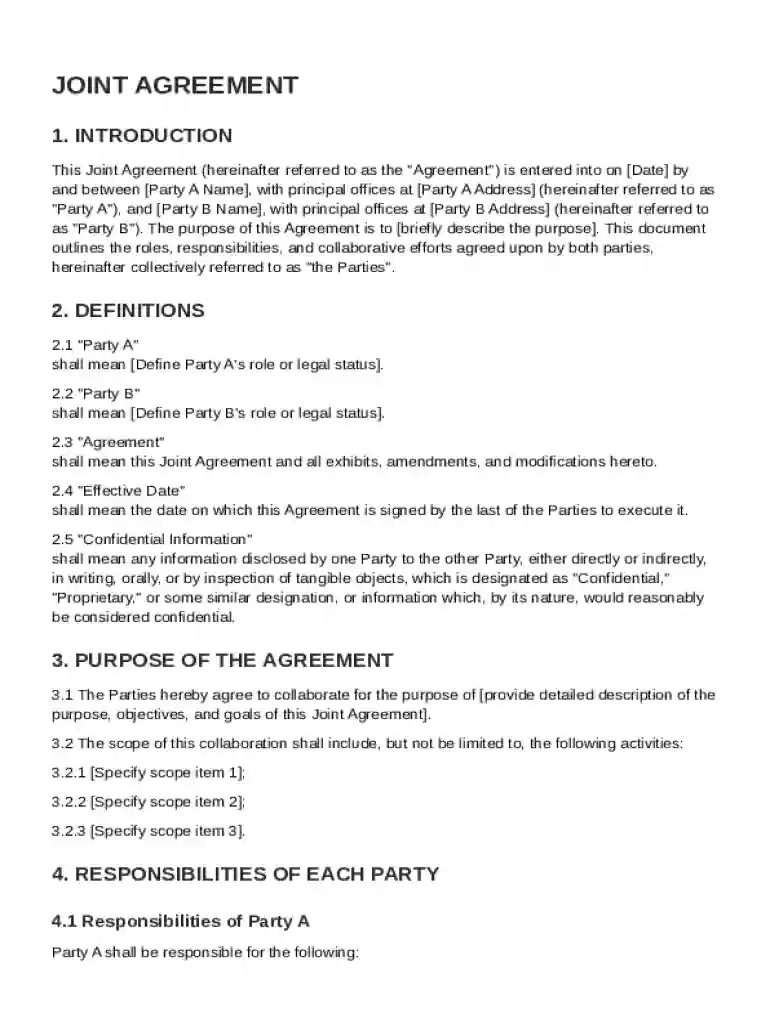
Joint Agreement Template Preview on Page 1

Here's how it works

01. Edit your form online
Type text, add images, blackout confidential details, add comments, highlights and more.

02. Sign it in a few clicks
Draw your signature, type it, upload its image, or use your mobile device as a signature pad.

03. Share your form with others
Send it via email, link, or fax. You can also download it, export it or print it out.

Definition & Meaning

A Joint Agreement Template is a structured document designed to formalize the collaboration between two or more parties. It outlines the essential terms and conditions governing their relationship, including roles, responsibilities, and objectives. This template serves as a foundational document to ensure that all parties are aligned on mutual goals and expectations. Key components typically include confidentiality agreements, financial terms, dispute resolution mechanisms, and governing laws. By standardizing these elements, the template streamlines the process of creating a joint agreement, ensuring consistency and comprehensive coverage of essential aspects.

How to Use the Joint Agreement Template

To utilize the Joint Agreement Template effectively, begin by gathering all necessary information about the involved parties, including their names, roles, and objectives for the collaboration. Next, customize the template according to the specific needs and terms agreed upon by the parties. This involves detailing the scope of work, financial arrangements, and timelines. Consider using DocHub's features such as text boxes and annotation tools to personalize the document. Once completed, review the agreement with all parties to ensure accuracy and mutual understanding. Securely store the finalized document using password protection or encryption for added security.

Steps to Complete the Template

  1. Identify Parties: Clearly define all parties involved in the agreement.
  2. Outline Objectives: Specify the purpose and goals of the collaboration.
  3. Detail Roles: Assign roles and responsibilities to each party.
  4. Include Confidentiality Clauses: Protect sensitive information shared during the collaboration.
  5. Specify Financial Terms: Address financial contributions and payment schedules.
  6. Set Timelines: Define the duration of the agreement and key milestones.
  7. *Establish Dispute Resolution: Outline the process for handling disputes.
  8. Review and Approve: Ensure all parties have read and agree to the terms.

Key Elements of the Joint Agreement Template

The Joint Agreement Template is composed of various key elements that ensure a comprehensive framework for collaboration. These elements include:

  • Parties Involved: Identification of all entities entering the agreement.
  • Objectives and Scope: Clear articulation of the collaboration goals and scope of work.
  • Roles and Responsibilities: Detailed delineation of each party's contributions.
  • Financial Arrangements: Explicit terms regarding payments and expense sharing.
  • Confidentiality Obligations: Provisions to safeguard proprietary information.
  • Dispute Resolution: Predefined methods for resolving disagreements.
  • Governing Law: Legal jurisdiction under which the agreement is governed.
  • Termination Conditions: Criteria and processes for ending the collaboration.

Important Terms Related to Joint Agreement Template

Understanding the terminology used within the Joint Agreement Template is crucial for effective communication and implementation. Key terms include:

  • Confidentiality Agreement: A clause ensuring that sensitive information is not disclosed.
  • Indemnification: Provision that protects a party from legal liability incurred during the agreement.
  • Force Majeure: Conditions under which parties are not liable for non-performance due to unforeseeable events.

Legal Use of the Joint Agreement Template

The legal application of a Joint Agreement Template involves ensuring that all terms comply with the relevant laws and regulations. It's important that the template is tailored to meet any state-specific legal requirements, especially if the participating parties operate in different jurisdictions. The agreement must reflect the governing law chosen by the parties and adhere to any industry-specific regulations. Consulting with a legal professional during the drafting process can validate that the agreement is legally enforceable and comprehensive.

State-Specific Rules for the Joint Agreement Template

While the Joint Agreement Template provides a standardized structure, certain elements may vary based on state-specific legislation. It's essential to consult local laws to ensure compliance with regional regulations. For example, states may have unique requirements for confidentiality, tax obligations, or dispute resolution protocols. Parties should address these variations explicitly within the agreement to avoid legal complications. It's advisable to include legal counsel familiar with state regulations during the development and finalization of the agreement.

Examples of Using the Joint Agreement Template

The Joint Agreement Template can be applied in various contexts, such as:

  • Business Partnerships: Formalizing collaborations between two companies to pursue joint ventures or shared projects.
  • Academic Research Collaborations: Establishing terms between universities and industry partners for research initiatives.
  • Non-Profit Alliances: Documenting cooperative efforts between charitable organizations to achieve common goals.

Versions or Alternatives to the Joint Agreement Template

Several variants of the Joint Agreement Template may accommodate different types of collaborations or specific industry needs. For instance:

  • Memorandum of Understanding (MoU): A less formal variant for documenting initial agreements.
  • Partnership Agreement: Designed specifically for business partnerships with profit-sharing arrangements.
  • Collaboration Agreement: Focuses on academic or research-based partnerships, often including intellectual property clauses.

Business Types That Benefit Most from the Joint Agreement Template

Various entities can benefit from utilizing a Joint Agreement Template, depending on their collaboration needs:

  • Corporations: Establish partnerships or joint ventures with other businesses.
  • Small Businesses and Startups: Form strategic alliances to leverage resources and expertise.
  • Non-Governmental Organizations: Align efforts with other entities for greater impact on social causes.
  • Educational Institutions: Partner with industry for research or educational initiatives to foster innovation and development.

By customizing the Joint Agreement Template to address specific requirements and objectives, organizations of all types can ensure that their collaborative efforts are legally sound and strategically aligned.

be ready to get more

Complete this form in 5 minutes or less

Get form

Got questions?

We have answers to the most popular questions from our customers. If you can't find an answer to your question, please contact us.
Contact us
How to draft a contract in 13 simple steps Start with a contract template. Understand the purpose and requirements. Identify all parties involved. Outline key terms and conditions. Define deliverables and milestones. Establish payment terms. Add termination conditions. Incorporate dispute resolution.
This could be money, services, goods, or a promise to perform or refrain from performing an action, creating mutual obligations. For instance, if Jerry offered his gardening services as a business and Anthony paid him, their agreement wouldve been legally binding.
Essentially, it means that all of those named are obligated to perform all of the actions required under the agreement. For example, if a bank lends $100,000 to two people jointly and severally, both of those people are equally responsible for making sure that the total amount of the loan is repaid to the bank.
A joint contract is an agreement between two or more parties to carry out a commercial transaction and activities together by the parties. When the joint contract is signed, the parties involved in the agreement are deemed to have agreed to share both the losses and the gains of the enterprise.
In a joint obligation, each debtors share is generally presumed to be equal unless the contract or obligation states otherwise. For instance, if three joint debtors owe PHP 300,000 in a joint obligation and there is no special stipulation, each one owes PHP 100,000.

Security and compliance

At DocHub, your data security is our priority. We follow HIPAA, SOC2, GDPR, and other standards, so you can work on your documents with confidence.

Learn more
ccpa2
pci-dss
gdpr-compliance
hipaa
soc-compliance

People also ask

An example of a joint contract is used when two manufacturers collect their products in a single package and agree to sell them.
Joint ventures do not necessarily have to be formed through an equal 50-50 ownership split. The exact terms can be what the partners decide and negotiate, such as a 60-40 or 70-30 split, with the majority partner typically having more control in decisions and earning a greater share of the profits.
Crucial Things to Include in a Joint Venture Agreement #1: The Information of the Businesses Involved. #2: Members Information. #3: The Type of Joint Venture / The Purpose of the Joint Venture. #4: Resources to Be Shared. #5: Profits and Loss Allocation. #6: Rights and Duties. #7: Dispute Resolution.

Related links