







Definition & Meaning
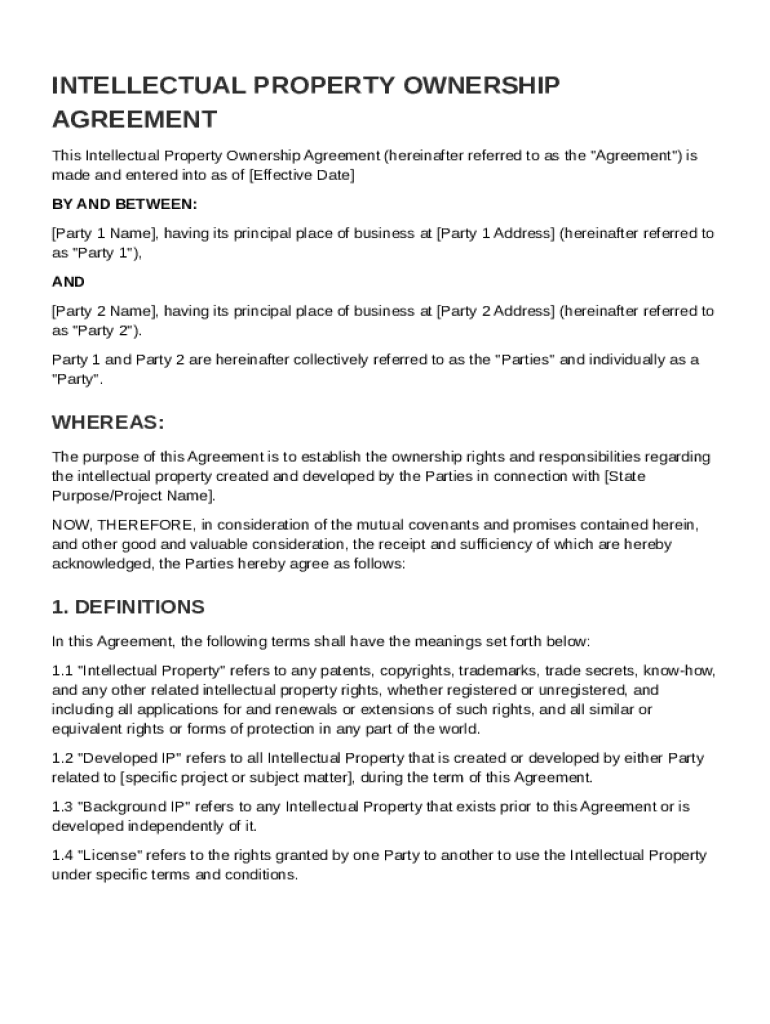
The Intellectual Property Ownership Agreement Template establishes the terms under which intellectual property (IP) is owned, used, and managed between two or more parties. This template is critical for delineating the ownership rights for IP that is developed in joint ventures, collaborations, or employment relationships. The agreement clarifies which party owns the developed intellectual property and addresses the sharing or transfer of copyrights, patents, trademarks, and other forms of IP. It also plays a vital role in preventing disputes by detailing the rules and responsibilities related to IP usage, licensing, and confidentiality.
Types of Intellectual Property
- Developed IP: Refers to intellectual property created as a result of the joint effort or work-related activities.
- Background IP: Encompasses pre-existing intellectual property that a party brings to the collaboration or project, which remains with the original owner unless otherwise specified.
Key Elements of the Intellectual Property Ownership Agreement Template
An Intellectual Property Ownership Agreement covers multiple key components:
- Ownership Clauses: Specifies whether the IP is solely owned or jointly owned, and delineates the specific rights each party has regarding the IP.
- Licensing Terms: Outlines conditions under which the intellectual property can be licensed to third parties or internally among the parties involved.
- Confidentiality Agreements: Ensures that sensitive information is safeguarded from unauthorized access or disclosure.
- Dispute Resolution: Establishes the process for resolving conflicts regarding intellectual property rights, often including arbitration or mediation options.
- Termination Conditions: Details when and how the agreement can be terminated, and outlines the subsequent treatment of IP.
How to Use the Intellectual Property Ownership Agreement Template
The template serves as a foundational document for organizing IP relations. Here’s a step-by-step guide to using it effectively:
- Customize the Template: Start by adapting the template to fit the specific needs of the parties involved by filling in the relevant names, project details, and IP specifics.
- Define Ownership Terms: Clearly identify and document whether the intellectual property will be owned jointly or solely by one of the parties.
- Outline Usage Rights: Specify how each party can use the developed and background IP, including possible licensing arrangements.
- Include Confidentiality Clauses: Add clear terms regarding the handling of any confidential information shared during the collaboration.
Examples of Customization
- A technology startup collaborating with a university may define clauses that specify who owns patents resulting from research efforts.
- Joint ventures can outline how product designs and manufacturing processes are shared or retained post-contract completion.
Important Terms Related to the Intellectual Property Ownership Agreement Template
Familiarity with key terms is crucial to understanding and applying this agreement:
- Sole Ownership: Refers to IP owned by one party, with exclusive rights to use and sublicense it.
- Joint Ownership: When IP is co-owned, requiring shared decision-making or mutual consent for licensing and selling.
- Licensing Agreement: A legal document granting permission for the use of IP under defined circumstances.
Who Typically Uses the Intellectual Property Ownership Agreement Template
The template is widely used in various industries:
- Businesses: Companies engaging in partnerships or joint ventures to protect and clarify IP rights.
- Universities: Academic institutions drafting collaborations with private sector companies for research projects.
- Startup Entrepreneurs: Early-stage businesses establishing terms with contractors, co-founders, or investors regarding innovative products and solutions.

Legal Use of the Intellectual Property Ownership Agreement Template
Using this template ensures compliance with legal standards:
- ESIGN Act Compliance: If signed electronically, the document remains legally binding under U.S. e-signature laws.
- Governing Law Clauses: Specifies which state's laws will govern the agreement and any arising disputes, ensuring clarity in jurisdictional matters.
State-Specific Rules for the Intellectual Property Ownership Agreement Template
The application of IP agreements can vary on a state-by-state basis:
- Patent Rules: Some states may have specific requirements or incentives for patent filings that could affect ownership agreements.
- Trade Secret Protections: State laws may dictate additional confidentiality and trade secret protections that should be incorporated.
Examples of Using the Intellectual Property Ownership Agreement Template
Real-world scenarios where the agreement template is applied include:
- Tech Company Collaborations: When two tech firms co-develop a new software, they use the agreement to determine who owns the resulting code.
- Academic and Corporate Partnerships: Universities and businesses often establish IP agreements to steward the outcome of joint research projects.
Practical Cases
- A biotech company may collaborate with a research institution, each contributing proprietary technology, and use the template to decide on new IP ownership.
- Two artists might co-create a piece of art and use the agreement to determine how the rights to reproduce, distribute, or sell the work are allocated.




